Input Parameters Optimization in Swarm DS-CDMA Multiuser Detectors
In this paper, the uplink direct sequence code division multiple access (DS-CDMA) multiuser detection problem (MuD) is studied into heuristic perspective, named particle swarm optimization (PSO). Regarding different system improvements for future tec…
Authors: Taufik Abr~ao, Leonardo D. Oliveira, Bruno A. Angelico
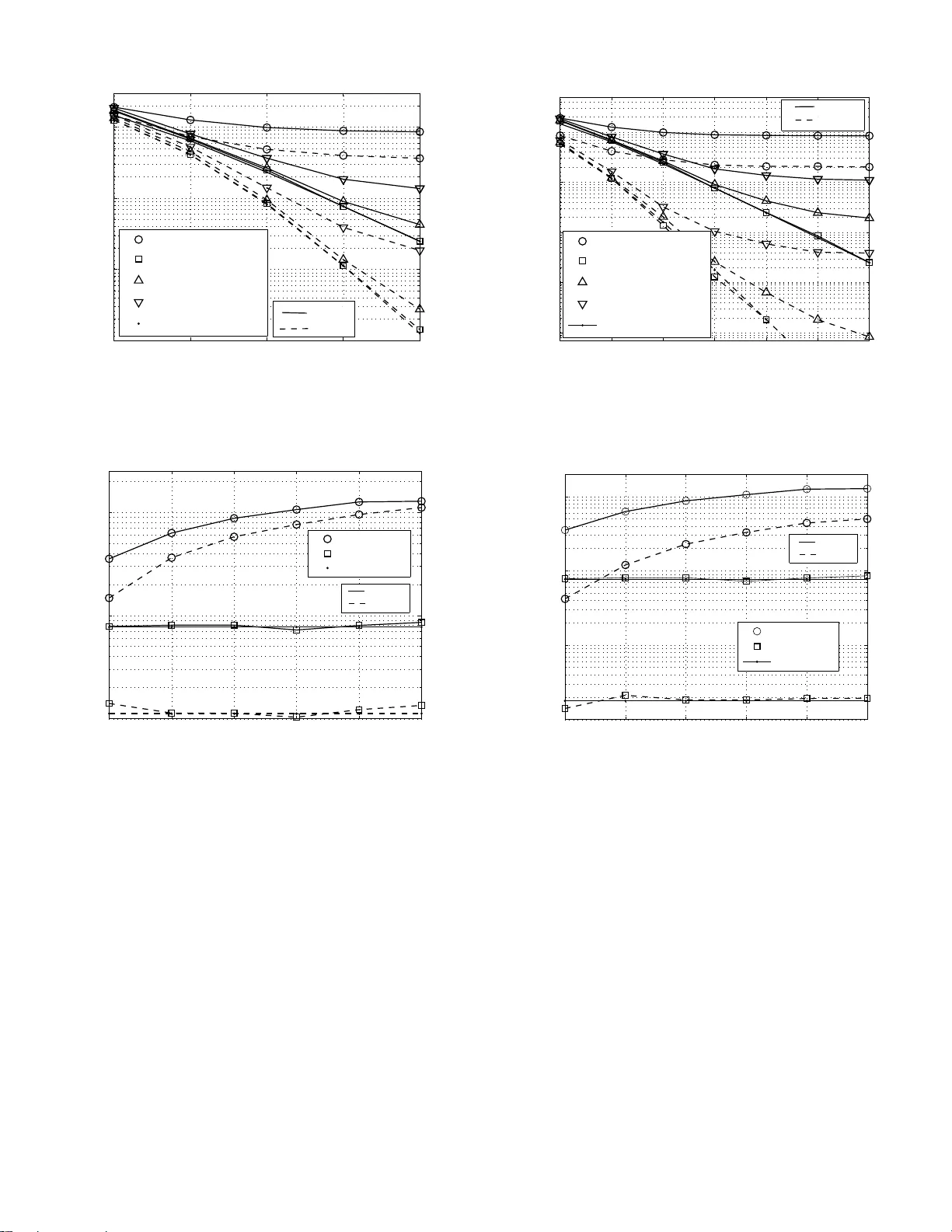
1 Input P aramet ers Op timiza tion in Swarm DS-CDMA Multiuser Det ectors T aufik Abr ˜ ao 1 , Leonardo D. Oli v eira 2 , Br uno A. Ang ´ elico 3 , Paul Jean E. Jeszensky 2 1 Dept. of Electrical Eng ineering; State Uni versity of Londrina, Brazil; taufik@uel.br http://www.u el.br/pessoal /taufik www.uel.br/p essoal/taufik 2 Dept. of T elecomm. and Control Engineer ing, Escola Polit ´ ecnica of the University of S ˜ ao Paulo, Brazil; { leonardo, pjj } @lcs .poli.usp.br 3 Federal University of T echnolo gy - Paran ´ a (UTFPR), Corn ´ elio Proc ´ opio, Brazil; bang elico@utfpr.e du.br Abstract In this paper, the uplink direct sequence code di vision multip le access ( DS-CDMA) multiuser d etection problem ( M U D ) is stud ied into h euristic perspe cti ve, named particle swarm o ptimization (PSO). Regarding different system improvements f or fu ture tec hnolog ies, su ch as high- order mod ulation and div ersity explo itation, a complete parameter optimization proced ure for the PSO applied to M U D problem is p rovided, which repr esents the major contribution of this paper . Furthermo re, the perfo rmance o f the PSO- M U D is b riefly analy zed via Mon te-Carlo simulations. Simu lation r esults show th at, after co n vergence, the p erforma nce reach ed b y the PSO- M U D is much better than th e conv entiona l detector, and somewhat clo se to th e single user bound (SuB). Rayleigh flat ch annel is initially conside red, but the results ar e fur ther extend to diversity (time and spatial) channe ls. I . I N T RO D U C T I O N In a DS-CDMA system, a con ventional detector by i tself may not provide a desirable quality of service, once the system capacity is strongly af fected by multip le access interference (MAI). The capacity of a DS-CDMA system in multi path channels is li mited mainly by the MAI, self-interference (SI), n ear -far ef fect (NFR) and fading. The con ventional recei ver (Rak e) explores the path diver sity in order to reduce fading effe ct, but it is not able to miti gate neither the MAI nor t he near-f ar effe ct [14], [25]. In this context, multiuser detection emerged as a solution t o overcome the MAI [25]. The best performance i s acquired by t he optimu m multiuser d etection ( O M U D ), based on the log-likelihood function (LLF) [25]. In [24] it was d emonstrated that m ultiuser detection problem results in a nondeterminis tic polynomial-tim e hard (NP-hard) problem. After the V erdu’ s re volutionary work, a great variety of su boptimal approaches have been proposed: from linear m ultiuser detectors [25], [2] to h euristic multi user detecto rs [9], [7]. 2 Alternative s to O M U D into th e class of linear mul tiuser detectors include t he Decorrelator [23], and MMSE [19]. Besides, the class ic non -linear multiuser detectors include the subt racti ve interference cancellation (IC) M U D [18] and zero-forcing decision feedback (ZFDF) [5]. In spi te of the relatively low complexity , t he drawback of (no n-)linear , ZFDF , and hybrid cancelers sub-optim al M U Ds is the failure in approaching the M L performance un der realis tic channel and system scenarios. More recently heuristic methods h a ve been proposed for s olving th e M U D problem, obtaining near -ML performance at cost of polynomial com putational complexity [7], [1]. Examples of heuristic multi user detection ( H E U R - M U D ) methods include: e volutionary programming (EP), specially the genetic algorithm (GA) [7], [4], particle swarm optim ization (PSO) [12], [26], [16] and , somet imes included in this classification, t he deterministic local search (LS) methods [13], [17], which has been shown to present an very att racti ve performance × complexity trade-of f for low order mod ulations. Ne vertheless, th ere are few works dealin g with complex and realistic syst em configurations . High-order modulation H E U R - M U D in SISO o r M IMO systems were previously addressed in [12], [26], [15]. In [15], PSO was appl ied to n ear -optimum asynchronou s DS-CDMA mult iuser detection probl em under 16 − QAM modulation and SISO multip ath channels. Previous results on literature [16 ], [1] suggest t hat ev olutionary algorithms and particle swarm op timization hav e simil ar performance, and that a simple local search heuristic opti mization is enoug h to solve the M U D problem with low-order modulation [17]. Howe ver for high-order modulatio n formats, the LS- M U D does not achiev e goo d performances due to a lack of search diversity , wh ereas the PSO-M U D has been shown to be m ore effic ient for s olving the optimi zation problem under M -QAM mo dulation [15]. Recent works appl ying PSO to M U D usu ally assum es con ventional values for PSO input parameters, such [10], or optimized values only for s pecific syst em and channel scenarios , s uch [16 ] for flat Rayleigh channel, [15] for m ultipath and high-order modulati on, and [1] for multicarrier CDMA systems as well. In this paper , a wide analysis, with BPSK, QP SK and 16-QAM modulation schemes, and di versity e xploration is carried out. This paper provides a quite com plete parameter opti mization of the PSO- M U D appli ed to DS-CDMA systems in Rayleigh channels wi th BPSK, QPSK and 16-QAM m odulations. The t ext has the following organization: Section II presents the syst em model, includ ing DS-CDMA, OMuD, and the PSO- M U D . The PSO parameter optimization is shown in Section III, while Section IV exhibits some performance results i n terms of Monte Carlo simul ation (MCS). Finally , Section V summarizes the main conclusions of this work. 3 I I . S Y S T E M M O D E L In this Section, a sin gle-cell asynchronous multiple access DS-CDMA system model is described for Rayleigh channels, cons idering diff erent modulati on schemes, such as bi nary/quadrature phase shift keying (BPSK/QPSK) and 16-quadrature amplitude m odulation (16 -QAM), and single or mul tiple antennas at the base station recei ver . After describing th e conv entional detectio n approach wi th a maximum ratio combining (MRC) ru le, the O M U D and the PSO-M U D are described. Th e model is generic eno ugh t o allow describing additiv e white Gaussian noise (A WGN) and Rayleigh flat channels, other modu lation formats and single-antenna receiv er . A. DS-CDMA The base-band transm itted signal of the k th user is d escribed as [20] s k ( t ) = r E k T ∞ X i = −∞ d ( i ) k g k ( t − iT ) , (1) where E k is the s ymbol energy , and T is the symbol duratio n. Each symb ol d ( i ) k , k = 1 , . . . , K is t aken independently and wit h equal probabil ity from a complex alphabet set A of cardinali ty M = 2 m in a squared constellation, i.e., d ( i ) k ∈ A ⊂ C , w here C is the set of com plex numbers. Fig. 1 s hows t he modulation formats considered, while Fig. 2 sketches the K base-band DS-CDMA transm itters. −1 1 −1 1 (1101) (1001) (1100) (1000) (0001) (0101) (0000) (0100) (1110) (1010) (0010) (0110) (1111) (1011) (0011) (0111) 16−QAM QPSK (10) (11) (00) (01) −1 1 −3 3 −1 1 −3 3 (0) (1) BPSK ℑ ℜ ℑ ℜ ℑ ℜ Fig. 1. Three modu lation formats with Gray mapping. S/P s 1 BPSK, M-QAM Mapping A 1 g 1 ( t ) BPSK, M-QAM Mapping A K g K ( t ) SIMO Channel CSI f Dpl user K S/P s K user 1 Fig. 2. Uplink base-band DS-CDMA transmission model with K users. 4 The normalized spreading sequence for the k -th user is giv en b y g k ( t ) = 1 √ N N − 1 X n =0 a k ( n ) p ( t − nT c ) , 0 ≤ t ≤ T , (2) where a k ( n ) is a rando m sequ ence wi th N chips assuming the values {± 1 } , p ( t ) is the pulse sh aping, assumed r ectangular with unitary amplitude and duration T c , with T c being the c hip interv al. The processing gain is given by N = T /T c . The equiv alent bas e-band receiv ed signal at q th receive antenna, q = 1 , 2 , . . . , Q , containing I symbols for each us er in multipath fading channel can be expressed by r q ( t ) = I − 1 X i =0 K X k =1 L X ℓ =1 A k d ( i ) k g k ( t − nT − τ q ,k ,ℓ ) h ( i ) q ,k ,ℓ e j ϕ q,k ,ℓ + η q ( t ) , (3) with A k = q E k T , L being the number of channel paths, adm itted equ al for all K users, τ q ,k ,ℓ is th e to tal delay 1 for the signal of the k th user , ℓ th path at q t h receive antenna, e j ϕ q,k ,ℓ is t he respective received phase carrier; η q ( t ) is th e addi tiv e white Gaussian noise with bilateral power spectral density equal to N 0 / 2 , and h ( i ) q ,k ,ℓ is th e complex channel coef ficient for the i th symbol, defined as h ( i ) q ,k ,ℓ = γ ( i ) q ,k ,ℓ e j θ ( i ) q,k ,ℓ , (4) where the gain γ ( i ) q ,k ,ℓ is a characterized by a Rayleigh distribution and the phase θ ( i ) q ,k ,ℓ by the uniform distribution U [0 , 2 π ] . Generally , a sl o w and frequency selectiv e channel 2 is assumed. The expression in (3) is quite general and in cludes so me special and i mportant cases: if Q = 1 , a SISO system i s obt ained; if L = 1 , the channel becomes no n-selectiv e (flat) Rayleigh; if h ( i ) q ,k ,ℓ = 1 , it result s in the A WGN channel; mo reov er , if τ q ,k ,ℓ = 0 , a syn chronous DS-CDMA system i s characterized. At the base s tation, the received signal is submitted to a matched filter bank (CD), with D ≤ L branches (fingers) per antenna of each user . When D ≥ 1 , CD is known as Rake receiver . Assuming p erfect phase estimation (carrier phase), after despreading the resultant signal is given by y ( i ) q ,k ,ℓ = 1 T Z ( i +1) T nT r q ( t ) g k ( t − τ q ,k ,ℓ ) dt (5) = A k h ( i ) q ,k ,ℓ d ( i ) k + S I ( i ) q ,k ,ℓ + I ( i ) q ,k ,ℓ + e η ( i ) q ,k ,ℓ . The first term i s th e signal of interest, th e second corresponds to the self-interference (SI), the t hird t o the mu ltiple-access interference (MAI) and the last one corresponds to the filtered A WGN. 1 Considering the asynch ronism among the users and random delay s for differe nt paths. 2 Slow ch annel: channel coefficients were admitted constant along the symbol period T ; and frequenc y selective condition is hold: 1 T c >> (∆ B ) c , the coh erence bandwidth of the chann el. 5 Considering a maximal ratio combining (M RC) rule with div ersity order equal to D Q for each user , the M − level compl ex decisi on variable is giv en by ζ ( i ) k = Q X q =1 D X ℓ =1 y ( i ) q ,k ,ℓ · w ( i ) q ,k ,ℓ , k = 1 , . . . , K (6) where t he M RC weights w ( i ) q ,k ,ℓ = b γ ( i ) q ,k ,ℓ e − j b θ ( i ) q,k ,ℓ , with b γ ( i ) q ,k ,l and b θ ( i ) q ,k ,ℓ been a channel amplitude and ph ase estimation, respectively . After that, at each symbo l interva l, decisio ns are made on the i n-phase and quadrature components 3 of ζ ( i ) k by scaling i t into the constellation limits obt aining ξ ( i ) k , and choosing the comp lex sy mbol with minimum Eucli dean d istance regarding th e scaled decision var iable. Alternatively , this procedure can be replaced by separate √ M − leve l quantizers qtz acti ng on the in -phase and quadrature t erms separately , such that b d ( i ) , CD k = qtz A real ℜ n ξ ( i ) k o + j qtz A imag ℑ n ξ ( i ) k o , (7) for k = 1 , . . . , K , and wh ere A real and A imag is the real and imaginary value sets, respectiv ely , from the complex alphabet set A , and ℜ{·} and ℑ{·} representing the real and i maginary operators, respective ly . Fig. 3 il lustrates the general system structu re. decisor MRC, user 1 MRC, user K Q antenna q th antenna user 1 user K decisor user 1 user K R T s 0 ( · ) R T s 0 ( · ) g K ( t − τ q,K , 1 ) R T s 0 ( · ) R T s 0 ( · ) g 1 ( t − τ q, 1 , 1 ) D branches g 1 ( t − τ q, 1 ,D ) D branches g K ( t − τ q,K ,D ) Q q 1 h q, 1 ,L K 1 h 1 , 1 , 1 h 1 , 1 ,L h Q, 1 , 1 h Q, 1 ,L h q, 1 , 1 h Q,K, 1 h Q,K,L DS/CDMA Tx s ( i ) K DS/CDMA Tx s ( i ) 1 η ( t ) η ( t ) η ( t ) y ( i ) q, 1 , 1 y ( i ) q, 1 ,D y ( i ) q,K , 1 y ( i ) q, 1 ,K,D b s ( i ) 1 b s ( i ) K Fig. 3. Uplink base-band DS-C DMA system model wi th Conv entional receiv er: K users transmitters, SIMO channel and con ven tional (Rake) recei ver with Q multiple recei ve antenna s. 3 Note that, for BP SK, only the in-ph ase term is presented. 6 B. Optimum Detection The O M U D estim ates the symbols for all K users by choosing the symbol combination associated with the minim al distance metric among all possible symbol combinations in the M = 2 m constellation points [25]. In the asynchronou s multip ath channel scenario consi dered in this paper , the one-shot asyn chronous channel approach is adopted, where a configuration with K asynchronous users, I symbols and D branches is equiv alent to a synchronous scenario wit h K I D v irtual users. Furthermore, in order to av oid handling comp lex-v alued variables in high-order squared modul ation formats, henceforward the alphabet set is re-arranged as A real = A imag = Y ⊂ Z of cardinality √ M , e.g., 16 − QAM ( m = 4 ): d ( i ) k ∈ Y = {± 1 , ± 3 } . The O M U D is based on the m aximum li kelihood criterion t hat chooses the vector of sy mbols d p , formally defined i n (12), whi ch maximi zes th e metric d opt = arg max d p ∈Y 2 K I D Ω d p , (8) where, i n a SIMO channel, the sing le-objectiv e functio n i s generally writ ten as a combinati on of the LLFs from all recei ve antennas, given by Ω d p = Q X q =1 Ω q d p . (9) In th e more general case considered here, i.e., K asynchronous users in a SIMO multipath Rayleigh channel wi th diversity D ≤ L , t he LLF can be defined as a decoupled opt imization problem with only real-v alued variables, such that Ω q ( d p ) = 2 d ⊤ p W ⊤ q y q − d ⊤ p W q R W ⊤ q d p , (10) with definition s y q := ℜ{ y q } ℑ{ y q } ; W q := ℜ{ AH } −ℑ{ AH } ℑ{ AH } ℜ{ AH } ; d p := ℜ{ d p } ℑ{ d p } ; R := R 0 0 R , (11) where y q ∈ R 2 K I D × 1 , W q ∈ R 2 K I D × 2 K I D , d p ∈ Y 2 K I D × 1 , R ∈ R 2 K I D × 2 K I D . The vector d p ∈ Y K I D × 1 in Eq. (11) is defined as d p = [( d (1) 1 · · · d (1) 1 | {z } D times ) · · · ( d (1) K · · · d (1) K | {z } D times ) · · · ( d ( I ) 1 · · · d ( I ) 1 | {z } D times ) · · · ( d ( I ) K · · · d ( I ) K | {z } D times )] ⊤ . (12) 7 In addition, the y q ∈ C K I D × 1 is the despread sign al in Eq. (6) for a given q , in a vector notation, described as y q = h ( y (1) q , 1 , 1 · · · y (1) q , 1 ,D ) · · · ( y (1) q ,K, 1 · · · y (1) q ,K, D ) · · · ( y ( I ) q , 1 , 1 · · · y ( I ) q , 1 ,D ) · · · ( y ( I ) q ,K, 1 · · · y ( I ) q ,K, D ) i (13) Matrices H and A are the coefficients and ampli tudes diagonal m atrices, and R represents t he block- tridiagonal, bl ock-T oeplit z cross-correlation matrix, compo sed by the sub-matrices R [1] and R [0] , such that [25] R = R [0] R [1] ⊤ 0 . . . 0 0 R [1] R [0] R [1] ⊤ . . . 0 0 0 R [1] R [0] . . . 0 0 . . . . . . . . . . . . . . . . . . 0 0 0 . . . R [1] R [0] , (14) with R [0] and R [1] being K D m atrices with elements ρ a,b [0] = 1 , if ( k = u ) and ( ℓ = l ) ρ q k ,ℓ,u,l , if ( k < u ) or ( k = u, ℓ < l ) ρ q u,l,k , ℓ , if ( k > u ) or ( k = u, ℓ > l ) , ρ a,b [1] = 0 , if k ≥ u ρ q u,l,k , ℓ , if k < u , (15) where a = ( k − 1) D + ℓ , b = ( u − 1) D + l and k , u = 1 , 2 , . . . , K ; ℓ, l = 1 , 2 , . . . , D ; t he cross-correlation element between t he k t h user , ℓ th path and u th u ser , d th path, at q t h recei ve antenna, ρ q k ,ℓ,u,d , is ρ q k ,ℓ,u,d = 1 T Z T 0 g k ( t − τ q ,k ,ℓ ) g u ( t − τ q ,u,d ) dt. (16) The ev alu ation in (8) can be extended along the whole m essage, where all symbols of the transmi tted vector for all K u sers are j ointly detected (vector ML approach), or t he d ecisions can be taken considering the opt imal singl e symb ol detection of all K mult iuser signals (symbol M L approach). In the s ynchronous case, the symbol ML approach with I = 1 is considered, whereas in the asynchronous case the vector ML approach i s adopted wi th I = 7 ( I must be, at least, equal to three ( I ≥ 3 )). The vector d p in (11) belongs to a discrete set with s ize depending on M , K , I and D . Hence, the optimizatio n problem posed by (8) can be solved directly us ing a m − dimension al ( m = log 2 M ) search method. Therefore, the associated combinat orial problem strictly requires an exhaustive search in A K I D possibili ties of d , or equiv alently an exhaustive s earch in Y 2 K I D possibili ties of d p for the decoupled optimizatio n problem with only real-va lued variables. As a result , t he m aximum li kelihood detector has a 8 complexity that increases exponentially with the modulation order , number of users, symbol s and branches, becoming prohibi tiv e e ven for m oderate product values m K I D , i.e., even for a BPSK mo dulation format, medium system l oading ( K / N ), small number of symbols I and D Rake fingers. C. Discr ete Swarm Op timization Algorith m A discrete or , in sev eral cases, binary PSO [11] is considered i n this paper . Such scheme is suitable to deal with digit al information detection/decoding. Hence, binary PSO is adopted herein. The particle selection for evolving is b ased on the highest fitness va lues obtain ed through (10) and (9). Accordingly , each candidate-vector defined like d i has i ts bi nary representation , b p [ t ] , of size mK I , used for t he velocity calculation, and the p th PSO particle p osition at instant (iteration) t is represented by the mK I × 1 binary vector b p [ t ] = [ b 1 p b 2 p · · · b r p · · · b K I p ]; (17) b r p = b r p, 1 · · · b r p,ν · · · b r p,m ; b r p,ν ∈ { 0 , 1 } , where each binary vector b r p is associated with one d ( i ) k symbol in Eq. (12). Each particle has a velocity , which is calculated and upd ated according to v p [ t + 1] = ω · v p [ t ] + φ 1 · U p 1 [ t ]( b best p [ t ] − b p [ t ]) + φ 2 · U p 2 [ t ]( b best g [ t ] − b p [ t ]) , (18) where ω is the inertial weig ht; U p 1 [ t ] and U p 2 [ t ] are diagonal matri ces wi th d imension mK I , whose elements are random variables wi th uniform dis tribution U ∈ [0 , 1] ; b best g [ t ] and b best p [ t ] are the best global position and the best local positions foun d until the t th iteration, respectively; φ 1 and φ 2 are weight factors (acceleration coeffi cients) regarding the best individual and the best gl obal positions influences in the velocity update, respectively . For M U D optimization with bi nary representation, each element in b p [ t ] in (18) just assumes “0” or “1” values. Hence, a discrete mode for t he p osition choice is carried out inserting a probabilisti c decision step based on t hreshold, depending on the velocity . Sever al functi ons have thi s characteristic, su ch as the sigmoid function [11] S ( v r p,ν [ t ]) = 1 1 + e − v r p,ν [ t ] , (19) where v r p,ν [ t ] is the r th element of the p th p article velocity vector , v r p = v r p, 1 · · · v r p,ν · · · v r p,m , and the selection of the future particle position is obtained through t he statement if u r p,ν [ t ] < S ( v r p,ν [ t ]) , b r p,ν [ t + 1] = 1; otherwise , b r p,ν [ t + 1] = 0 , (20) 9 where b r p,ν [ t ] is an element of b p [ t ] (see Eq. (18)), a nd u r p,ν [ t ] i s a random variable with uniform distri b ution U ∈ [0 , 1 ] . After obtain ing a new particle posit ion b p [ t + 1] , it is mapped back into its correspondent symbol vector d p [ t + 1] , and further in the real form d p [ t + 1] , for the ev aluation of th e objective function in (9). In o rder to obtain further diversity for the search universe, the V max factor is add ed to the PSO m odel, Eq. (18), being responsible for l imiting the velocity in t he range [ ± V max ] . The insertion of this factor in the velocity calculation enables the algorithm t o escape from possibl e l ocal o ptima. The likelihood of a bit change i ncreases as the particle velocity crosses the li mits established by [ ± V max ] , as sho wn i n T ab . I. T ABLE I M I N I M U M B I T C H A N G E P RO B A B I L I T Y A S A F U N C T I O N O F V max . V max 1 2 3 4 5 1 − S ( V max ) 0 . 26 9 0 . 1 19 0 . 047 0 . 018 0 . 007 Population size P i s typi cally i n the range of 10 to 40 [6]. Howe ver , based on [16], it is set to P = 10 j 0 . 3454 p π ( mK I − 1) + 2 k . (21) Algorithm 1 describes the ps eudo-code for the PSO implement ation. I I I . P S O - M U D P A R A M E T E R S O P T I M I Z A T I O N In this section, the PSO-M U D p arameters optim ization is carried out using Monte Carlo sim ulation. Such an op timization is directly related to t he complexity × performance t rade-of f of th e algorithm. A wide analysi s with BPSK, QPSK and 16 -QAM modulatio n s chemes, and diversity exploration is carried out. A first analysis of the PSO parameters giv es raise to the following beha viors: ω is responsible for creating an i nertia of the particles, inducing them to keep the movement t o wards the last d irections of their velocities; φ 1 aims to guide the particles t o each ind ividual best pos ition, inserting diversification in the search; φ 2 leads all particles tow ards the best global position, hence intensi fying the search and reducing the conv er gence tim e; V max inserts perturbation limits in th e m ovement of the particles, all owing more or less diversifica tion in the algorithm. The optimization process for the initial velocity of the particles achie ves simil ar result s for three different conditions: null , random and CD output as initial velocity . Hence, it i s adopted here, for simpl icity , nul l initial velocity , i.e., v [0] = 0 . 10 Algorithm 1 PSO Alg orithm f or th e M U D Problem Input: d CD , P , G , ω , φ 1 , φ 2 , V max ; Output: d PSO begin 1. initialize first popu lation: t = 0 ; B [0] = b CD ∪ e B , where e B contains ( P − 1) p articles ran domly generated ; b best p [0] = b p [0] an d b best g [0] = b CD ; v p [0] = 0 : null initial velocity; 2. while t ≤ G a. calculate Ω( d p [ t ]) , ∀ b p [ t ] ∈ B [ t ] using (9); b . u pdate velocity v p [ t ] , p = 1 , . . . , P , throug h (18); c. upda te best positions: for p = 1 , . . . , P if Ω( d p [ t ]) > Ω( d best p [ t ]) , b best p [ t + 1] ← b p [ t ] else b best p [ t + 1] ← b best p [ t ] end if ∃ b p [ t ] such that h Ω( d p [ t ]) > Ω( d best g [ t ]) i ∧ Ω( d p [ t ]) ≥ Ω( d j [ t ]) , j 6 = p , b best g [ t + 1] ← b p [ t ] else b best g [ t + 1] ← b best g [ t ] d. Evolve to a new swarm p opulation B [ t + 1 ] , using (20); e. set t = t + 1 . end 3. b PSO = b best g [ G ]; b PSO map − → d PSO . end − − − − − − − − − − − − − − − − − − − − −− d CD : CD output. P : Population size. G : number of sw arm iterations. For each d p [ t ] there is a b p [ t ] associated. In [16], the best performance × complexity trade-off for BPSK PSO-M U D algorithm was obtained setting V max = 4 . Herein, simulatio ns carried out varying V max for dif ferent modulations and diversity exploration accomplish thi s value as a g ood alternative. This optimization process is quite similar for systems with QPSK and 1 6-QAM modulati on formats. A. ω Optimization It is worth noti ng that a relatively lar ger value for ω is helpful for gl obal optimu m, and lesser influenced by th e b est glob al and local posit ions, whil e a relatively smaller value for ω is helpful for course con vergence, i.e., smaller i nertial weigh t encourages the local exploration [6], [21] as the particles are more attracted towards b best p [ t ] and b best g [ t ] . Fig. 4 shows th e con vergence of the PS O scheme for di f ferent values of ω considering BPSK modulatio n and flat channel. It is e vi dent that the best p erformance × complexity trade-of f is accomplished with ω = 1 . Many research papers ha ve been proposed new strategies for PSO principle in order to improve its performance and reduce its complexity . For ins tance, in [3] the autho rs ha ve been discussed adaptive nonlinear inertia weight in order to improve PSO con ver gence. Howe ver , the current analysis indicates 11 0 5 10 15 20 25 30 35 40 10 −3 10 −2 10 −1 Iterations BER Avg SuB (BPSK) CD ω = 0 . 50 ω = 0 . 75 ω = 1 . 0 ω = 1 . 25 ω = 2 . 50 Fig. 4. ω optimization under Rayleigh flat channels with BPSK modulation, E b / N 0 = 22 dB, K = 15 , φ 1 = 2 , φ 2 = 10 and V max = 4 . that n o further specialized st rategy i s necessary , since the con ventional PSO works well to solve th e M U D DS-CDMA problem i n severa l practical scenarios. The optimi zation of the inertial weight, ω , achie ves analogo us results for QPSK and 16-QAM m od- ulation schemes, where ω = 1 also achie ves the best performance × compl exity trade-of f (results not shown). A special attention is given for φ 1 and φ 2 optimizatio n in the next, since their va lues impact deeply in the PSO performance, also varying for each modulation. B. φ 1 and φ 2 Optimizati on 1) BPSK Modulatio n: For Rayleigh channels , the performance improvement expected by φ 1 increment is not evident, and its value can be reduced without performance lo sses, as can be seen in Fig. 5. T herefore, a good choi ce seems to be φ 1 = 2 , achie ving a reasonable con vergence rate. 0 5 10 15 20 25 30 10 −3 10 −2 10 −1 Iterations BER Avg φ 1 = 0 . 5 φ 1 = 2 . 0 φ 1 = 4 . 0 φ 1 = 8 . 0 CD SuB (BPSK) Fig. 5. φ 1 optimization in Rayleigh flat channels wit h BPSK modulation, E b / N 0 = 22 dB, K = 15 , φ 2 = 10 , V max = 4 , and ω = 1 . Fig. 6.(a) i llustrates different con vergence performances achieve d with φ 1 = 2 and φ 2 ∈ [1; 15] for medium s ystem loading and medium -high E b / N 0 . Even for high system loading, the PSO performance 12 is qu ite similar for different values of φ 2 , as observed in Fig. 6.(b). Hence, consi dering the performance × complexity trade-off, a reasonable choice for φ 2 under Rayleigh flat channels is φ 2 = 10 . a) 0 5 10 15 20 25 30 10 −3 10 −2 10 −1 E b / N 0 [ dB ] BER Avg CD SuB (BPSK) φ 2 = 1 φ 2 = 2 φ 2 = 4 φ 2 = 7 φ 2 = 1 0 φ 2 = 1 5 b) 5 10 15 20 25 10 −3 10 −2 10 −1 K [use rs ] BER Avg CD SuB (BPSK) φ 2 = 2 φ 2 = 4 φ 2 = 7 φ 2 = 1 0 φ 2 = 1 5 Fig. 6. φ 2 optimization in Rayleigh flat channels with BPSK modulation, V max = 4 , ω = 1 , and φ 1 = 2 ; a) con ver gence performance wit h E b / N 0 = 22 dB and K = 15 ; b) av erage B ER × K with E b / N 0 = 20 dB, G = 30 iterations. 2) QPSK Modulation: Dif ferent results from BPSK are achie ved when a QPSK mo dulation scheme is adopted. Note in Fig. 7 that low values of φ 2 and hi gh values φ 1 delay the con ver gence, the in verse results in lack of diversity . Hence, the best performance × complexity is achieved wit h φ 1 = φ 2 = 4 . 0 5 10 15 20 25 30 35 40 45 50 10 −2 10 −1 Iterations SER Avg SuB (QPSK) CD φ 1 = 2; φ 2 = 2 φ 1 = 2; φ 2 = 10 φ 1 = 4; φ 2 = 4 φ 1 = 6; φ 2 = 1 φ 1 = 6; φ 2 = 2 φ 1 = 10; φ 2 = 1 φ 1 = 10; φ 2 = 2 Fig. 7. φ 1 and φ 2 optimization under flat Rayleigh channels for QPSK modulation, E b / N 0 = 22 dB, K = 15 , ω = 1 and V max = 4 . 3) 16-QAM Modulatio n: Under 16 -QAM modulation, the PSO-M U D requires more intensification, once t he search becomes m ore complex due to each symbol maps to 4 bits. Fig. 8 shows the con ver gence curves for different values of φ 1 and φ 2 , where it is clear that the performance gap is m ore evident wi th an increasing number of users and E b / N 0 . Analyzing thi s resul t, the chosen values are φ 1 = 6 and φ 2 = 1 . 13 0 50 100 150 200 10 −3 10 −2 10 −1 10 0 Iterations SER Avg SuB (16−QAM) CD φ 1 = 10; φ 2 = 2 φ 1 = 6; φ 2 = 2 φ 1 = 6; φ 2 = 1 φ 1 = 2; φ 2 = 2 φ 1 = 2; φ 2 = 10 Fig. 8. φ 1 and φ 2 optimization under flat Rayleigh channels for 16-QAM modulation, E b / N 0 = 30 dB, K = 15 , ω = 1 and V max = 4 . C. Diversity Exploration The best range for t he acceleration coef ficients under resolvable mul tipath channels ( L ≥ 2 ) for MuD SISO DS-CDMA problem seems φ 1 = 2 and φ 2 ∈ [1 2; 15 ] , as indicated by the simulation resul ts shown in Fig. 9. For medium system loadin g and SNR, Fig. 9 indicates that t he best values for acceleration coef ficients are φ 1 = 2 and φ 2 = 15 , all o wing the combination of fast con vergence and near-optimum performance achiev ement. 0 5 10 15 20 25 30 35 40 45 50 10 −3 10 −2 10 −1 Iterations BER Avg CD SuB (BPSK) φ 1 = 2; φ 2 = 2 φ 1 = 2; φ 2 = 6 φ 1 = 2; φ 2 = 10 φ 1 = 2; φ 2 = 15 φ 1 = 6; φ 2 = 2 φ 1 = 6; φ 2 = 10 Fig. 9. φ 1 and φ 2 optimization under Rayleigh channels with path div ersity ( L = D = 2 ) for BPSK modulation, E b / N 0 = 22 dB, K = 15 , ω = 1 , V max = 4 . D. Optimized parameters for PSO- M U D As previously menti oned, th e optimi zed input parameters for PSO- M U D vary regarding the system and channel scenario condit ions. M onte-Carlo si mulations exhibited in Section IV adopt the values presented in T ab . II as the o ptimized input PSO parameters. L oading system L range indicates the boundaries for 14 T ABLE I I O P T I M I Z E D PA R A M E T E R S F O R A S Y N C H R O N O U S P S O - M U D . Channel & Modulation L rang e ω φ 1 φ 2 V max Flat Rayleigh BPSK [0.16; 1 .00] 1 2 10 4 Flat Rayleigh QPSK [0.16; 1.00] 1 4 4 4 Flat Rayleigh 16 -QAM [ 0.03; 0.50] 1 6 1 4 Div ersity Rayleigh BPSK [0.03; 0 .50] 1 2 15 4 K N which th e in put PSO parameters opti mization was carried out. For system operation characterized by spatial diversity ( Q > 1 recei ve antennas), th e PSO-M U D behaviour , in terms of conv er gence speed and quality of sol ution, is very sim ilar to that p resented under multipath diversity . I V . N U M E R I C A L R E S U L T S W I T H O P T I M I Z E D P A R A M E T E R S In this section, n umerical performance results are obtained using Mont e-Carlo sim ulations. The results are compared wit h theoreti cal single-user bound (SuB), according to Appendix A, si nce the O M U D computational complexity result s prohibitive. The adopt ed PSO- M U D parameters, as well as system and channel condit ions employed in Monte Carlo simulati ons are summarized in T ab . III. T ABLE I II S Y S T E M , C H A N N E L A N D P S O - M U D PA R A M E T E R S F O R FA D I N G C H A N N E L S P E R F O R M A N C E A NA LY S I S . Parameter Adopted V alues DS-CDMA System # Rx antennas Q = 1 , 2 , 3 Spreading Seq uences Rando m, N = 31 modulatio n BPSK, QPSK and 16 − QAM # m obile users K ∈ [5; 31] Receiv ed SNR E b / N 0 ∈ [0 ; 30 ] dB PSO- M U D P arameter s Population size, P Eq. (21) acceleration coefficients φ 1 = 2 , 6; φ 2 = 1 , 10 inertia weight ω = 1 Maximal velocity V max = 4 Rayleigh Channel Channel state info. (CSI) perfectly known at Rx coefficient erro r estimates Number of paths L = 1 , 2 , 3 15 Fig. 10 presents the performance as a function of recei ved E b / N 0 for two different near-fa r ratio scenarios under flat Rayleigh channel. Fig. 1 0.(a) was obtained for perfect po wer control , whereas Fig. 10.(b) was generated cons idering half us ers with N F R = +6 dB. Here, the BER Avg performance is calculated only for t he weaker users. Note t he performance of the PSO-M U D is alm ost constant despite of the N F R = + 6 dB for half of the users, ill ustrating the rob ustness of the PSO-M U D against unbalanced powers in flat fading channels. 0 5 10 15 20 25 30 10 −4 10 −3 10 −2 10 −1 E b / N 0 [dB] BER Avg CD PSO SuB (BPSK) (a) 0 5 10 15 20 25 30 10 −4 10 −3 10 −2 10 −1 E b / N 0 [dB] BER Avg CD PSO SuB (BPSK) (b) Fig. 10. A verage BER Avg × E b / N 0 for fl at Rayleigh channe l with K = 15 : (a) perfect po wer control; (b) N F R = +6 dB for 7 users. In scenario (b), the performan ce is calculated only for the weaker users. A. Diversity In th e results presented here, two assumpti ons are considered wh en there are more than one antenna at receiver (Spatial Di versity): first, the av erage receive d power is equal for all antennas; and second, the SNR at the recei ver input is defined as th e receiv ed SNR p er antenna. Th erefore, there i s a po wer gain of 3 dB when adopted Q = 2 , 6 dB with Q = 3 , and so on. The effe ct of increasing the number of recei ve antennas i n the con ver gence curves is shown in Fig. 11, where PSO- M U D works on systems wi th Q = 1 , 2 and 3 antennas. A d elay in the PSO-M U D conv er gence is observed when more antennas are added to t he recei ver , caused by the l ar ger gap that it has to surpass. Furthermore, PSO-M U D achieves the SuB p erformance for all the t hree cases. The exploitation of the path div ersity also improves the system capacity . Fig. 11 sh ows the BER Avg con vergence of PSO-M U D for different of paths, L = 1 2 and 3 , wh en the detector explores fully th e path dive rsity , i.e., the numb er of fingers of con ventional detector is equal the nu mber of copi es o f signal recei ved, D = L . The power delay profile consi dered is e xponential, wi th mean paths energy as s hown 16 in T ab . IV [20]. It is worth m entioning that the mean received energy is equal for the three conditions, i.e., the resul tant improvement with increasing num ber of paths i s due th e diver sity gain only . 0 5 10 15 20 25 30 10 −3 10 −2 10 −1 Iterations BER Avg CD PSO SuB (BPSK) L = 1 L = 2 L = 3 (a) 0 5 10 15 20 25 30 10 −5 10 −4 10 −3 10 −2 10 −1 Iterations BER Avg CD PSO SuB (BPSK) Q = 1 Q = 2 Q = 3 (b) Fig. 11. Con v ergence performance of PS O-M U D , with K = 15 , E b / N 0 = 15 , BPSK modu lation, (a) under asyn chronous multipath slo w Rayleigh channels and I = 3 , for L = 1 , 2 and 3 paths; and (b) synchronous flat Rayleigh channel, I = 1 and Q = 1 , 2 , 3 antennas. T ABLE I V T H R E E P O W E R - D E L AY P R O FI L E S F O R D I FF E R E N T R A Y L E I G H FA D I N G C H A N N E L S U S E D I N M O N T E - C A R L O S I M U L A T I O N S . Param. P D - 1 P D - 2 P D - 3 Path, ℓ 1 1 2 1 2 3 τ ℓ 0 0 T c 0 T c 2 T c E [ γ 2 ℓ ] 1 . 00 00 0 . 8320 0 . 1680 0 . 8047 0 . 162 5 0 . 0328 Note there is a performance gain with the exploration of such dive rsity , verified i n both the Rake recei ver and PSO- M U D . The PSO- M U D performance is close to SuB in all cases, exhibiting its capabili ty of exploring path diversity and dealing w ith SI as well. In addition, t he con vergence aspects are kept for all condition s. The PSO- M U D is als o ev alu ated under channel error esti mation, which are m odeled through the continuous uniform distributions U [1 ± ǫ ] centralized on the true values of the coeffic ients, resulting b γ ( i ) k ,ℓ = U [1 ± ǫ γ ] × γ ( i ) k ,ℓ ; b θ ( i ) k ,ℓ = U [1 ± ǫ θ ] × θ ( i ) k ,ℓ , (22) where ǫ γ and ǫ θ are the maximum module and phase normali zed errors for the channel coefficients, respectiv ely . For a low-moderate SNR and mediu m system loading ( L = 15 / 31 ), Fig . 12 shows the performance degradation of the PSO- M U D considering BPSK modul ation, L = 1 and L = 2 p aths or Q = 1 and Q = 2 antennas, with estimati on errors o f order of 1 0% or 2 5% , i.e., ǫ γ = ǫ θ = 0 . 1 0 17 0 5 10 15 20 10 −4 10 −3 10 −2 10 −1 E b /N 0 [dB] BER Avg C D PSO - ǫ γ = ǫ φ = 0 . 00 PSO - ǫ γ = ǫ φ = 0 . 10 PSO - ǫ γ = ǫ φ = 0 . 25 SuB (B PSK) L = 1 L = 2 (a) 0 5 10 15 20 25 30 10 −5 10 −4 10 −3 10 −2 10 −1 E b /N 0 [dB] BER Avg CD PSO : ǫ γ = ǫ φ = 0 . 00 PSO : ǫ γ = ǫ φ = 0 . 10 PSO : ǫ γ = ǫ φ = 0 . 25 SuB (B PSK) Q = 1 Q = 2 (b) Fig. 12. Performance of PSO- M U D wit h K = 15 , BPSK modulation and error in the channel esti mation, f or (a) path div ersity and (b) spatial di versity . 5 10 15 20 25 30 10 −3 10 −2 10 −1 K [u se rs ] BER Avg CD PSO SuB (BPSK) L = 1 L = 2 (a) 5 10 15 20 25 30 10 −4 10 −3 10 −2 10 −1 K [u se rs ] BER Avg CD PSO SuB (BPSK) Q = 1 Q = 2 (b) Fig. 13. P erformance of PSO- M U D with E b / N 0 = 15 dB and BPSK modulation, for (a) path div ersity and (b) spatial diversity . or ǫ γ = ǫ θ = 0 . 25 , respectively . Note t hat PSO-M U D reaches the SuB in both conditions wi th perfect channel estimati on, and the improvement is more e vident when the div ersity gain increases. Howe ver , note that, with spatial diversity , t he gain is h igher , s ince the av erage ener gy is equally dist ributed among antennas, while for path d iv ersity is cons idered a realis tic exponential power -delay profile. Althou gh there is a general performance degradation when the error in channel coef ficient estimation increases, PSO- M U D still achie ves much better performance than t he CD under any error estimation condition, b eing more evident fo r larger number of antennas. Fig. 13 shows the performance as function of num ber of users K . It is evident that the PSO- M U D performance is much superior then the CD schem e. 18 B. QPSK and 16-QAM Modulati ons Fig. 14 shows con vergence comparison for three differ ent modulati ons: (a) BPSK, (b) QPSK, and (c) 16-QAM. It i s worth m entioning, as presented in T ab . II, that the PSO-M U D opt imized parameters is specific for each modul ation. a) 0 20 40 60 80 10 −5 10 −4 10 −3 10 −2 10 −1 Iterations BER Avg CD PSO SuB (BPSK) Q = 1 Q = 2 b) 0 20 40 60 80 10 −5 10 −4 10 −3 10 −2 10 −1 Iterations SER Avg CD PSO SuB (QPSK) Q = 1 Q = 2 c) 0 20 40 60 80 10 −4 10 −3 10 −2 10 −1 Iterations SER Avg CD PSO SuB (16−QAM) Q = 1 Q = 2 Fig. 14. Co n ver gence of PSO- M U D under flat Rayleigh channel, E b / N 0 = 20 dB, and a) K = 24 users with BP SK modulation, b) K = 12 users with QPSK modulation and c) K = 6 users with 16 -QAM modu lation Similar result s are o btained for E b / N 0 curves in QPSK and 16-QAM cases. Never theless, Fig. 15 shows that for 16-QAM modulati on wit h φ 1 = 6 , φ 2 = 1 , t he PSO-M U D performance degradation is q uite slight in the range ( 0 < L ≤ 0 . 5 ), but t he performance is hardly degraded in m edium to high loadin g scenarios. V . C O N C L U S I O N This paper provides an analysis of the PSO scheme applied to the multiuser DS-C DMA system , focusing on the parameters opti mization of the algorithm. It wa s shown that ω = 1 represents a good choice for the consi dered detection problem and configurations. Regarding the accelera tion coefficients ( φ 1 and phi 2 ) in Rayleigh flat channels, it was dem onstrated that their choices depend on the modulation order . W ith BPSK φ 1 = 2 and φ 2 = 10 represent a good choice. For QPSK φ 1 = 4 and φ 2 = 4 represented a good complexity × performance trade-off, whi le for 19 5 10 15 20 25 10 −3 10 −2 10 −1 10 0 K [users ] SER Avg CD PSO SuB (16−QAM) Fig. 15. P SO- M U D and CD performance de gradation × system loading under 16 -QAM modulation, in flat Rayleigh cha nnel. 16-QAM, it was observed that φ 1 = 6 and φ 2 = 1 provide a good result . Howev er , in the lat ter case, the performance is not optim um for hi gh system loading. W ith BPSK and Rayleigh dive rsity channels, it was shown that φ 1 = 2 and φ 2 = 12 to 15 provide a good con ver gence of t he PSO. The PSO algorit hm shows to be ef ficient for SISO/SIMO M U D asy nchronous DS-CDMA probl em when the inpu t parameters are properly chosen. Under a variety of simulated/analyzed realistic scenarios, the performance achieved by PSO-M U D, exce pt for high order mod ulation in the high system loadin g condition, was near-optimal. In the presence of channel errors, the PSO- M U D kee ps m uch more efficient than con ventional receiv er with perfect channel est imation. In all e valuated syst em condi tions, PSO-M U D resulted in small degradation performance if those errors are confined to 10% of the actual instantaneous values. A P P E N D I X A. Mini mal Number of T ri als and Sin gle-User P erfor mance The minim al number of tri als ( T R ) ev aluated in the each simul ated p oint (SNR) was obt ained based on the s ingle-user bound (SuB) performance. Considering a confidence interval, and adm itting that a non- spreading and a spreading system s ha ve t he same equiv alent bandwidth ( B W ≈ 1 T s = B W spread ≈ N T c ), and thus, equi valently , both sys tems have the same channel response (delay spread, d iv ersity order and so on), the SuB performance in both sys tems will be equiv alent. So, th e a verage sy mbol error rate for a sin gle-user u nder M -QAM DS-CDMA system and L Rayleigh fading path channels wi th exponential power -delay p rofile and m aximum ratio combi ning reception is fou nd in [22 , Eq. (9.26 )] as 20 SER SuB = 2 α L X ℓ =1 p ℓ (1 − β ℓ ) + (23) α 2 " 4 π L X ℓ =1 p ℓ β ℓ × ta n − 1 1 β ℓ − L X ℓ =1 p ℓ # where: p ℓ = L Y k =1 ,k 6 = ℓ 1 − ν k ν ℓ ! − 1 , α = 1 − 1 √ M , β ℓ = s ν ℓ g Q A M 1 + ν ℓ g Q A M , g Q A M = 3 2( M − 1) , and ν ℓ = ν ∗ ℓ log 2 M = mν ∗ ℓ denotes the a verage receiv ed signal-noi se rati o per s ymbol for the ℓ th path, with ν ∗ ℓ being the correspondent SNR p er bit per path. Once the lower bound is defined, the mi nimal number o f trials can be defined as TR = n errors SER SuB , where the higher n errors value, the more reliable will be the estimate of the SER obtained in MCS [8]. In this work, t he m inimum adopted n errors = 10 0 , and consi dering a reliable i nterval of 95% , it is assured that the estimate d SER ⊂ [ 0 . 823; 1 . 2 15] SER . Simulations were carried out using MA TLAB v .7.3 plataform , The MathW orks, Inc. R E F E R E N C E S [1] T aufik Abr ˜ ao, Leonardo D. de Oli veira, Fernando Ciriaco, Bruno A. Ang ´ elico, Pau l Jean E. Jeszen sky , and Fernando Jose Casade v all Palacio. S/mimo mc-cdma heuristic multiuser detectors based on single-objecti ve optimization. W ir eless P ersona l Communications , April 2009. [2] P . Castoldi. Multiuser Detection in CDMA Mobile T erminals . Artech House, London, UK, 2002 . [3] A. C hatterjee and P . Siarry . Nonlinear inertia weight variation for dynamic adaptation in particle swarm optimization. C omputer s & Operation s R esear ch , 33(3):859–871 , March 2006. [4] F . Ciriaco, T . Abr ˜ ao, and P . J. E. Jeszensk y . Ds/cdma multiuser detection with evolu tionary algorithms. Journ al Of Universal C omputer Science , 12(4):450 –480, 2006. [5] A. Duel-Hallen. A family of multiuser decision-feedb ack detectors for asynchron ous cdma channels. IEEE T ransactions on Communications , 43(2/3/4):421– 434, 1995. [6] R. Eberhart and Y . Shi. Particle sw arm optimization: de velo pments, applications and resources. In Pr oceedings of the 2001 Congr ess on Evolutionary Computa tion , volume 1, pages 81– 86, May 2001. [7] C. Erg ¨ u n and K. Hacioglu. Multiuser detection using a genetic algorithm in cdma communications systems. IEEE T ran sactions on Communications , 48:1374–1 382, 2000. [8] M. C. Jeruchim, P . Balaban, and K. S . Shanmu gan. Simulation of Communication Systems . Plenum Press, Ne w Y ork, 1992. [9] M. J. Juntti, T . S chlosser , and J. O. Lilleberg. Genetic algorithms for multiuser detection in synch ronous cdma. In Pr oceedings of the IEEE International Symposium on Information Theory , page 492, 1997. 21 [10] S OO K. K. , SIU Y . M., CHAN W . S., Y ANG L., and CHEN R. S. Particle-swarm-optimization-based multiuser detector for cdma communications. IEEE transac tions on V ehicular T echnolo gy , 56(5):3006–30 13, May 2007. [11] James Kenn edy and Russell Eberhart. A discrete binary version of the particle swarm algorithm. In IEEE i nternational confer ence on Systems , pages 4104 –4108, 1997. [12] A. A. Khan, S. Bashir , M. Naeem, and S. I. S hah. Heuristics assisted detection in high speed wireless communication systems. In IEEE Multitopic Confer ence , pages 1–5, Dec. 2006. [13] H. S. Lim and B. V enkatesh. An efficient l ocal search heu ristics for asynchronou s multiuser detection . IE EE Communications Letters , 7(6):299–30 1, June 2003. [14] S . Mosha vi. Multi-user detection for ds-cdma commun ications. IEEE Communication Ma gazine , 34:132–13 6, Oct. 1996. [15] L . D. Oliveira, T . Abr ˜ ao, P . J. E. Jeszensky , and F . Casadev all . Particle swarm optimization assisted multiuser detector for m-qam ds/cdma systems. In SIS’08 - IEEE Swa rm Intelligence Symposium , page s 1–8, Sept. 2008. [16] L . D. Oliv eira, F . Ci riaco, T . Abr ˜ ao, and P . J. E. Jeszensk y . Particle swarm and quantum particle swarm optimization applied to ds/cdma multiuser detection in fl at rayleigh chan nels. In ISSST A ’06 - IEEE Interna tional Symposium on Spr ead Spectrum T ec hniques and Applications , pages 133–137, Manaus, Brazil, 2006 . [17] L . D. Oliveira, F . Ciriaco, T . Abr ˜ ao, and P . J. E. Jeszensky . Local search multiuser detection. AE ¨ U International Jou rnal of Electr onics and Communications , 63(4):259 –270, April 2009. [18] P . Patel and J. M. Holtzman. Analysis of a single successiv e interference cancellation scheme in a ds/cdma system. IE EE J ournal on Selected Ar eas in Commun ication , 12(5):796–807, 1994. [19] H. V . Poor and S. V erd ´ u. P robability of error in mmse multiuser detection. IEEE Tr ansactions on Information Theory , 43(3):858–871, 1997. [20] J. Pr oakis. Digital Communication s . McGraw-Hill, McGraw-Hill, 1989. [21] Y ..H. Shi and R. C. Eberhart. Parameter selection i n particle swarm optimization. In 1998 Annual Confer ence on E volutionary Pr ogr amming , San Diego , USA, March 1998. [22] Marvin K. Simon and Mohamed-Slim Alouini. Digital Communication over F ading Chann els . J. Wile y & Sons, Inc., secon d edition, 2005. [23] S . V erd ´ u. Minimum probability of error for synchronous gaussian multiple-access channels. IE EE T rans actions on Information Theory , 32:85–96 , 1986. [24] S . V erd ´ u. Computational complexity of optimum multiuser detection. Algorithmica , 4(1):303 –312, 1989. [25] S . V erd ´ u. Multiuser Detection . Cambridge Unive rsity Press, Ne w Y ork, 1998. [26] H. Zhao, H. Long , and W . W ang. Pso selection of surviving nodes in qrm detection for mimo systems. In GL OBECOM - IEEE Global T elecommun ications Confer ence , pages 1–5, Nov . 200 6.
Original Paper
Loading high-quality paper...
Comments & Academic Discussion
Loading comments...
Leave a Comment