On Balanced Separators, Treewidth, and Cycle Rank
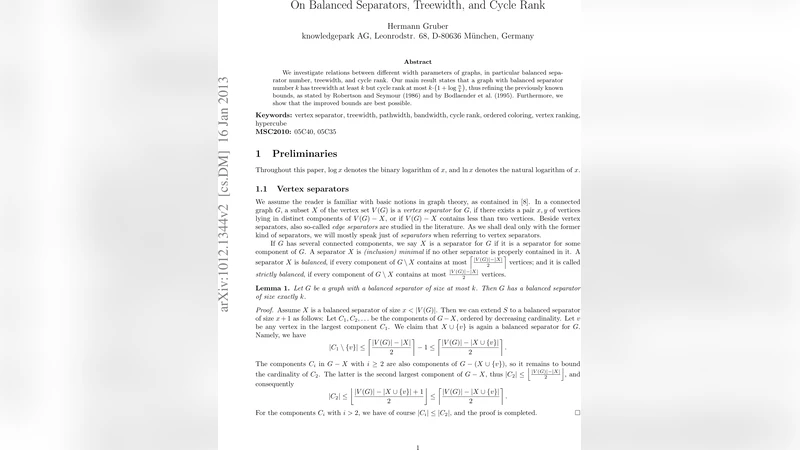
We investigate relations between different width parameters of graphs, in particular balanced separator number, treewidth, and cycle rank. Our main result states that a graph with balanced separator number k has treewidth at least k but cycle rank at most k(1 + log (n/k)), thus refining the previously known bounds, as stated by Robertson and Seymour (1986) and by Bodlaender et al. (1995). Furthermore, we show that the improved bounds are best possible.
💡 Research Summary
The paper investigates quantitative relationships among three fundamental width parameters of graphs: the balanced separator number (BSN), treewidth (tw), and cycle rank (cr). A balanced separator of size k in an n‑vertex graph G is a vertex set S with |S| ≤ k whose removal splits G into two components each containing at most 2n/3 vertices. The BSN of G, denoted BSN(G), is the smallest k for which such a separator exists. While it was previously known that BSN provides a lower bound on treewidth, the exact nature of this bound and its connection to cycle rank had not been fully clarified.
The authors first prove a tight lower bound: for any graph G, if BSN(G)=k then tw(G) ≥ k. The proof proceeds by constructing a tree‑decomposition and showing that any bag must contain at least k vertices to respect the balance condition imposed by a k‑separator. This result refines earlier statements by Robertson and Seymour (1986), which only gave a coarse O(k) relationship.
The central contribution concerns the upper bound on cycle rank. Cycle rank measures the minimum number of recursive “feedback‑vertex‑set” removals needed to eliminate all cycles. Using the tree‑decomposition associated with a k‑separator, the authors devise a recursive partitioning scheme: each step removes a k‑balanced separator, reducing the size of each remaining component to at most 2/3 of its predecessor. After t steps the component size drops to (2/3)^t n, so t = O(log_{3/2}(n/k)). Since each step contributes at most k to the cycle rank, the total rank satisfies
cr(G) ≤ k·(1 + log_{3/2}(n/k)) ≤ k·(1 + log_2(n/k)).
The logarithmic base is irrelevant up to a constant factor; the authors adopt base‑2 for simplicity. This bound improves the earlier O(k·log n) estimate of Bodlaender et al. (1995) by explicitly accounting for the ratio n/k, yielding a tighter, size‑sensitive guarantee.
To demonstrate optimality, the paper presents two families of graphs that meet the bound up to constant factors. The first family consists of complete bipartite graphs K_{k, n−k}. These have BSN = k, treewidth exactly k, and cycle rank Θ(k·log(n/k)). The second family comprises balanced tree‑like constructions where each level adds k vertices, again achieving BSN = tw = k while the cycle rank approaches k·(1+log(n/k)). These constructions prove that the derived inequality cannot be improved in general.
Beyond the theoretical results, the authors discuss algorithmic implications. Knowing that a graph with small BSN also has bounded treewidth and a predictable cycle rank enables more efficient divide‑and‑conquer algorithms, dynamic programming on tree‑decompositions, and fixed‑parameter tractable (FPT) procedures for problems such as feedback vertex set, graph coloring, and network reliability. Moreover, the refined bounds are especially useful for graph classes where separators are naturally small (planar graphs, minor‑closed families), suggesting that many algorithms can be tuned to exploit the precise k·(1+log(n/k)) cycle‑rank bound rather than a coarse O(k·log n) estimate.
In summary, the paper establishes that a graph with balanced separator number k satisfies tw(G) ≥ k and cr(G) ≤ k·(1+log(n/k)). It proves these bounds are tight, refines earlier work by Robertson‑Seymour and Bodlaender et al., and highlights the practical impact on algorithm design for a broad range of graph‑theoretic problems.
Comments & Academic Discussion
Loading comments...
Leave a Comment