Collaborative Astronomical Image Mosaics
This chapter describes how astronomical imaging survey data have become a vital part of modern astronomy, how these data are archived and then served to the astronomical community through on-line data access portals. The Virtual Observatory, now under development, aims to make all these data accessible through a uniform set of interfaces. This chapter also describes the scientific need for one common image processing task, that of composing individual images into large scale mosaics and introduces Montage as a tool for this task. Montage, as distributed, can be used in four ways: as a single thread/process on a single CPU, in parallel using MPI to distribute similar tasks across a parallel computer, in parallel using grid tools (Pegasus/DAGMan) to distributed tasks across a grid, or in parallel using a script-driven approach (Swift). An on-request web based Montage service is available for users who do not need to build a local version. We also introduce some work on a new scripted version of Montage, which offers ease of customization for users. Then, we discuss various ideas where Web 2.0 technologies can help the Montage community.
💡 Research Summary
The chapter begins by outlining the explosion of astronomical imaging data generated by modern surveys across multiple wavelengths and the consequent need for robust archiving and distribution mechanisms. It describes how the Virtual Observatory (VO) framework standardizes metadata and access protocols such as SIAP, enabling seamless retrieval of heterogeneous image collections from distributed archives. Within this context, the scientific requirement for large‑scale image mosaics—combining thousands of individual exposures into a single, seamless view—is identified as a common bottleneck for many research projects.
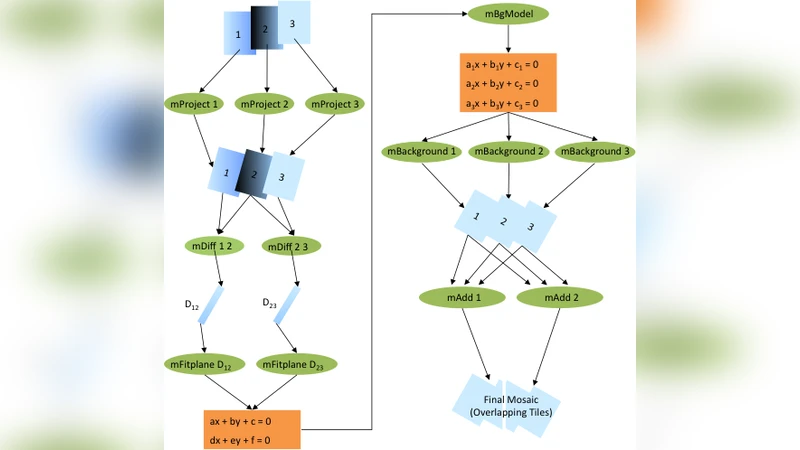
Montage is introduced as an open‑source toolkit specifically designed to automate the three core steps of mosaic creation: reprojection of images to a common World Coordinate System, background matching to remove photometric offsets, and co‑addition into a final FITS mosaic. Each step is implemented as an independent command‑line program, allowing users to construct custom pipelines or rely on the full automated workflow.
Four distinct execution models for Montage are detailed. The simplest runs on a single CPU, suitable for small test cases. An MPI‑based parallel version distributes identical tasks across multiple processors, achieving near‑linear speed‑up on cluster hardware. The Pegasus/DAGMan approach translates a user‑defined directed acyclic graph (DAG) of tasks into a grid‑ready workflow, enabling the use of geographically dispersed resources. Finally, the Swift scripting engine offers a high‑level, declarative way to express data dependencies, automatically handling file staging and task scheduling without requiring deep knowledge of parallel programming.
In addition to local installations, the authors note the availability of an on‑demand web service. Users submit sky coordinates, resolution, and wavelength parameters through a web portal; the backend automatically fetches the necessary images, runs the Montage pipeline, and returns a downloadable mosaic. This service lowers the barrier for researchers lacking local compute resources or for rapid prototyping.
Recent development efforts focus on a new Python‑wrapped version of Montage and integration with Jupyter notebooks. The wrapper converts command‑line calls into Python functions, simplifying parameter handling and error checking, while notebooks provide an interactive environment for iterative parameter tuning, intermediate visualization, and immediate inspection of results.
The chapter concludes with a forward‑looking discussion of how Web 2.0 technologies can enhance the Montage community. A wiki‑based documentation site ensures up‑to‑date manuals and FAQs; a public GitHub repository supports collaborative code development, issue tracking, and continuous integration testing. Real‑time communication platforms such as Slack or Discord are proposed to foster rapid user support and idea exchange. By embedding these social and collaborative tools, the authors argue that Montage can evolve into a more sustainable, user‑friendly ecosystem that accelerates the production and sharing of large astronomical image mosaics across the global research community.
Comments & Academic Discussion
Loading comments...
Leave a Comment