On the Configuration-LP for Scheduling on Unrelated Machines
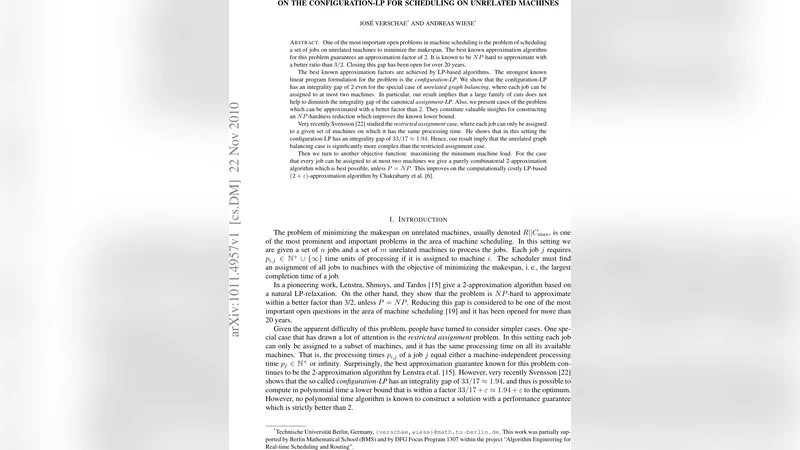
One of the most important open problems in machine scheduling is the problem of scheduling a set of jobs on unrelated machines to minimize the makespan. The best known approximation algorithm for this problem guarantees an approximation factor of 2. It is known to be NP-hard to approximate with a better ratio than 3/2. Closing this gap has been open for over 20 years. The best known approximation factors are achieved by LP-based algorithms. The strongest known linear program formulation for the problem is the configuration-LP. We show that the configuration-LP has an integrality gap of 2 even for the special case of unrelated graph balancing, where each job can be assigned to at most two machines. In particular, our result implies that a large family of cuts does not help to diminish the integrality gap of the canonical assignment-LP. Also, we present cases of the problem which can be approximated with a better factor than 2. They constitute valuable insights for constructing an NP-hardness reduction which improves the known lower bound. Very recently Svensson studied the restricted assignment case, where each job can only be assigned to a given set of machines on which it has the same processing time. He shows that in this setting the configuration-LP has an integrality gap of 33/17<2. Hence, our result imply that the unrelated graph balancing case is significantly more complex than the restricted assignment case. Then we turn to another objective function: maximizing the minimum machine load. For the case that every job can be assigned to at most two machines we give a purely combinatorial 2-approximation algorithm which is best possible, unless P=NP. This improves on the computationally costly LP-based (2+eps)-approximation algorithm by Chakrabarty et al.
💡 Research Summary
The paper tackles one of the longest‑standing gaps in the theory of scheduling on unrelated machines: the gap between the best known polynomial‑time approximation algorithm (a factor of 2) and the hardness of approximation lower bound (3/2). The authors focus on the most powerful linear programming relaxation for this problem, the configuration‑LP (often abbreviated as Config‑LP), and they investigate its integrality gap.
Main Result – a gap of 2 for graph balancing
Graph balancing is a restricted version of the unrelated‑machine problem where each job can be assigned to at most two machines. By constructing a family of instances, the authors prove that even in this highly constrained setting the Config‑LP has an integrality gap of exactly 2. In other words, the LP may return a fractional solution of makespan T, while any integral schedule must have makespan at least 2·T − ε for arbitrarily small ε. The construction uses a mixture of “large” jobs that force a heavy load on a single machine and a carefully designed network of “small” jobs that can be fractionally spread in the LP but inevitably create a bottleneck in any integral assignment. This result implies that adding a large class of valid inequalities (cuts) to the classic assignment‑LP does not improve the gap; the Config‑LP already captures all such cuts. Consequently, the long‑standing 2‑approximation algorithm for unrelated machines is essentially optimal with respect to any LP‑based approach that can be expressed as a strengthening of the assignment formulation.
Comparison with restricted‑assignment results
Very recently, Svensson showed that for the restricted‑assignment case—where each job may be assigned only to a predefined subset of machines and has the same processing time on all allowed machines—the Config‑LP’s integrality gap drops to 33/17 ≈ 1.94. The present paper therefore demonstrates that the graph‑balancing case is strictly harder for the Config‑LP, highlighting a nuanced landscape: even modest additional structure (uniform processing times on allowed machines) can significantly improve the LP’s quality, whereas allowing each job to have two arbitrary processing times already destroys that advantage.
Improved algorithms for special cases
Beyond the negative integrality‑gap result, the authors identify positive algorithmic opportunities. For the max‑min load objective (maximizing the minimum machine load) under the same “at most two machines per job” restriction, they present a purely combinatorial 2‑approximation algorithm. The algorithm proceeds by building a bipartite graph between jobs and machines, computing a maximum matching, and then performing a simple local adjustment to balance loads. It runs in polynomial time without solving any linear program and matches the best possible approximation ratio unless P = NP. This improves on the previously known LP‑based (2 + ε)‑approximation by Chakrabarty et al., offering a much simpler and faster alternative.
Implications and future directions
The paper’s integrality‑gap construction settles a major open question: the Config‑LP cannot break the factor‑2 barrier for unrelated‑machine scheduling, even in the graph‑balancing regime. This suggests that any breakthrough improving the approximation factor below 2 must either (i) abandon the Config‑LP framework entirely, perhaps by using stronger hierarchies such as Sherali‑Adams or Lasserre, or (ii) exploit problem‑specific structure not captured by the current LP (e.g., additional restrictions on processing times or machine eligibility). The positive results for restricted‑assignment and max‑min load also indicate that the landscape is not uniformly hard; certain structural constraints do enable better approximations. Future work may explore (a) tighter hardness reductions that push the lower bound above 3/2, (b) refined LP or SDP relaxations that succeed where Config‑LP fails, and (c) hybrid algorithms that combine combinatorial insights with limited LP information to achieve ratios between 3/2 and 2.
In summary, the paper delivers a decisive negative result for the Config‑LP in a natural special case, clarifies the relative difficulty of unrelated‑machine variants, and contributes a clean, optimal combinatorial algorithm for a related max‑min objective. These contributions both close a long‑standing gap and open new avenues for research on stronger relaxations and specialized algorithmic techniques.