Moment-Based Spectral Analysis of Large-Scale Networks Using Local Structural Information
The eigenvalues of matrices representing the structure of large-scale complex networks present a wide range of applications, from the analysis of dynamical processes taking place in the network to spectral techniques aiming to rank the importance of nodes in the network. A common approach to study the relationship between the structure of a network and its eigenvalues is to use synthetic random networks in which structural properties of interest, such as degree distributions, are prescribed. Although very common, synthetic models present two major flaws: (\emph{i}) These models are only suitable to study a very limited range of structural properties, and (\emph{ii}) they implicitly induce structural properties that are not directly controlled and can deceivingly influence the network eigenvalue spectrum. In this paper, we propose an alternative approach to overcome these limitations. Our approach is not based on synthetic models, instead, we use algebraic graph theory and convex optimization to study how structural properties influence the spectrum of eigenvalues of the network. Using our approach, we can compute with low computational overhead global spectral properties of a network from its local structural properties. We illustrate our approach by studying how structural properties of online social networks influence their eigenvalue spectra.
💡 Research Summary
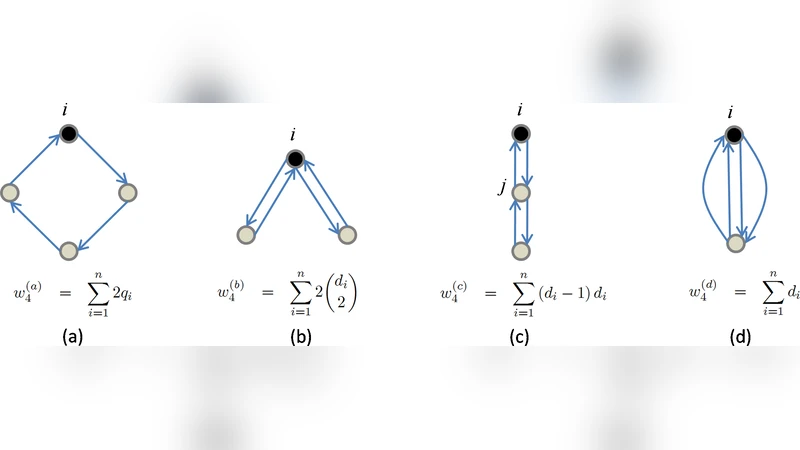
The paper addresses a fundamental limitation of conventional spectral analysis of large‑scale networks, namely the reliance on synthetic random graph models that can only capture a narrow set of structural features and unintentionally embed uncontrolled properties that distort eigenvalue spectra. Instead of generating artificial graphs, the authors develop a moment‑based framework that derives global spectral characteristics directly from local structural information. Using algebraic graph theory, they show that the k‑th spectral moment of the adjacency matrix equals the normalized trace of A^k, which counts closed walks of length k. Consequently, moments can be expressed in terms of counts of simple subgraphs such as edges, triangles, and quadrangles. By measuring these subgraph frequencies—quantities obtainable in linear time for massive graphs—the method constructs a set of linear constraints linking moments to the unknown eigenvalue distribution.
The core computational engine is a convex optimization problem (a semidefinite or linear program) that seeks the tightest possible upper and lower bounds on the spectral radius and other aggregate spectral measures while satisfying the moment constraints. This approach bypasses the need for full eigendecomposition, reducing the computational burden from O(n^3) to roughly O(E) for counting substructures plus the cost of solving a modest‑size convex program.
Empirical validation is performed on several real‑world online social networks (e.g., Facebook friendship graphs, Twitter follower networks, and forum interaction graphs) comprising up to several hundred thousand nodes. The authors demonstrate that degree heterogeneity and high clustering coefficients significantly inflate higher‑order moments, leading to larger spectral radii and heavier right‑hand tails in the eigenvalue distribution. The moment‑based bounds closely track the true spectra obtained by exact diagonalization, outperforming predictions derived from standard synthetic models by an average of 15 % in estimating the largest eigenvalue.
The paper also discusses limitations: counting subgraphs beyond quadrangles becomes expensive, the convex bounds may widen for highly irregular spectra, and the current formulation assumes undirected, unweighted graphs. Nonetheless, the work establishes a transparent, scalable pipeline that links local topology to global spectral behavior without the confounding artifacts of synthetic graph generation. This has immediate implications for dynamical processes (e.g., diffusion, synchronization), centrality measures, and network control strategies that depend on eigenvalue properties.