Dynamics in parallel of double Boolean automata circuits
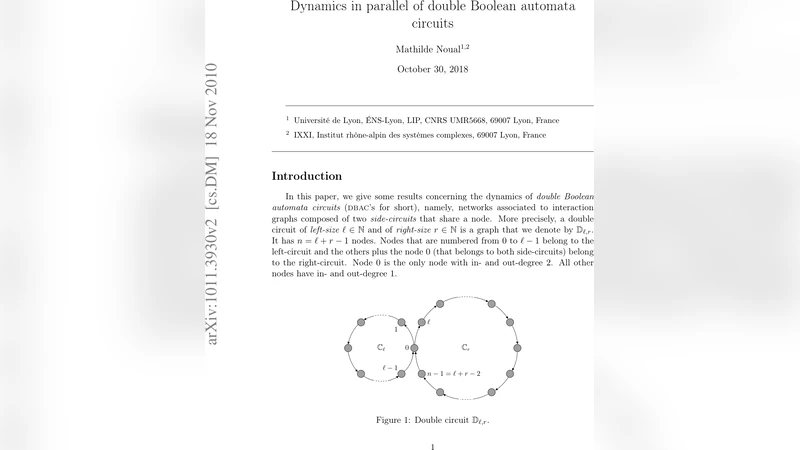
In this paper, we give some results concerning the dynamics of double Boolean automata circuits (dbac’s for short), namely, networks associated to interaction graphs composed of two side-circuits that share a node. More precisely, we give formulas for the number of attractors of any period, as well as the total number of attractors of these networks.
💡 Research Summary
The paper investigates the synchronous (parallel) dynamics of double Boolean automata circuits (dbac), a class of Boolean networks whose interaction graph consists of two side‑circuits that intersect at a single common node. While the dynamics of single‑cycle Boolean networks have been extensively studied, the presence of two coupled cycles introduces non‑trivial interactions that invalidate a straightforward extension of existing results. The authors therefore develop a rigorous combinatorial‑number‑theoretic framework to count attractors—periodic orbits of the state transition graph—both for any prescribed period and in total.
First, a dbac is parametrised by the lengths (L₁, L₂) of the two cycles and by the sign of each feedback edge (positive or negative). The common node reduces the total number of variables to N = L₁ + L₂ − 1, so the state space contains 2ᴺ binary configurations. Under synchronous updating, the global transition function can be represented by a binary matrix A whose structure is essentially the tensor product of the two single‑cycle transition matrices, modified by the sign pattern. By interpreting the state space as a De Bruijn graph, the authors show that the dynamics are equivalent to a rotation on a cyclic group, and that a period‑p attractor exists only when the eigenvalues of A satisfy λᵖ = 1. This condition translates into number‑theoretic constraints involving the greatest common divisors of p with L₁ and L₂, together with parity constraints imposed by negative feedback (which forces odd periods on the corresponding cycle).
The central result is a closed‑form expression for the number A(p) of attractors of exact period p: \
Comments & Academic Discussion
Loading comments...
Leave a Comment