Parametric fitting of data obtained from detectors with finite resolution and limited acceptance
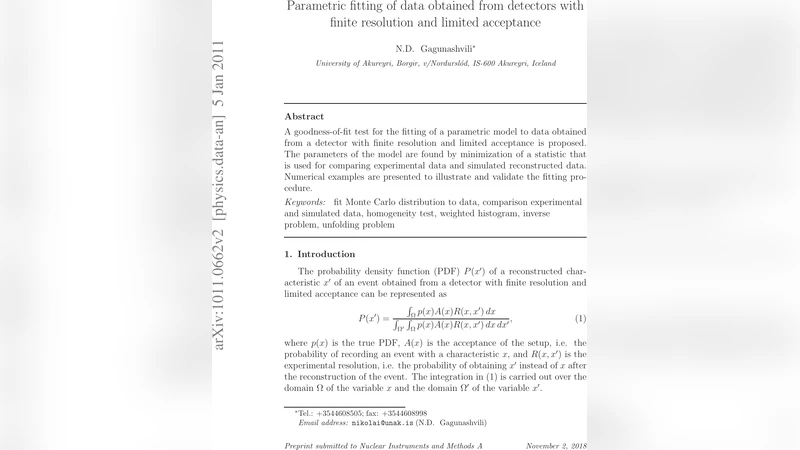
A goodness-of-fit test for the fitting of a parametric model to data obtained from a detector with finite resolution and limited acceptance is proposed. The parameters of the model are found by minimization of a statistic that is used for comparing experimental data and simulated reconstructed data. Numerical examples are presented to illustrate and validate the fitting procedure.
💡 Research Summary
The paper addresses a pervasive problem in experimental physics and related fields: measured data are often distorted by the finite resolution and limited acceptance of detectors, making direct comparison with theoretical models unreliable. Traditional approaches either attempt to correct the data (unfolding) or to invert the detector response, both of which can introduce large statistical uncertainties or rely on approximations that are difficult to validate. To overcome these limitations, the authors propose a fitting framework that incorporates the detector effects explicitly through Monte‑Carlo simulation and a specially designed test statistic.
The core idea is to generate a “reconstructed” Monte‑Carlo sample for any set of model parameters θ by passing the theoretical distribution f(x; θ) through the detector response R(y|x) and acceptance A(x). The resulting simulated histogram n_i^sim(θ) is then directly compared with the experimental histogram n_i^exp in the same binning. The comparison is quantified by a χ²‑type statistic:
χ²ₛ(θ) = Σ_i
Comments & Academic Discussion
Loading comments...
Leave a Comment