Spin Chains with Non-Diagonal Boundaries and Trigonometric SOS Model with Reflecting End
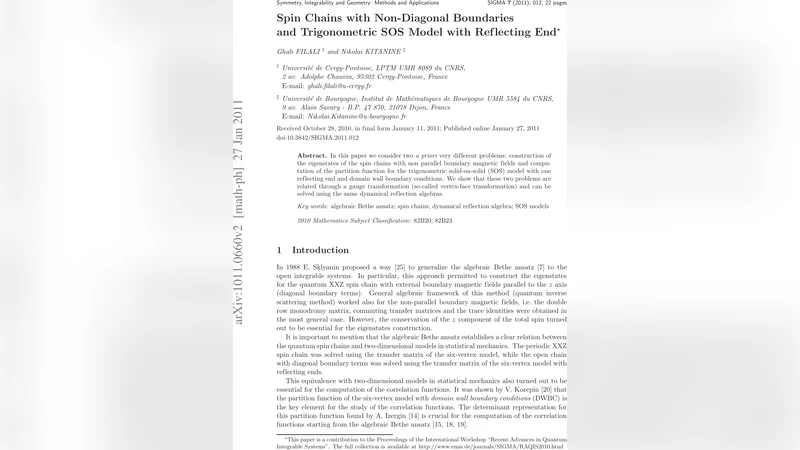
In this paper we consider two a priori very different problems: construction of the eigenstates of the spin chains with non parallel boundary magnetic fields and computation of the partition function for the trigonometric solid-on-solid (SOS) model with one reflecting end and domain wall boundary conditions. We show that these two problems are related through a gauge transformation (so-called vertex-face transformation) and can be solved using the same dynamical reflection algebras.
💡 Research Summary
The paper tackles two seemingly unrelated problems—constructing eigenstates of an XXZ spin‑½ chain with non‑parallel (non‑diagonal) boundary magnetic fields and evaluating the exact partition function of the trigonometric solid‑on‑solid (SOS) model with a reflecting end and domain‑wall boundary conditions—and demonstrates that they are unified through a vertex‑face (gauge) transformation.
In the first part the authors start from the open XXZ Hamiltonian with generic boundary K‑matrices that are not simultaneously diagonalizable. The standard algebraic Bethe Ansatz fails because the Sklyanin reflection algebra assumes diagonal K‑matrices. To overcome this, they apply a vertex‑face transformation that maps the vertex‑type R‑matrix to a dynamical R‑matrix R(λ) depending on a height (spectral) variable λ, and simultaneously maps the non‑diagonal boundary K‑matrix to a dynamical reflection matrix 𝒦(λ). The resulting objects satisfy the dynamical Yang‑Baxter equation and the dynamical reflection equation, defining a dynamical reflection algebra.
Using this algebra they build a dynamical monodromy matrix T(λ) and the corresponding double‑row operator U(λ)=T(λ) 𝒦(λ) T⁻¹(−λ). Because of the λ‑dependence, the usual creation operators acquire shift operators in λ, leading to a “dynamical Bethe vector” |Ψ(λ)⟩. By acting with the transfer matrix (the trace of U(λ)) on |Ψ(λ)⟩ they derive a set of Bethe equations that contain finite‑difference terms in λ. These equations reduce to the usual Bethe equations when the boundary matrices become diagonal, confirming the consistency of the approach. Thus the eigenstates of the spin chain with non‑parallel boundaries are obtained exactly.
The second part shows that the same dynamical reflection algebra governs the trigonometric SOS model with a reflecting end. The SOS model is formulated in terms of face variables (heights) h(i,j) with Boltzmann weights given by the dynamical R‑matrix. The reflecting end introduces a boundary weight 𝒦(λ) on one side of the lattice, while the domain‑wall condition fixes the heights on the remaining three sides. By adapting the Izergin‑Korepin determinant representation to the dynamical case, the authors construct a λ‑dependent determinant formula for the partition function Z(λ). The determinant has the same structure as the well‑known domain‑wall partition function for the six‑vertex model, but each entry is shifted by the dynamical variable, reflecting the presence of the reflecting boundary.
The central insight is that both the eigenstate problem of the spin chain and the partition‑function problem of the SOS model are two faces of the same algebraic structure: the dynamical reflection algebra obtained after the vertex‑face transformation. Consequently, techniques developed for one problem (dynamical Bethe Ansatz) can be transferred to the other (dynamical determinant representation). This unification clarifies the role of gauge transformations in preserving integrability under non‑diagonal boundary conditions and provides a systematic framework for treating models with both dynamical bulk interactions and dynamical boundary reflections.
Beyond the immediate results, the work suggests several broader implications. First, it highlights that dynamical algebras naturally encode boundary‑induced height variables, opening the way to study more general integrable models with “dynamical” boundaries. Second, the vertex‑face transformation is shown to be more than a technical trick; it is a genuine gauge equivalence that respects the full set of algebraic relations, including the reflection equation. Third, the combined use of dynamical Bethe vectors and dynamical determinant formulas offers a powerful toolbox for exact calculations in quantum spin chains, statistical lattice models, and possibly in related quantum field theories where boundary effects play a crucial role. In summary, the paper provides a coherent and elegant solution to two long‑standing problems by revealing their common dynamical reflection algebraic backbone.
Comments & Academic Discussion
Loading comments...
Leave a Comment