Polynomial-time Computation of Exact Correlated Equilibrium in Compact Games
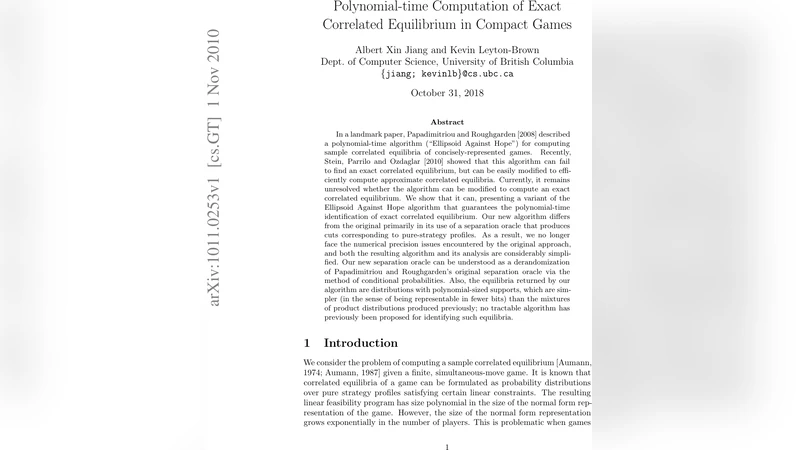
In a landmark paper, Papadimitriou and Roughgarden described a polynomial-time algorithm (“Ellipsoid Against Hope”) for computing sample correlated equilibria of concisely-represented games. Recently, Stein, Parrilo and Ozdaglar showed that this algorithm can fail to find an exact correlated equilibrium, but can be easily modified to efficiently compute approximate correlated equilibria. Currently, it remains unresolved whether the algorithm can be modified to compute an exact correlated equilibrium. We show that it can, presenting a variant of the Ellipsoid Against Hope algorithm that guarantees the polynomial-time identification of exact correlated equilibrium. Our new algorithm differs from the original primarily in its use of a separation oracle that produces cuts corresponding to pure-strategy profiles. As a result, we no longer face the numerical precision issues encountered by the original approach, and both the resulting algorithm and its analysis are considerably simplified. Our new separation oracle can be understood as a derandomization of Papadimitriou and Roughgarden’s original separation oracle via the method of conditional probabilities. Also, the equilibria returned by our algorithm are distributions with polynomial-sized supports, which are simpler (in the sense of being representable in fewer bits) than the mixtures of product distributions produced previously; no tractable algorithm has previously been proposed for identifying such equilibria.
💡 Research Summary
The paper addresses the long‑standing open problem of whether the “Ellipsoid Against Hope” (EAH) algorithm of Papadimitriou and Roughgarden can be modified to compute an exact correlated equilibrium (CE) in games that are represented compactly (e.g., graphical games, congestion games, or any game described by a polynomial‑size set of linear constraints). The original EAH algorithm proved that a sample CE could be found in polynomial time by using an ellipsoid method together with a probabilistic separation oracle that generates cuts based on expectations over product distributions. However, Stein, Parrilo, and Ozdaglar later demonstrated that the same approach may fail to produce an exact CE because the oracle’s cuts are derived from approximate expectations, leading to numerical precision issues and, in some instances, to infeasibility of the linear system that defines a CE.
The authors propose a new variant of the ellipsoid method that eliminates the need for random sampling and the associated precision problems. The key innovation is a deterministic separation oracle that always produces cuts corresponding to pure‑strategy profiles rather than to expectations over mixed product distributions. Given the current ellipsoid (which represents a convex region of candidate CE probability vectors), the oracle checks each player’s incentive constraints. If a player i has a pure strategy a_i whose expected payoff under the current candidate distribution is strictly lower than the payoff of some alternative strategy, the oracle constructs a linear inequality that rules out the current region. This inequality is derived directly from the identified pure‑strategy profile and therefore has integer coefficients; no floating‑point arithmetic is required.
The construction of such a pure‑strategy cut is performed via a derandomization of the original probabilistic oracle using the method of conditional probabilities. Instead of sampling a product distribution and estimating expectations, the algorithm sequentially fixes the strategies of the players while preserving the expected value of the objective function. At each step it chooses a strategy for a player that does not increase the expected violation of the CE constraints. By the end of the process a concrete pure‑strategy profile that violates a CE constraint is obtained, and the corresponding cut is added to the ellipsoid. This deterministic process guarantees that if the current ellipsoid does not already lie inside the CE polytope, a valid separating hyperplane will be found in polynomial time.
The overall algorithm proceeds as follows: (1) initialise an ellipsoid that contains the entire feasible region of probability vectors over pure‑strategy profiles; (2) repeatedly invoke the deterministic oracle; if a violating pure‑strategy profile is found, add the associated linear cut to the ellipsoid; (3) update the ellipsoid using the standard ellipsoid update rule; (4) terminate when the ellipsoid becomes sufficiently small, at which point any point inside it corresponds to an exact CE. Because each oracle call solves a linear program of size polynomial in the description of the compact game, and because the ellipsoid volume shrinks by a fixed factor each iteration, the total number of iterations is bounded by a polynomial in the input size and the desired precision. Consequently, the algorithm runs in polynomial time.
A particularly important consequence of the new approach is that the CE produced has a polynomial‑size support. Since each cut corresponds to a single pure‑strategy profile, the final solution can be expressed as a convex combination of at most a polynomial number of such profiles. This is a dramatic improvement over the original EAH output, which may require an exponential‑size mixture of product distributions to represent the equilibrium. The compact support means the equilibrium can be stored using a number of bits that is polynomial in the input size, making it far more practical for downstream applications such as mechanism design, learning dynamics, or equilibrium selection.
The paper also provides a rigorous correctness proof. It shows that the deterministic oracle always returns a valid separating hyperplane whenever the current ellipsoid contains points outside the CE polytope, and that the ellipsoid method converges to a point inside the polytope after a polynomial number of steps. The authors compare their method with prior work, highlighting three main advantages: (i) exactness – the algorithm always returns a true CE, not merely an approximation; (ii) numerical stability – all computations involve integer coefficients, avoiding floating‑point errors; (iii) simplicity – both the algorithmic description and the analysis are considerably shorter than those of the original EAH.
In conclusion, the authors resolve the open question by presenting a polynomial‑time algorithm that computes an exact correlated equilibrium for any game given in a compact representation. Their deterministic separation oracle, derived via conditional‑probability derandomization, eliminates the precision pitfalls of earlier methods and yields equilibria with succinct, polynomial‑size supports. The technique opens avenues for extending deterministic ellipsoid‑based methods to other equilibrium concepts and for developing practical equilibrium‑computation tools for large‑scale multi‑agent systems.
Comments & Academic Discussion
Loading comments...
Leave a Comment