The effect of Coulombic friction on spatial displacement statistics
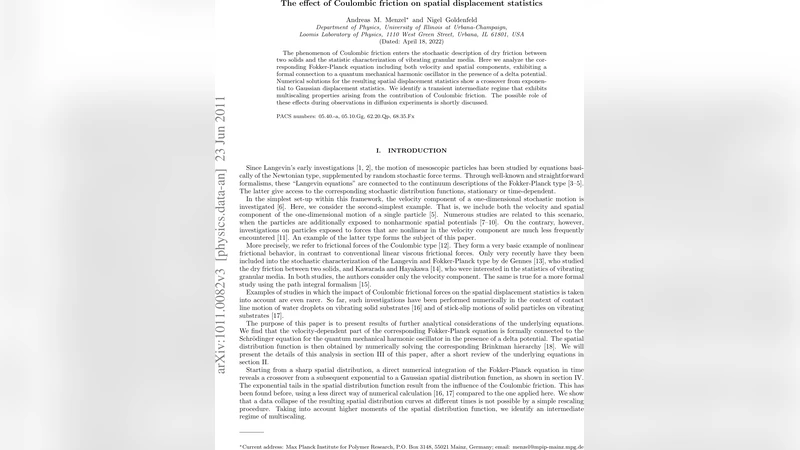
The phenomenon of Coulombic friction enters the stochastic description of dry friction between two solids and the statistic characterization of vibrating granular media. Here we analyze the corresponding Fokker-Planck equation including both velocity and spatial components, exhibiting a formal connection to a quantum mechanical harmonic oscillator in the presence of a delta potential. Numerical solutions for the resulting spatial displacement statistics show a crossover from exponential to Gaussian displacement statistics. We identify a transient intermediate regime that exhibits multiscaling properties arising from the contribution of Coulombic friction. The possible role of these effects during observations in diffusion experiments is shortly discussed.
💡 Research Summary
The paper investigates how Coulombic (dry) friction influences the statistics of spatial displacements in stochastic particle dynamics. Starting from a one‑dimensional Langevin equation, the authors add a friction term proportional to the sign of the velocity (‑γ sgn(v)) together with Gaussian white noise. This leads to a two‑dimensional Fokker‑Planck equation (FPE) for the joint probability density ψ(x,v,t) that simultaneously describes the evolution of position x and velocity v. A key theoretical insight is that the velocity part of the FPE admits eigenfunctions identical to those of a quantum harmonic oscillator, while the spatial part maps onto a quantum harmonic oscillator perturbed by a delta‑function potential. This formal analogy allows the authors to borrow techniques from quantum mechanics—spectral decomposition, variational approximations, and normalization conditions—to treat the otherwise intractable problem.
Numerically, the authors solve the coupled FPE using a combination of finite‑difference discretization in velocity and spectral methods in space. They initialize the system with a narrow Gaussian (or δ‑like) distribution, representing particles that start essentially at rest. The time evolution of the spatial marginal distribution P(x,t)=∫ψ(x,v,t)dv reveals three distinct regimes. In the early stage, the Coulombic friction dominates: particles experience a strong “sticking” effect, and the displacement distribution exhibits exponential tails. This reflects the fact that the friction force is independent of speed magnitude, effectively suppressing small displacements.
As time progresses, a crossover regime emerges. The distribution no longer follows a pure exponential nor a pure Gaussian; instead, it shows multiscaling behavior. Higher‑order moments grow with non‑trivial scaling exponents, indicating that different length scales (short‑range exponential tails versus intermediate‑range quasi‑Gaussian core) evolve at different rates. The authors attribute this to the nonlinear, velocity‑sign dependent friction term, which injects intermittent bursts of “sticking” and “slipping” into the dynamics, thereby generating heterogeneous scaling.
In the long‑time limit, the influence of the dry friction becomes subdominant to the diffusive spreading induced by the noise. The spatial distribution converges to a Gaussian, consistent with the central limit theorem, and the multiscaling signatures fade away. The authors quantify the crossover by tracking the kurtosis and the scaling of the second and fourth moments, showing a smooth transition from exponential‑dominated to Gaussian‑dominated statistics.
The paper also discusses experimental relevance. In microrheology, granular media, or single‑particle tracking experiments, deviations from Gaussian diffusion are often reported as anomalous diffusion. The present analysis suggests that such deviations could arise from unaccounted Coulombic friction, especially in systems where particles experience intermittent sticking (e.g., rough surfaces, granular contacts). The identified intermediate multiscaling regime provides a diagnostic signature: exponential tails coexisting with a Gaussian core and non‑Gaussian scaling of higher moments. Detecting this pattern could help experimentalists infer the presence of dry friction forces without directly measuring them.
Finally, the authors emphasize that the mapping to a quantum harmonic oscillator with a delta potential opens avenues for analytical progress. Variational estimates of eigenvalues, perturbative treatments of the delta term, and semiclassical approximations could yield closed‑form expressions for the crossover time scales and the shape of the intermediate distribution. Such analytical tools would complement the numerical findings and deepen the theoretical understanding of non‑linear friction in stochastic transport.
In summary, the study provides a comprehensive theoretical and numerical framework for how Coulombic friction modifies spatial displacement statistics, revealing a clear crossover from exponential to Gaussian behavior with a distinct multiscaling intermediate regime, and highlights the practical implications for interpreting diffusion experiments in systems where dry friction is present.
Comments & Academic Discussion
Loading comments...
Leave a Comment