Stable Takens Embeddings for Linear Dynamical Systems
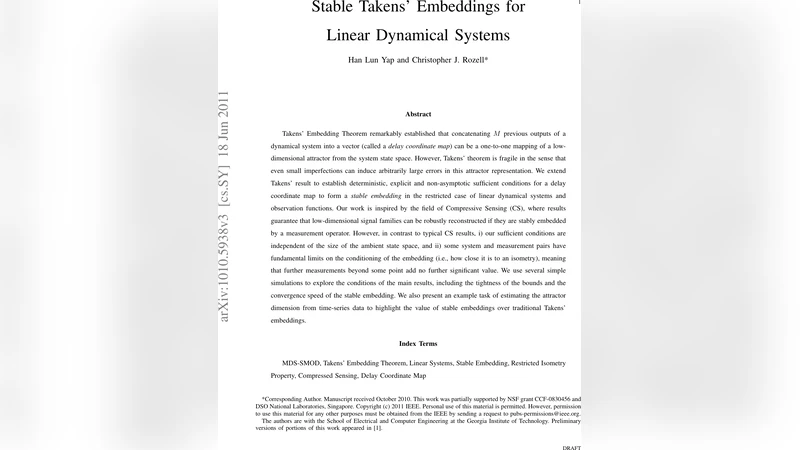
Takens’ Embedding Theorem remarkably established that concatenating M previous outputs of a dynamical system into a vector (called a delay coordinate map) can be a one-to-one mapping of a low-dimensional attractor from the system state space. However, Takens’ theorem is fragile in the sense that even small imperfections can induce arbitrarily large errors in this attractor representation. We extend Takens’ result to establish deterministic, explicit and non-asymptotic sufficient conditions for a delay coordinate map to form a stable embedding in the restricted case of linear dynamical systems and observation functions. Our work is inspired by the field of Compressive Sensing (CS), where results guarantee that low-dimensional signal families can be robustly reconstructed if they are stably embedded by a measurement operator. However, in contrast to typical CS results, i) our sufficient conditions are independent of the size of the ambient state space, and ii) some system and measurement pairs have fundamental limits on the conditioning of the embedding (i.e., how close it is to an isometry), meaning that further measurements beyond some point add no further significant value. We use several simple simulations to explore the conditions of the main results, including the tightness of the bounds and the convergence speed of the stable embedding. We also present an example task of estimating the attractor dimension from time-series data to highlight the value of stable embeddings over traditional Takens’ embeddings.
💡 Research Summary
The paper addresses a fundamental weakness of Takens’ Embedding Theorem: while the theorem guarantees that a delay‑coordinate map can provide a one‑to‑one reconstruction of a low‑dimensional attractor, even infinitesimal noise or model mismatch can cause arbitrarily large distortions in the reconstructed set. To remedy this, the authors focus on the restricted but practically important case of linear dynamical systems with linear observation functions and develop explicit, deterministic, non‑asymptotic sufficient conditions under which a delay‑coordinate map becomes a stable embedding—i.e., it satisfies a Restricted Isometry Property (RIP)‑type inequality.
Problem setting.
The system evolves as (x_{t+1}=A x_t) with (A\in\mathbb{R}^{N\times N}) stable (all eigenvalues inside the unit circle). The scalar observation is linear: (y_t = c^{\top}x_t). The delay‑coordinate map of order (M) is defined as
\
Comments & Academic Discussion
Loading comments...
Leave a Comment