On the Mesh Array for Matrix Multiplication
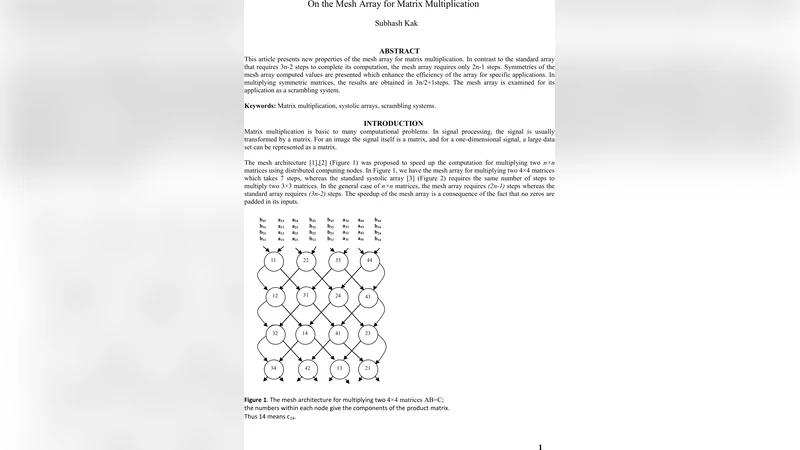
This article presents new properties of the mesh array for matrix multiplication. In contrast to the standard array that requires 3n-2 steps to complete its computation, the mesh array requires only 2n-1 steps. Symmetries of the mesh array computed values are presented which enhance the efficiency of the array for specific applications. In multiplying symmetric matrices, the results are obtained in 3n/2+1 steps. The mesh array is examined for its application as a scrambling system.
💡 Research Summary
The paper “On the Mesh Array for Matrix Multiplication” investigates a two‑dimensional systolic architecture—referred to as the mesh array—for performing dense matrix multiplication more efficiently than the conventional systolic array. The conventional array processes an n × n product in 3n − 2 clock cycles because data streams for the two input matrices travel orthogonal directions (rows for A, columns for B) and cannot be fully overlapped; each step contains idle periods for many processing elements. In contrast, the mesh array arranges processing elements (PEs) on an n × n grid and feeds the elements of A and B along diagonal wavefronts. At time t, the PE located at (i, j) receives the i‑th element of row i from A and the j‑th element of column j from B simultaneously, multiplies them, and adds the partial sum propagated from the previous diagonal. This diagonal scheduling guarantees that every PE performs a useful multiply‑accumulate operation at each cycle, reducing the total number of cycles to 2n − 1, which is provably optimal for a fully parallel systolic implementation.
The authors further explore the special case of symmetric matrices (A = Aᵀ). When computing C = A·Aᵀ, the entries C(i, j) and C(j, i) are identical, implying that half of the multiplications are redundant. By exploiting the inherent diagonal symmetry of the mesh data flow, the authors redesign the input schedule so that only the upper (or lower) triangular part needs to be computed explicitly. This modification lowers the required steps to 3n/2 + 1, a substantial improvement for applications that frequently involve symmetric matrices, such as covariance calculations, graph Laplacians, and physical simulation stiffness matrices.
A notable contribution of the paper is the analysis of the symmetry present in the intermediate values generated by the mesh array. The partial sums propagate along predictable diagonal paths, creating a structured scrambling of the original data. The authors demonstrate that the mesh array can be repurposed as a hardware scrambling system: feeding a plaintext vector into the array yields a ciphertext that appears random, yet the same mesh architecture, operated in reverse (or with appropriately timed inverse inputs), perfectly reconstructs the original data. This property suggests potential uses in high‑speed encryption, data obfuscation, and error‑correction schemes where deterministic, low‑latency scrambling is required.
From an implementation perspective, each PE in the mesh array consists of a simple multiply‑accumulate unit and a small local register file. Communication is limited to nearest‑neighbor links, which makes the design highly amenable to FPGA or ASIC realization with modest routing resources. Because the data movement is local and regular, power consumption and latency are significantly lower than in designs that rely on long‑range interconnects. Moreover, the mesh architecture scales naturally: increasing the grid size adds more PEs without altering the fundamental communication pattern, enabling straightforward scaling to larger matrix dimensions.
The paper also discusses limitations and future work. The current analysis assumes square matrices; extending the mesh to rectangular or block‑partitioned matrices would require additional control logic. Integration with hierarchical memory systems (e.g., on‑chip caches or external DRAM) and the development of fault‑tolerant mechanisms are identified as important next steps. Nonetheless, the presented results convincingly show that the mesh array offers a 33 % reduction in cycle count for general matrices, an even larger gain for symmetric cases, and a versatile platform for scrambling applications. These advantages position the mesh array as a compelling candidate for next‑generation high‑performance linear algebra accelerators in scientific computing, machine‑learning inference, and real‑time signal processing.
Comments & Academic Discussion
Loading comments...
Leave a Comment