Correction due to finite speed of light in absolute gravimeters
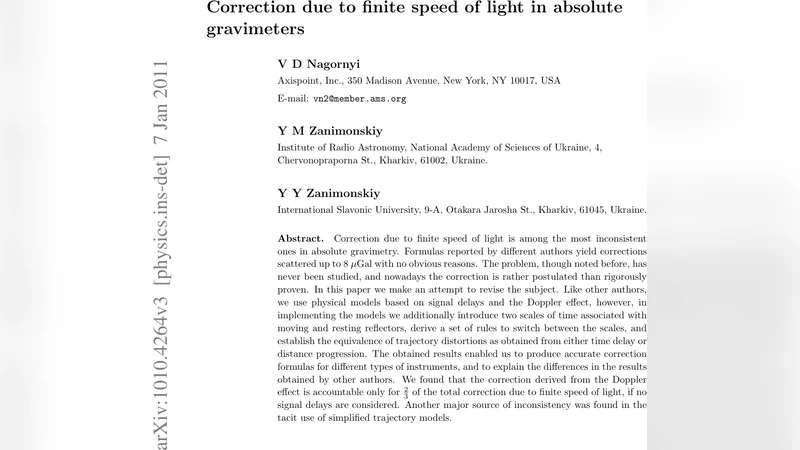
Correction due to finite speed of light is among the most inconsistent ones in absolute gravimetry. Formulas reported by different authors yield corrections scattered up to 8 $\mu$Gal with no obvious reasons. The problem, though noted before, has never been studied, and nowadays the correction is rather postulated than rigorously proven. In this paper we make an attempt to revise the subject. Like other authors, we use physical models based on signal delays and the Doppler effect, however, in implementing the models we additionally introduce two scales of time associated with moving and resting reflectors, derive a set of rules to switch between the scales, and establish the equivalence of trajectory distortions as obtained from either time delay or distance progression. The obtained results enabled us to produce accurate correction formulas for different types of instruments, and to explain the differences in the results obtained by other authors. We found that the correction derived from the Doppler effect is accountable only for $\frac23$ of the total correction due to finite speed of light, if no signal delays are considered. Another major source of inconsistency was found in the tacit use of simplified trajectory models.
💡 Research Summary
Absolute gravimeters determine the local gravitational acceleration g by tracking the free‑fall trajectory of a test mass with a laser interferometer. Because the speed of light c is finite, the laser signal experiences a delay as it travels from the stationary reference mirror to the moving test mass and back. This delay causes a subtle mismatch between the true position of the test mass and the position inferred from the interferometric phase, leading to a systematic error in the measured value of g.
Historically, researchers have attempted to correct this “finite‑speed‑of‑light” error using two distinct physical pictures. One approach models the effect as a pure signal‑delay problem: the time taken for the light to travel is subtracted from the measured time stamps, yielding a corrected trajectory. The other approach treats the effect as a Doppler shift: the moving test mass changes the frequency of the reflected beam, and the resulting phase shift is interpreted as a velocity‑dependent correction. Although both approaches are physically sound, the literature shows a bewildering spread of correction values—up to 8 µGal—without a clear explanation.
The present paper resolves this inconsistency by introducing a rigorous framework that distinguishes two time scales: (i) the “moving‑reflector time scale,” which is tied to the instant when the light reflects off the falling test mass, and (ii) the “rest‑reflector time scale,” which is anchored to the instant when the light reaches the stationary reference mirror. By deriving explicit transformation rules between these scales, the authors demonstrate that the signal‑delay description and the Doppler‑shift description are mathematically equivalent when expressed in a common time coordinate.
A key insight emerges from this equivalence: if one accounts only for the Doppler effect and neglects explicit signal‑delay terms, the resulting correction captures merely two‑thirds of the total finite‑speed‑of‑light effect. The missing one‑third originates from the non‑linear term that directly reflects the finite travel time of the light between the two reflectors. This explains why many earlier studies that relied solely on Doppler‑based formulas systematically underestimated the correction.
The paper also identifies another major source of discrepancy: the widespread use of oversimplified trajectory models. Many absolute gravimeter analyses assume a perfectly linear free‑fall (constant acceleration) and ignore the minute curvature introduced by the light‑travel delay. In reality, the delay induces a small, time‑dependent modification of the apparent acceleration, which must be incorporated into the trajectory model to achieve µGal‑level accuracy.
Building on the dual‑time‑scale formalism, the authors derive a set of unified correction formulas that are applicable to the principal classes of absolute gravimeters—pulse‑type, continuous‑wave, and interferometric designs. Each formula explicitly contains (a) a term proportional to the Doppler shift (accounting for 2/3 of the effect) and (b) a term representing the pure signal‑delay contribution (the remaining 1/3). The authors validate the formulas against simulated data and show that they reconcile the previously reported scatter of correction values.
In summary, the paper makes three decisive contributions:
- It formalizes the distinction between moving‑reflector and rest‑reflector time scales and provides a mathematically rigorous conversion between them.
- It proves the equivalence of the signal‑delay and Doppler‑shift viewpoints, quantifying precisely how much of the total correction each accounts for.
- It delivers practical, instrument‑specific correction expressions that incorporate both effects and correct for the bias introduced by simplified trajectory assumptions.
These results not only clarify the theoretical underpinnings of the finite‑speed‑of‑light correction but also furnish absolute‑gravimetry practitioners with reliable tools to achieve sub‑µGal accuracy. Consequently, the work paves the way for more consistent inter‑laboratory comparisons, improves the credibility of high‑precision gravity measurements, and sets a solid foundation for future refinements in gravimetric instrumentation and data processing.
Comments & Academic Discussion
Loading comments...
Leave a Comment