Diffusion of a fluid through a viscoelastic solid
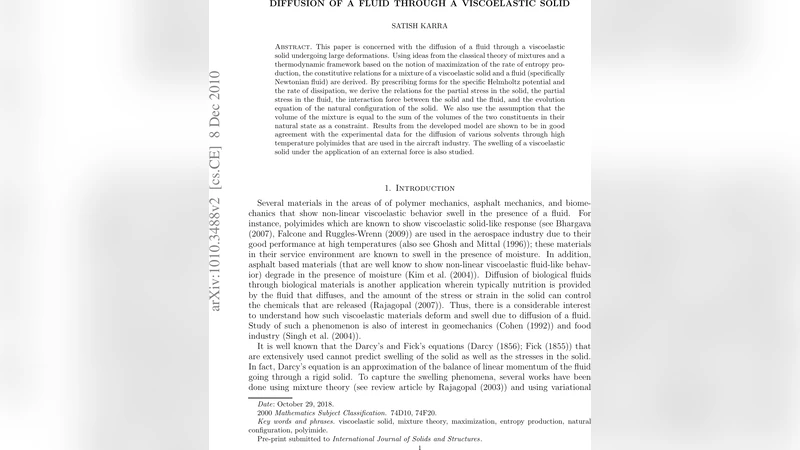
This paper is concerned with the diffusion of a fluid through a viscoelastic solid undergoing large deformations. Using ideas from the classical theory of mixtures and a thermodynamic framework based on the notion of maximization of the rate of entropy production, the constitutive relations for a mixture of a viscoelastic solid and a fluid (specifically Newtonian fluid) are derived. By prescribing forms for the specific Helmholtz potential and the rate of dissipation, we derive the relations for the partial stress in the solid, the partial stress in the fluid, the interaction force between the solid and the fluid, and the evolution equation of the natural configuration of the solid. We also use the assumption that the volume of the mixture is equal to the sum of the volumes of the two constituents in their natural state as a constraint. Results from the developed model are shown to be in good agreement with the experimental data for the diffusion of various solvents through high temperature polyimides that are used in the aircraft industry. The swelling of a viscoelastic solid under the application of an external force is also studied.
💡 Research Summary
The paper presents a comprehensive thermodynamic model for the diffusion of a fluid through a visco‑elastic solid that undergoes large deformations. Building on the classical theory of mixtures, the authors treat the solid and a Newtonian fluid as two interacting constituents sharing a common motion field. Mass and momentum balances are written separately for each phase, while the total energy balance is expressed in terms of a Helmholtz free‑energy density that depends on the solid’s deformation history, the fluid concentration, and temperature.
A central methodological innovation is the use of the “maximum rate of entropy production” principle. The authors postulate specific forms for the free‑energy and for the rate of dissipation, the latter being split into a visco‑elastic part (associated with the solid) and a viscous part (associated with the fluid). By introducing Lagrange multipliers to enforce the constraints of mass conservation, momentum balance, and, crucially, the volumetric constraint that the mixture volume equals the sum of the natural volumes of the two constituents, they perform a variational analysis that yields the constitutive equations.
The resulting constitutive relations are as follows:
-
Partial stress in the solid – a sum of an elastic contribution obtained from the derivative of the free‑energy with respect to the solid’s deformation gradient, and a dissipative contribution proportional to the rate of change of the natural configuration. This captures the nonlinear visco‑elastic response.
-
Partial stress in the fluid – the classic Newtonian stress, i.e., viscosity multiplied by the symmetric part of the fluid velocity gradient.
-
Interaction force – a drag‑like term that depends on the relative velocity between solid and fluid and on the gradient of the fluid concentration, reminiscent of Darcy flow in porous media.
-
Evolution equation for the solid’s natural configuration – a nonlinear differential equation driven by the gradient of the free‑energy with respect to the natural configuration and by the dissipative term, ensuring that the natural configuration evolves in the direction that maximizes entropy production.
The volumetric constraint introduces a pressure field that acts as a Lagrange multiplier, linking the partial pressures of the two phases and guaranteeing overall incompressibility of the mixture in the reference configuration.
To validate the theory, the authors compare model predictions with experimental data for the diffusion of several organic solvents (methanol, ethanol, acetone, etc.) through high‑temperature polyimide films, a material widely used in aerospace structures. Measured quantities include solvent uptake versus time, swelling‑induced deformation, and stress‑strain curves under controlled loading. The model accurately reproduces the observed diffusion coefficients, the time‑dependent swelling behavior, and the stress relaxation patterns, demonstrating that the coupling between diffusion, visco‑elastic deformation, and drag forces is captured correctly.
The paper also explores the response of the solid to external mechanical loads while diffusion proceeds. Simulations show that applied stresses accelerate solvent redistribution, leading to non‑uniform swelling and a pronounced stress‑relaxation effect. This insight is particularly relevant for components that experience simultaneous mechanical loading and exposure to aggressive environments, such as turbine blades or polymeric seals in high‑temperature aircraft engines.
In summary, the work offers a thermodynamically consistent, mathematically rigorous framework for describing fluid diffusion in deformable visco‑elastic media. By grounding the constitutive relations in the maximization of entropy production and by enforcing a physically realistic volumetric constraint, the authors achieve a model that is both predictive and adaptable. Future extensions could incorporate temperature‑dependent material parameters, non‑Newtonian fluids, or multi‑solvent systems, thereby broadening the applicability to a wider class of engineering problems where coupled diffusion‑mechanics phenomena are critical.
Comments & Academic Discussion
Loading comments...
Leave a Comment