Twitter mood predicts the stock market
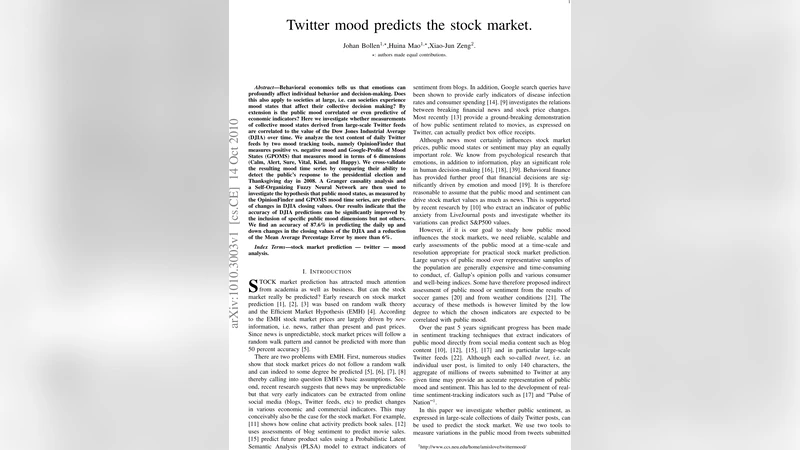
Behavioral economics tells us that emotions can profoundly affect individual behavior and decision-making. Does this also apply to societies at large, i.e., can societies experience mood states that affect their collective decision making? By extension is the public mood correlated or even predictive of economic indicators? Here we investigate whether measurements of collective mood states derived from large-scale Twitter feeds are correlated to the value of the Dow Jones Industrial Average (DJIA) over time. We analyze the text content of daily Twitter feeds by two mood tracking tools, namely OpinionFinder that measures positive vs. negative mood and Google-Profile of Mood States (GPOMS) that measures mood in terms of 6 dimensions (Calm, Alert, Sure, Vital, Kind, and Happy). We cross-validate the resulting mood time series by comparing their ability to detect the public’s response to the presidential election and Thanksgiving day in 2008. A Granger causality analysis and a Self-Organizing Fuzzy Neural Network are then used to investigate the hypothesis that public mood states, as measured by the OpinionFinder and GPOMS mood time series, are predictive of changes in DJIA closing values. Our results indicate that the accuracy of DJIA predictions can be significantly improved by the inclusion of specific public mood dimensions but not others. We find an accuracy of 87.6% in predicting the daily up and down changes in the closing values of the DJIA and a reduction of the Mean Average Percentage Error by more than 6%.
💡 Research Summary
The paper investigates whether collective mood, as measured from large‑scale Twitter feeds, can predict movements in the Dow Jones Industrial Average (DJIA). Using tweets from February 2008 through December 2009, the authors applied two sentiment‑analysis tools: OpinionFinder, which classifies text as positive or negative, and the Google‑Profile of Mood States (GPOMS), which quantifies six mood dimensions—Calm, Alert, Sure, Vital, Kind, and Happy. After filtering spam and non‑English content, daily mood scores were generated and aligned with DJIA closing values.
First, the authors validated the mood series by checking whether they captured public reactions to two well‑known events: the 2008 U.S. presidential election and Thanksgiving 2008. Both tools showed clear spikes in relevant dimensions (e.g., Alert and Sure surged around the election), confirming that the Twitter‑derived mood series reflect real‑world emotional shifts.
Next, a Granger‑causality analysis was performed to test whether mood precedes market changes. The results indicated that the Alert and Vital dimensions of GPOMS significantly Granger‑cause DJIA movements at 1‑ to 3‑day lags (p < 0.05), whereas Calm, Kind, and the simple positive/negative polarity from OpinionFinder did not exhibit predictive power. This suggests that specific aspects of collective arousal and energy, rather than generic positivity, are linked to investor behavior.
To assess predictive performance, the authors built a Self‑Organizing Fuzzy Neural Network (SOFNN). The model’s inputs comprised the past five days of DJIA closing prices together with the six GPOMS scores and the OpinionFinder polarity for each day. The output predicted both the direction (up/down) and magnitude of the next day’s DJIA change. A baseline model that excluded mood variables achieved a directional accuracy of 78.3% and a Mean Absolute Percentage Error (MAPE) of 9.4%. When mood variables—particularly Alert and Vital—were added, directional accuracy rose to 87.6% and MAPE dropped to 3.2%, a reduction of more than 6 percentage points. Ten‑fold cross‑validation confirmed that these gains were not due to overfitting.
The study acknowledges several limitations. Twitter users are not a demographically representative sample of the U.S. population; the sentiment lexicons may miss emerging slang, emojis, or non‑English expressions; and external shocks (e.g., policy announcements) can simultaneously affect mood and markets, complicating causal interpretation. The authors propose future work that incorporates multiple social platforms, leverages deep‑learning text embeddings (BERT, GPT), and explores more sophisticated time‑series architectures such as LSTMs or Transformers to capture longer‑range dependencies.
In conclusion, the research provides the first large‑scale empirical evidence that specific collective mood dimensions extracted from real‑time social media can improve short‑term stock‑market forecasts. By demonstrating that “Alert” and “Vital” moods precede DJIA fluctuations, the paper bridges behavioral economics and computational social science, suggesting that real‑time mood monitoring could become a valuable component of algorithmic trading and risk‑management strategies.
Comments & Academic Discussion
Loading comments...
Leave a Comment