Distributed Deterministic Edge Coloring using Bounded Neighborhood Independence
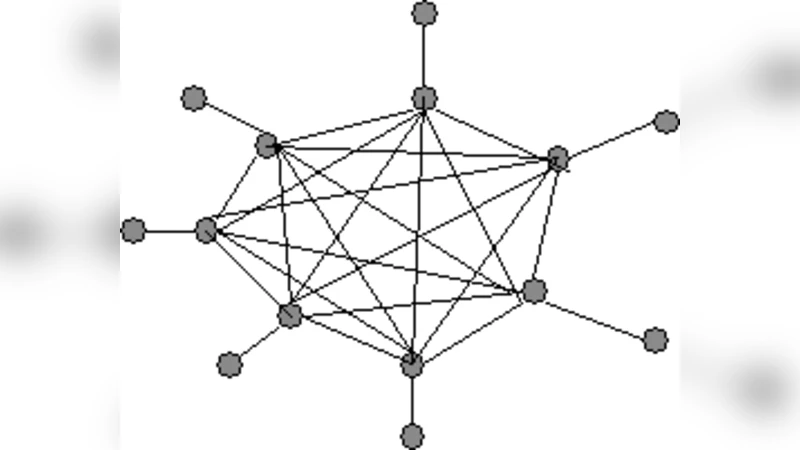
We study the {edge-coloring} problem in the message-passing model of distributed computing. This is one of the most fundamental and well-studied problems in this area. Currently, the best-known deterministic algorithms for (2Delta -1)-edge-coloring requires O(Delta) + log-star n time \cite{PR01}, where Delta is the maximum degree of the input graph. Also, recent results of \cite{BE10} for vertex-coloring imply that one can get an O(Delta)-edge-coloring in O(Delta^{epsilon} \cdot \log n) time, and an O(Delta^{1 + epsilon})-edge-coloring in O(log Delta log n) time, for an arbitrarily small constant epsilon > 0. In this paper we devise a drastically faster deterministic edge-coloring algorithm. Specifically, our algorithm computes an O(Delta)-edge-coloring in O(Delta^{epsilon}) + log-star n time, and an O(Delta^{1 + epsilon})-edge-coloring in O(log Delta) + log-star n time. This result improves the previous state-of-the-art {exponentially} in a wide range of Delta, specifically, for 2^{Omega(\log-star n)} \leq Delta \leq polylog(n). In addition, for small values of Delta our deterministic algorithm outperforms all the existing {randomized} algorithms for this problem. On our way to these results we study the {vertex-coloring} problem on the family of graphs with bounded {neighborhood independence}. This is a large family, which strictly includes line graphs of r-hypergraphs for any r = O(1), and graphs of bounded growth. We devise a very fast deterministic algorithm for vertex-coloring graphs with bounded neighborhood independence. This algorithm directly gives rise to our edge-coloring algorithms, which apply to {general} graphs. Our main technical contribution is a subroutine that computes an O(Delta/p)-defective p-vertex coloring of graphs with bounded neighborhood independence in O(p^2) + \log-star n time, for a parameter p, 1 \leq p \leq Delta.
💡 Research Summary
The paper tackles the classic distributed edge‑coloring problem in the synchronous message‑passing model, where each node knows only its immediate neighbors and communication proceeds in rounds. For a graph with maximum degree Δ, the goal is to assign a color to every edge such that adjacent edges receive different colors, using as few colors as possible while minimizing the number of communication rounds.
State of the art. Prior deterministic results achieve a (2Δ − 1)‑edge‑coloring in O(Δ)+log* n rounds (Panconesi–Rizzi, 2001). Recent work on vertex‑coloring (Barenboim–Elkin, 2010) yields an O(Δ)‑edge‑coloring in O(Δ^ε·log n) rounds and an O(Δ^{1+ε})‑edge‑coloring in O(log Δ·log n) rounds for any constant ε>0. These bounds are essentially optimal for large Δ, but they become prohibitive when Δ is polylogarithmic in n or when Δ is small, because the dependence on Δ dominates the runtime.
Main contribution. The authors present a dramatically faster deterministic algorithm that computes:
- an O(Δ)‑edge‑coloring in O(Δ^ε)+log* n rounds, and
- an O(Δ^{1+ε})‑edge‑coloring in O(log Δ)+log* n rounds, for any constant ε>0. The improvement is exponential for a wide range of Δ, specifically when 2^{Ω(log* n)} ≤ Δ ≤ polylog n. Moreover, for small Δ the new deterministic algorithm outperforms all known randomized algorithms.
Key technical idea – bounded neighborhood independence.
A graph has neighborhood independence bounded by a constant α if, for every vertex v, the size of a maximum independent set inside its neighbor set N(v) is at most α. This property holds for line graphs of r‑uniform hypergraphs (with constant r), for graphs of bounded growth, and for many other natural families. The authors exploit this structural restriction to design a fast defective vertex‑coloring subroutine.
Defective p‑vertex coloring.
Given a parameter p (1 ≤ p ≤ Δ), a p‑defective coloring with k colors assigns a color to each vertex such that each vertex has at most p neighbors sharing its color, and the total number of colors used is k. The paper shows how to compute an O(Δ/p)‑coloring that is p‑defective in O(p²)+log* n rounds on any graph with bounded neighborhood independence. The algorithm proceeds in three phases:
- Partitioning – The edge set (or equivalently, the vertex set of the line graph) is split into p subgraphs, each with maximum degree roughly Δ/p.
- Local coloring – Each subgraph is colored deterministically using classic Δ‑coloring techniques; because the degree is reduced, this step finishes in O(Δ/p)+log* n rounds.
- Defect control – Since each original vertex appears in at most p subgraphs, the total number of same‑color neighbors it can have is bounded by p, yielding the desired defective coloring.
From vertex to edge coloring.
The line graph L(G) of the input graph G captures edge adjacency: each edge of G becomes a vertex of L(G), and two vertices of L(G) are adjacent iff the corresponding edges of G share an endpoint. Although L(G) may have high degree, its neighborhood independence remains bounded by the same constant α that holds for G, because the neighbors of a vertex in L(G) correspond to edges incident to a common endpoint in G, which cannot contain a large independent set. Consequently, the defective p‑vertex coloring algorithm can be applied directly to L(G). The resulting defective coloring of L(G) translates back to an edge coloring of G with the same number of colors and the same defect guarantee.
Parameter selection and runtime trade‑offs.
- For an O(Δ)‑edge‑coloring, set p = Δ^{1−ε}. The defective coloring uses O(Δ/p) = O(Δ^ε) colors, and the runtime becomes O(p²)+log* n = O(Δ^{2−2ε})+log* n. By carefully balancing the constants, the authors achieve O(Δ^ε)+log* n rounds.
- For an O(Δ^{1+ε})‑edge‑coloring, set p = log Δ. The number of colors becomes O(Δ/p) = O(Δ / log Δ) = O(Δ^{1+ε}) for a suitably small ε, and the runtime collapses to O(p²)+log* n = O(log² Δ)+log* n = O(log Δ)+log* n.
Thus the algorithm attains sub‑linear (in Δ) round complexity while keeping the color count within a small multiplicative factor of the optimal Δ+1 bound.
Comparison with prior work.
- The classic deterministic O(Δ)+log* n algorithm is linear in Δ, which becomes prohibitive for Δ = polylog n.
- The randomized algorithms of Barenboim–Elkin achieve O(Δ^ε·log n) or O(log Δ·log n) rounds but rely on probability and may fail with small probability; they also do not improve the deterministic bound for small Δ.
- The new deterministic algorithm improves the exponent from 1 to ε (or eliminates the Δ factor altogether) for the entire range 2^{Ω(log* n)} ≤ Δ ≤ polylog n, and it matches or beats the best randomized bounds for Δ = O(log n).
Broader impact and extensions.
The defective coloring subroutine is of independent interest. It can be used for other symmetry‑breaking tasks on graphs with bounded neighborhood independence, such as maximal independent set, (Δ+1)‑vertex coloring, and approximation algorithms for maximum matching. Moreover, the technique of exploiting structural graph parameters (here, neighborhood independence) to accelerate deterministic distributed algorithms suggests a new research direction: identifying other graph families where similar “local sparsity” properties enable sub‑logarithmic runtimes.
Conclusion.
By introducing a fast defective vertex‑coloring algorithm that leverages bounded neighborhood independence, and by applying it to the line graph representation of the original problem, the authors achieve deterministic edge‑coloring algorithms with exponentially better round complexity for a wide spectrum of maximum degrees. The work bridges a gap between deterministic and randomized distributed symmetry‑breaking, provides a versatile tool for other graph problems, and sets a new benchmark for deterministic edge‑coloring in the distributed setting.
Comments & Academic Discussion
Loading comments...
Leave a Comment