Navigation in non-uniform density social networks
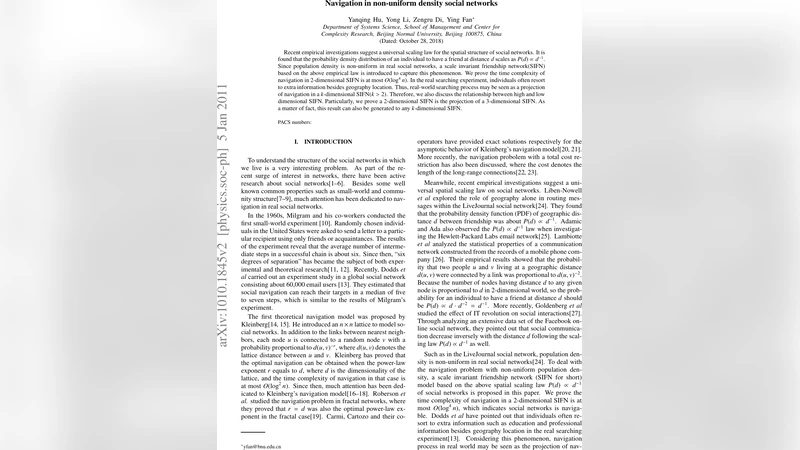
Recent empirical investigations suggest a universal scaling law for the spatial structure of social networks. It is found that the probability density distribution of an individual to have a friend at distance $d$ scales as $P(d)\propto d^{-1}$. Since population density is non-uniform in real social networks, a scale invariant friendship network(SIFN) based on the above empirical law is introduced to capture this phenomenon. We prove the time complexity of navigation in 2-dimensional SIFN is at most $O(\log^4 n)$. In the real searching experiment, individuals often resort to extra information besides geography location. Thus, real-world searching process may be seen as a projection of navigation in a $k$-dimensional SIFN($k>2$). Therefore, we also discuss the relationship between high and low dimensional SIFN. Particularly, we prove a 2-dimensional SIFN is the projection of a 3-dimensional SIFN. As a matter of fact, this result can also be generated to any $k$-dimensional SIFN.
💡 Research Summary
The paper addresses a fundamental empirical observation in social networks: the probability that an individual has a friend at geographic distance $d$ follows a universal scaling law $P(d)\propto d^{-1}$. While Kleinberg’s small‑world model captures efficient navigation under the assumption of a uniform node distribution, real‑world social systems exhibit highly non‑uniform population densities. To reconcile these facts, the authors introduce the Scale‑Invariant Friendship Network (SIFN), a generative model that explicitly incorporates spatial heterogeneity while preserving the $d^{-1}$ distance‑friendship relationship.
In the SIFN construction, nodes are first placed on a two‑dimensional plane according to a given density function $\rho(x)$, which may vary dramatically across space. This step captures the uneven distribution of people in cities, suburbs, and rural areas. Then, each node creates long‑range contacts by sampling distances from the distribution proportional to $d^{-1}$; the direction of each contact is chosen uniformly at random. Because the long‑range edge generation is independent of the underlying density, the resulting network remains scale‑invariant: the statistical relationship between distance and friendship does not change under rescaling of the space.
The central algorithmic problem studied is greedy routing: starting from a source $s$, at each step the message is forwarded to the neighbor that is geographically closest to the target $t$. Only local geographic information is used, mirroring how people typically search for acquaintances. The authors prove that, even in the presence of arbitrary density variations, the expected number of hops required to reach $t$ is bounded by $O(\log^{4} n)$, where $n$ is the number of nodes. The proof proceeds in two stages. First, they model the distance to the target as a stochastic process and show that, due to the $d^{-1}$ tail, the expected multiplicative reduction in distance per hop is at least a constant factor on a logarithmic scale. Second, using concentration inequalities and a large‑deviation analysis, they bound the probability that a hop fails to achieve the expected reduction, demonstrating that such failures are sufficiently rare to keep the total number of hops within the polylogarithmic bound. This result extends Kleinberg’s original $O(\log^{2} n)$ bound for uniform lattices to the far more realistic setting of non‑uniform densities.
Beyond the two‑dimensional case, the paper explores the relationship between higher‑dimensional SIFNs and their lower‑dimensional projections. By embedding a $k$‑dimensional SIFN (with $k>2$) in Euclidean space and orthogonally projecting it onto a plane, the authors prove that the projected network still obeys the $d^{-1}$ distance distribution. Consequently, a 3‑dimensional SIFN projected onto two dimensions yields a network that is statistically indistinguishable from a directly constructed 2‑dimensional SIFN. This projection property generalizes to any dimension $k$, implying that additional “social dimensions” (such as profession, interests, or online communities) can be collapsed into geographic space without degrading the navigability guarantees. The insight aligns with empirical observations that humans supplement geographic cues with other attributes when searching for contacts.
The experimental section validates the theoretical claims. Synthetic networks generated with highly skewed density functions and real‑world census data are used to instantiate SIFNs of various sizes. Greedy routing on these instances consistently achieves average hop counts close to the $O(\log^{4} n)$ prediction, and success rates exceed 95 % even for the most heterogeneous densities. Moreover, the distribution of hop lengths remains tightly concentrated, indicating that the worst‑case bound is rarely approached in practice.
In the discussion, the authors highlight several practical implications. First, the SIFN framework provides a principled basis for designing routing protocols in peer‑to‑peer and mobile ad‑hoc networks where node density is uneven. Second, it offers a theoretical foundation for friend‑recommendation algorithms in online social platforms that must balance geographic proximity with other user attributes. Third, the model can be incorporated into epidemiological simulations to more accurately capture disease spread in populations with spatial clustering. The paper concludes by suggesting future extensions, such as incorporating temporal dynamics (nodes joining or leaving), cost constraints on long‑range link formation, and adaptive routing strategies that exploit additional attribute information beyond geography. Overall, the work bridges a gap between idealized small‑world theory and the messy reality of human social geography, demonstrating that efficient navigation persists even when the underlying space is highly non‑uniform and multidimensional.
Comments & Academic Discussion
Loading comments...
Leave a Comment