On the development of QPOs in Bondi-Hoyle accretion flows
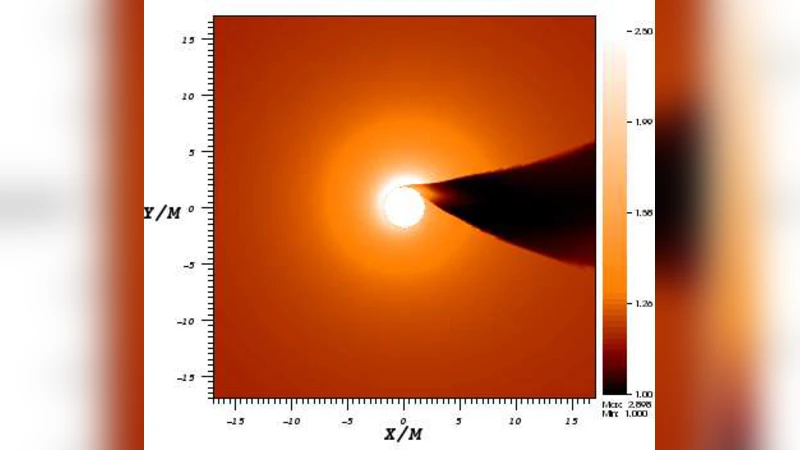
The numerical investigation of Bondi-Hoyle accretion onto a moving black hole has a long history, both in Newtonian and in general-relativistic physics. By performing new two-dimensional and general-relativistic simulations onto a rotating black hole, we point out a novel feature, namely, that quasi-periodic oscillations (QPOs) are naturally produced in the shock cone that develops in the downstream part of the flow. Because the shock cone in the downstream part of the flow acts as a cavity trapping pressure perturbations, modes with frequencies in the integer ratios 2:1 and 3:1 are easily produced. The frequencies of these modes depend on the black-hole spin and on the properties of the flow, and scale linearly with the inverse of the black-hole mass. Our results may be relevant for explaining the detection of QPOs in Sagittarius A*, once such detection is confirmed by further observations. Finally, we report on the development of the flip-flop instability, which can affect the shock cone under suitable conditions; such an instability has been discussed before in Newtonian simulations but was never found in a relativistic regime.
💡 Research Summary
The paper presents a comprehensive numerical study of Bondi‑Hoyle accretion onto a moving black hole, focusing on the relativistic regime and the emergence of quasi‑periodic oscillations (QPOs) within the downstream shock cone. Using two‑dimensional general‑relativistic hydrodynamic (GRHD) simulations in Boyer‑Lindquist coordinates, the authors model a Kerr black hole with spin parameters ranging from non‑rotating (a* = 0) to near‑extremal (a* ≈ 0.99). The inflowing gas is supplied at infinity with prescribed density, velocity, and sound speed, allowing systematic variation of the Mach number and thermodynamic properties. High‑resolution grids (Δr ≈ 0.01 r_g, Δθ ≈ 0.5°) and a robust HLL Riemann solver combined with a third‑order TVD Runge‑Kutta integrator ensure accurate capture of shock formation, relativistic frame‑dragging, and acoustic wave propagation.
The simulations reveal that the shock cone, which forms downstream of the black hole as the supersonic flow is abruptly decelerated, acts as an acoustic cavity. Pressure perturbations generated near the shock front reflect repeatedly between the cone’s outer boundary and the strong gravitational field close to the horizon. This trapping leads to the amplification of discrete eigenmodes whose frequencies appear in simple integer ratios, most prominently 2:1 and 3:1 relative to a fundamental frequency f₀. Spectral analysis shows a clean ladder of peaks at f₀, 2f₀, and 3f₀, with the higher harmonics being weaker but still detectable. The fundamental frequency scales inversely with the black‑hole mass (f₀ ∝ M⁻¹) and increases with spin because the cone is compressed toward the horizon, shortening the acoustic path length. Moreover, higher Mach numbers produce a sharper cone and higher quality factors, allowing non‑linear coupling that can generate weaker higher‑order harmonics (e.g., 4f₀, 5f₀).
A second major finding is the occurrence of the flip‑flop instability in the relativistic context. For certain combinations of Mach number and spin (e.g., Mach ≈ 2.5, a* ≈ 0.7), the shock cone becomes asymmetrically deflected to one side and then abruptly switches to the opposite side on a quasi‑periodic timescale. This behavior, previously reported only in Newtonian simulations, is reproduced here with full GR dynamics, indicating that the instability is robust against relativistic corrections. During flip‑flop episodes the QPO spectrum is temporarily modulated, with transient enhancements of the higher harmonics, suggesting a coupling between the global cone oscillation and the acoustic cavity modes.
The authors discuss the astrophysical relevance of these results, particularly for Sagittarius A* (Sgr A*), the supermassive black hole at the Galactic centre. Scaling the fundamental frequency to M ≈ 4 × 10⁶ M⊙ yields f₀ ≈ 0.025 Hz (≈ 40 s period). If future high‑sensitivity X‑ray or radio observations detect low‑frequency QPOs in Sgr A* with the characteristic 2:1 or 3:1 ratios, the Bondi‑Hoyle shock‑cone resonance mechanism would provide a natural explanation without invoking exotic disk oscillations or magnetohydrodynamic instabilities. The linear mass scaling also implies that similar QPO signatures could be present in stellar‑mass black holes, albeit at kilohertz frequencies, offering a unified framework across many orders of magnitude in mass.
In conclusion, the paper establishes that (1) the downstream shock cone in relativistic Bondi‑Hoyle accretion naturally forms an acoustic resonator capable of producing QPOs with integer‑ratio frequencies, (2) these frequencies depend systematically on black‑hole spin and flow parameters while scaling as M⁻¹, and (3) the flip‑flop instability, a hallmark of non‑linear shock dynamics, persists in the general‑relativistic regime. The work bridges a gap between earlier Newtonian studies and modern GR simulations, opening avenues for future three‑dimensional, magnetohydrodynamic, and radiative‑transfer extensions that will further clarify the role of such resonances in real astrophysical systems.
Comments & Academic Discussion
Loading comments...
Leave a Comment