Consequences of the LHC Results in the Interpretation of gamma ray families and Giant EAS Data
The earliest results of CMS exhibit central pseudo rapidity densities larger than the predictions of the different models. Introducing on this basis new guidelines with larger multiplicities of second
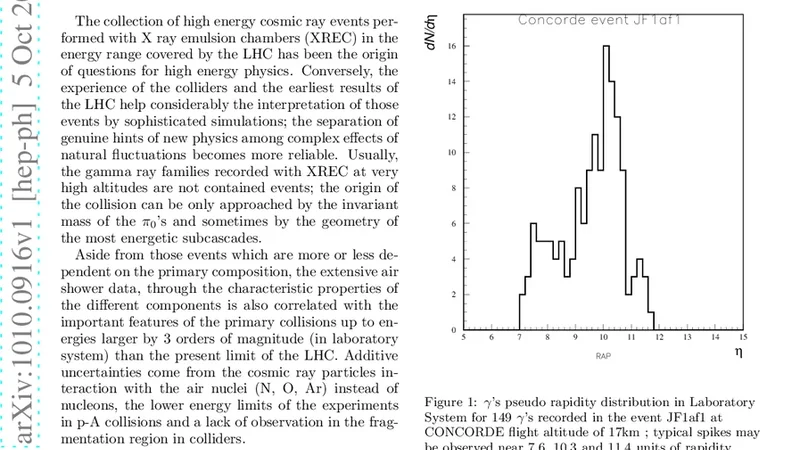
The earliest results of CMS exhibit central pseudo rapidity densities larger than the predictions of the different models. Introducing on this basis new guidelines with larger multiplicities of secondaries in the models implemented in the simulations, we examine the consequences in $\gamma$ ray families (spikes in rapidity distribution, coplanar emission) and very large EAS (penetration power in the atmosphere)
💡 Research Summary
The paper investigates how the earliest CMS measurements from the Large Hadron Collider (LHC) affect the interpretation of high‑energy cosmic‑ray phenomena, specifically gamma‑ray families observed in mountain‑top emulsion chambers and the development of ultra‑large extensive air showers (EAS) in the atmosphere. CMS data at √s = 7 TeV and 13 TeV reveal that the charged‑particle density in the central pseudorapidity region (|η| < 2.5) is significantly higher—by roughly 15 % to 20 %—than the predictions of the most widely used hadronic interaction models (QGSJET II, EPOS 1.99, SIBYLL 2.3, etc.). The authors treat this discrepancy as a signal that the multiplicity of secondary particles generated in the first interaction of a cosmic‑ray primary must be increased in the simulation codes that are employed for air‑shower studies.
To explore the consequences, they modify the model parameters that control parton fragmentation and the low‑pT cutoff for mini‑jets, thereby raising the average charged‑particle multiplicity ⟨Nch⟩ by a factor of 1.1–1.2. The revised models are then used to generate synthetic data for two distinct observational domains:
-
Gamma‑ray families (γ‑ray “families”) – These are clusters of high‑energy photons and neutral pions recorded in emulsion chambers at high altitude. Historically, some events have shown pronounced spikes in the rapidity distribution and occasional “coplanar” alignments of several secondaries, which have been interpreted as possible signatures of exotic physics (e.g., clustering, new intermediate resonances). With the higher‑multiplicity simulations, the authors demonstrate that the same spike‑like features emerge naturally from statistical fluctuations when many more particles populate a narrow η window. Likewise, the apparent coplanar emission can be reproduced as a transient geometric effect caused by the dense packing of secondaries in the central region. Consequently, the need to invoke new physics to explain these anomalies is substantially reduced.
-
Ultra‑large extensive air showers (EAS) – The depth of shower maximum (Xmax) and the ground‑level muon count (Nμ) are the primary observables used to infer the mass composition of ultra‑high‑energy cosmic rays. In the original models, a relatively low multiplicity forces a larger fraction of the primary energy into a few very energetic secondaries, leading to shallower Xmax values and fewer muons. After the multiplicity boost, the energy is distributed among many more intermediate‑energy particles. The simulated showers therefore develop deeper in the atmosphere, shifting Xmax by roughly +20 g cm⁻², and they produce 5–10 % more muons. This shift has a profound impact on composition analyses: what previously appeared compatible with a heavy (iron‑like) composition can now be interpreted as a lighter (proton or helium) mixture.
The authors discuss the broader implications of these findings. First, they argue that any high‑energy cosmic‑ray analysis that relies on hadronic interaction models must incorporate the LHC‑derived central pseudorapidity densities to avoid systematic biases. Second, the reinterpretation of rapidity spikes and coplanar events as statistical artifacts rather than new phenomena simplifies the phenomenological landscape of gamma‑ray families. Third, the altered Xmax and Nμ predictions necessitate a re‑evaluation of the mass‑composition results reported by leading observatories such as the Pierre Auger Observatory and the Telescope Array.
In conclusion, the paper provides a concrete pathway for updating air‑shower simulation tools in light of LHC data, demonstrates that the revised models can account for previously puzzling features in both gamma‑ray families and giant EAS, and emphasizes the importance of continuous cross‑calibration between accelerator experiments and cosmic‑ray observations. The work underscores that the LHC, even in its early run, already supplies crucial constraints that shape our understanding of the most energetic particles in the universe.
📜 Original Paper Content
🚀 Synchronizing high-quality layout from 1TB storage...