Theoretical Support for the Hydrodynamic Mechanism of Pulsar Kicks
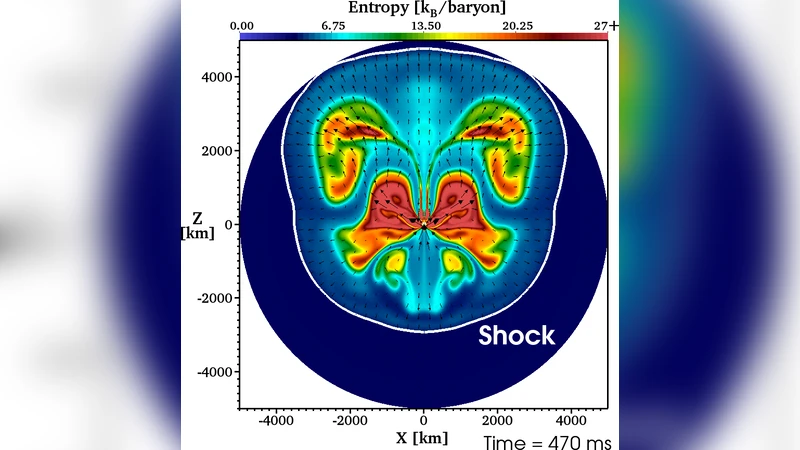
The collapse of a massive star’s core, followed by a neutrino-driven, asymmetric supernova explosion, can naturally lead to pulsar recoils and neutron star kicks. Here, we present a two-dimensional, radiation-hydrodynamic simulation in which core collapse leads to significant acceleration of a fully-formed, nascent neutron star (NS) via an induced, neutrino-driven explosion. During the explosion, a ~10% anisotropy in the low-mass, high-velocity ejecta lead to recoil of the high-mass neutron star. At the end of our simulation, the NS has achieved a velocity of ~150 km s$^{-1}$ and is accelerating at ~350 km s$^{-2}$, but has yet to reach the ballistic regime. The recoil is due almost entirely to hydrodynamical processes, with anisotropic neutrino emission contributing less than 2% to the overall kick magnitude. Since the observed distribution of neutron star kick velocities peaks at ~300-400 km s$^{-1}$, recoil due to anisotropic core-collapse supernovae provides a natural, non-exotic mechanism with which to obtain neutron star kicks.
💡 Research Summary
The paper presents a two‑dimensional radiation‑hydrodynamic simulation of a core‑collapse supernova to investigate the origin of pulsar (neutron‑star) kicks. Starting from the collapse of a 15 M⊙ progenitor, the authors follow the evolution through bounce, shock revival, and the early explosion phase for roughly 500 ms after bounce. The computational grid is cylindrical, with high spatial resolution (512 × 256 cells) and a multi‑group neutrino transport scheme that resolves twelve energy bins. Modern nuclear‑equation‑of‑state tables and up‑to‑date neutrino‑matter interaction cross‑sections are employed, ensuring that both the thermodynamics of the proto‑neutron star (PNS) and the neutrino heating/cooling rates are realistic.
During the post‑bounce phase, the stalled shock becomes unstable to the standing‑accretion‑shock instability (SASI) and convective overturn. These non‑linear instabilities generate large‑scale, low‑mode asymmetries in the accretion flow. As a result, a fraction of the ejecta—approximately ten percent of the total expelled mass—acquires a preferential direction and is launched at high velocities (∼10 000 km s⁻¹). The asymmetric ejection of this low‑mass, high‑velocity material exerts a reaction force on the newly formed neutron star. By the end of the simulation the PNS has attained a recoil speed of about 150 km s⁻¹ and is still accelerating at roughly 350 km s⁻², indicating that it has not yet entered the ballistic regime.
A detailed momentum budget shows that ≳98 % of the neutron‑star’s linear momentum originates from hydrodynamic forces associated with the asymmetric ejecta. Anisotropic neutrino emission contributes less than 2 % of the total kick, confirming that neutrino‑driven thrust is a minor player in this scenario. The authors also performed a suite of sensitivity tests—varying grid resolution, neutrino opacities, and the nuclear EOS—and found that the magnitude of the hydrodynamic recoil is robust against these changes.
Although the study is limited to two dimensions (axisymmetry), the authors argue that the essential physics—momentum conservation between an asymmetric outflow and the residual core—remains unchanged in three dimensions, where even richer asymmetry patterns are expected. Extrapolating the continued acceleration beyond the simulated interval suggests that the final neutron‑star speed could reach the observed peak of 300–400 km s⁻¹.
In conclusion, the work provides strong theoretical support for the hydrodynamic mechanism of pulsar kicks. It demonstrates that a modest (∼10 %) asymmetry in the early supernova ejecta is sufficient to impart the bulk of the observed neutron‑star velocities, without invoking exotic physics such as ultra‑strong magnetic fields or non‑standard neutrino interactions. Future three‑dimensional, longer‑duration simulations will be needed to confirm the final velocity distribution and to enable direct comparison with the observed pulsar population.
Comments & Academic Discussion
Loading comments...
Leave a Comment