Rectangular Polyomino Set Weak (1,2)-achievement Games
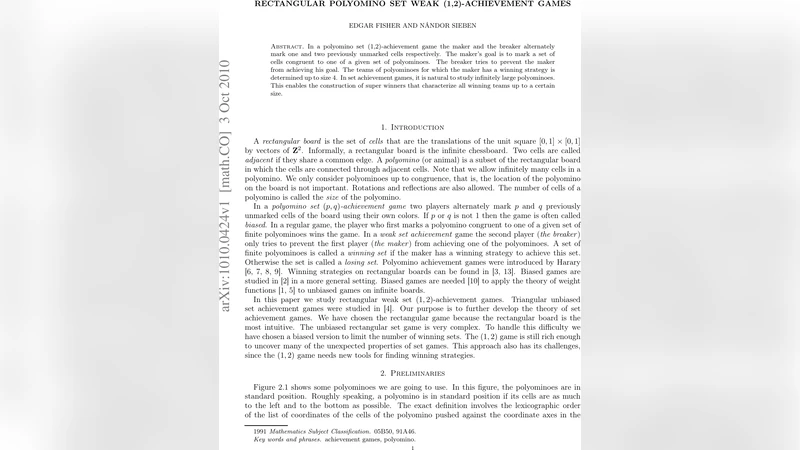
In a polyomino set (1,2)-achievement game the maker and the breaker alternately mark one and two previously unmarked cells respectively. The maker’s goal is to mark a set of cells congruent to one of a given set of polyominoes. The breaker tries to prevent the maker from achieving his goal. The teams of polyominoes for which the maker has a winning strategy is determined up to size 4. In set achievement games, it is natural to study infinitely large polyominoes. This enables the construction of super winners that characterize all winning teams up to a certain size.
💡 Research Summary
The paper investigates a variant of positional achievement games in which two players, called the Maker and the Breaker, alternately claim cells on an infinite rectangular grid. In each round the Maker marks exactly one previously unmarked cell, while the Breaker marks two. The Maker’s objective is to occupy a set of cells that is congruent (up to translation, rotation, and reflection) to one of the polyominoes in a prescribed family ℱ; the Breaker’s goal is to prevent this forever. This setting is called a weak (1, 2)‑achievement game because the Breaker cannot claim an immediate win before the Maker succeeds.
The authors first formalize the game, introducing the notions of “critical cell”, “protected zone” and “threat zone” that capture the geometric tension between the two players. They then perform an exhaustive case analysis for all polyomino families whose largest member contains at most four cells. For size 1 and 2 the Maker trivially wins. For size 3 there are three distinct shapes (straight line, L‑shape, and a right‑angled corner). The straight line is a Maker win, the L‑shape is a Breaker win because the Breaker can always occupy the two cells that would complete the L, and the corner shape is a Maker win only when the Maker’s first move occupies the cell that serves as the vertex of the corner.
When the maximal polyomino has four cells, five canonical shapes appear (square, T‑shape, Z‑shape, L‑shape with a tail, and a 2 × 2 block with one cell missing). The paper shows that the presence or absence of a “critical cell” – a cell whose early occupation forces the rest of the shape – determines the outcome. For example, the square is a Maker win because claiming the central diagonal cell forces the Breaker to split its two moves, leaving a pair of opposite corners free for later completion. Conversely, the T‑shape is a Breaker win because the Breaker can simultaneously block the two arms, leaving the Maker unable to close the top. All results are summarized in a table that lists each 4‑cell shape together with the optimal strategies for both players.
A major conceptual contribution is the introduction of infinite polyominoes, in particular the infinite rectangle (an unbounded strip of cells). The authors define a “super‑winner” as a polyomino family that contains such an infinite rectangle. They prove that any family ℱ that contains a super‑winner guarantees a Maker win for every subfamily of ℱ, regardless of the size of the polyominoes involved. The proof relies on a “growth strategy”: the Maker repeatedly extends a finite rectangle along a direction that the Breaker cannot fully block with only two cells per turn. Consequently, even when the target polyominoes have size five or more, the existence of a super‑winner collapses the classification problem to a binary decision – either the family contains a super‑winner (Maker wins) or it does not (the outcome must be determined by finite‑size analysis).
Building on this, the paper classifies all winning and losing families up to size 4, and shows how the super‑winner concept extends the classification to arbitrary sizes. The authors compare their findings with the classic (1, 1)‑achievement games, highlighting that the asymmetry of the (1, 2) rule dramatically changes the balance of power: many families that are Breaker wins in the (1, 1) setting become Maker wins when the Breaker is forced to claim two cells per turn.
The final section discusses limitations and future directions. The current work is confined to rectangular grids and the specific (1, 2) move pattern; extending the analysis to (k, ℓ) patterns, non‑rectangular lattices, or multi‑player variants remains open. Moreover, the exhaustive case analysis for larger polyominoes quickly becomes computationally infeasible, suggesting the need for algorithmic or probabilistic methods. The authors propose using computer‑assisted search to identify further super‑winners and to explore the threshold at which the Breaker’s two‑cell advantage can no longer be overcome.
In summary, the paper delivers a complete characterization of weak (1, 2)‑achievement games for polyomino families up to four cells, introduces the powerful notion of super‑winners via infinite rectangles, and provides a framework that potentially scales to larger families, thereby enriching the theory of positional games and combinatorial geometry.
Comments & Academic Discussion
Loading comments...
Leave a Comment