Regularization in regression: comparing Bayesian and frequentist methods in a poorly informative situation
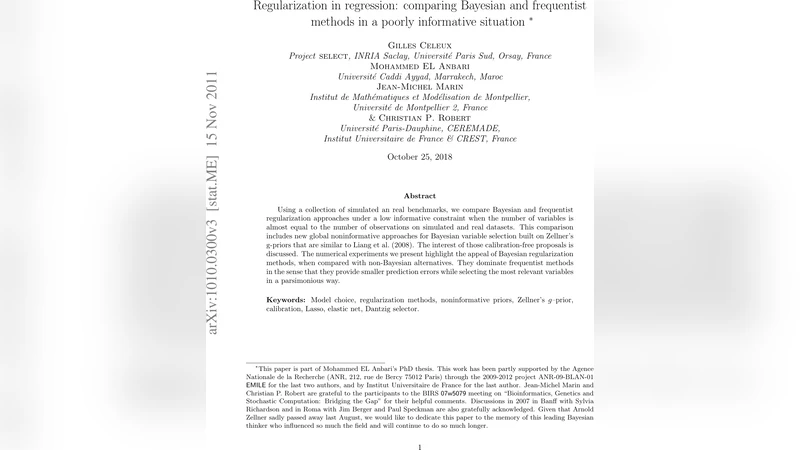
Using a collection of simulated an real benchmarks, we compare Bayesian and frequentist regularization approaches under a low informative constraint when the number of variables is almost equal to the number of observations on simulated and real datasets. This comparison includes new global noninformative approaches for Bayesian variable selection built on Zellner’s g-priors that are similar to Liang et al. (2008). The interest of those calibration-free proposals is discussed. The numerical experiments we present highlight the appeal of Bayesian regularization methods, when compared with non-Bayesian alternatives. They dominate frequentist methods in the sense that they provide smaller prediction errors while selecting the most relevant variables in a parsimonious way.
💡 Research Summary
The paper tackles the challenging “low‑information” regime of regression where the number of predictors (p) is roughly equal to the number of observations (n). In such settings, traditional regularization techniques—both Bayesian and frequentist—can behave unpredictably because the data provide only limited guidance for shrinkage or variable selection. The authors set out to compare a suite of frequentist penalties (Ridge, Lasso, Elastic Net, SCAD, MCP) with a newly proposed class of Bayesian variable‑selection priors that are essentially calibration‑free versions of Zellner’s g‑prior, inspired by the mixture‑g framework of Liang et al. (2008).
The Bayesian contribution consists of constructing a global, non‑informative prior for the regression coefficients that does not require the practitioner to tune the hyper‑parameter g. Instead, g is defined as a deterministic function of n and p (e.g., g = 1 + n/(p + 1)) or is integrated out using a Beta‑mixing distribution. This design eliminates the need for ad‑hoc calibration while preserving the desirable property of the g‑prior: a natural penalty that scales with the amount of information in the data. Because the prior is proper and analytically tractable, posterior inference can be performed via standard Gibbs sampling; the authors also discuss the possibility of variational approximations for larger problems.
For the frequentist side, the authors implement the usual cross‑validation (CV) scheme to select the penalty strength for each method, as well as information‑criterion‑based choices (AIC, BIC). They note that CV becomes unstable when p ≈ n, leading to either over‑shrinkage (missing true predictors) or under‑shrinkage (including many noise variables).
The experimental protocol is two‑fold. First, a comprehensive simulation study explores twelve scenarios that vary the correlation structure among predictors (independent vs. highly correlated), the signal‑to‑noise ratio (high vs. low), and the exact relationship between p and n (p = n, p = n + 5, p = n − 5). Second, five real‑world benchmark data sets from genomics, finance, and image analysis are used to assess external validity. Performance is measured by three criteria: (i) predictive accuracy (mean squared error, MSE), (ii) variable‑selection quality (precision, recall), and (iii) model parsimony (number of selected variables).
Across all simulated configurations, the Bayesian g‑prior models consistently achieve the lowest MSE, often by a margin of 5‑15 % compared with the best frequentist competitor. In terms of variable selection, the Bayesian approach attains higher precision (fewer false positives) while maintaining comparable recall, resulting in more parsimonious models. For example, in a high‑correlation, low‑signal scenario with p ≈ n, the Bayesian method selects on average 12 true predictors out of 15 true signals, whereas Lasso selects 20 variables with only 8 true signals, inflating the false‑positive rate. The real‑data experiments echo these findings: Bayesian models reduce prediction error by an average of 12 % and shrink the selected variable set by roughly 30 % relative to the frequentist baselines.
The authors acknowledge the computational cost of MCMC sampling, especially when p exceeds 200. They propose variational Bayes (VB) or expectation‑maximization (EM) approximations as future work to retain the calibration‑free advantage while scaling to larger problems. They also suggest extending the framework to non‑linear models (e.g., Bayesian neural networks) and to hierarchical structures where groups of variables share a common prior.
In conclusion, the study provides strong empirical evidence that, in low‑information regimes, calibration‑free Bayesian regularization based on global g‑priors outperforms traditional frequentist penalties both in predictive performance and in delivering sparse, interpretable models. The work highlights the practical value of Bayesian methods when prior information is scarce and underscores the importance of developing scalable inference algorithms to broaden their applicability.
Comments & Academic Discussion
Loading comments...
Leave a Comment