Productivity tools to study constrained motion: electricians approach to mechanicians problem
An application design is offered, which students of physics can use when authoring a solver for mechanical systems with constraints. A 'chainlist' concept is introduced to capture a constrained mechan
An application design is offered, which students of physics can use when authoring a solver for mechanical systems with constraints. A ‘chainlist’ concept is introduced to capture a constrained mechanical system configuration and to pass the simulation scenario to the solver application. Code samples are given to start off the solver application (simulator) project. A short review of linear algebra for constrained motion computations (pseudoinverse) is given.
💡 Research Summary
The paper presents a practical framework for physics students to develop a solver that handles mechanical systems with constraints. Inspired by the way electricians document circuit designs, the authors introduce a “chainlist” – a plain‑text file that enumerates bodies, their properties, and the constraints linking them. Each line follows a simple comma‑separated syntax, for example “B1,1.0,(0,0),fixed” to define a fixed mass point, or “C1,B1,B2,hinge” to declare a hinge between two bodies. A lightweight parser reads the chainlist, builds an internal graph representation, and automatically constructs the mass matrix (M) and the constraint Jacobian (J).
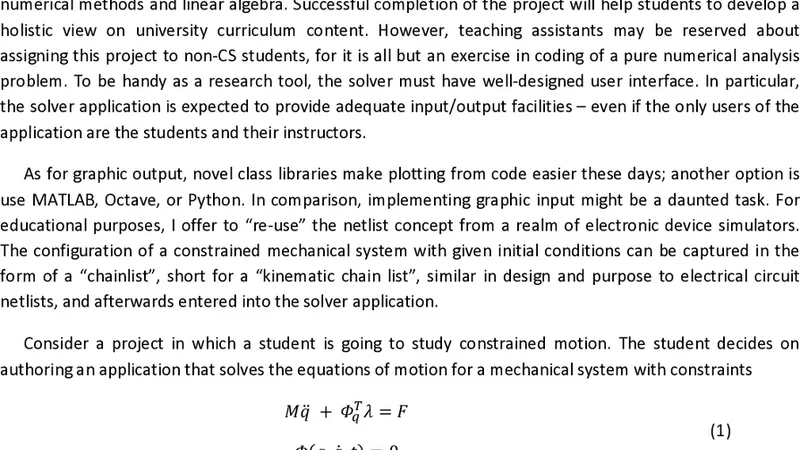
The mathematical core relies on the pseudoinverse to enforce constraints while integrating the equations of motion. Starting from the constrained dynamics equation (M\ddot{q}=F-J^{T}\lambda) together with the constraint condition (J\ddot{q}=b), the authors eliminate the Lagrange multipliers (\lambda) to obtain (\lambda=(J M^{-1} J^{T})^{+}(b-J M^{-1}F)), where ((\cdot)^{+}) denotes the Moore‑Penrose pseudoinverse. The pseudoinverse is computed via singular‑value decomposition (SVD); small singular values below a tolerance are truncated to avoid numerical instability.
Implementation details are supplied in both C++ and Python. Four main classes are defined: System (manages the overall simulation and loads the chainlist), Body (stores mass, position, velocity), Constraint (encapsulates constraint type, computes its Jacobian row and right‑hand side), and Solver (performs time integration and constraint projection). The solver follows a predictor‑corrector scheme: (1) compute provisional accelerations from external forces, (2) advance positions and velocities with an explicit integrator (Verlet or Runge‑Kutta), (3) evaluate the Jacobian and its pseudoinverse, (4) solve for (\lambda) and correct the state to satisfy constraints. The design is modular, allowing students to add new constraint types (e.g., sliders, springs, dampers) or swap the integrator with minimal code changes.
Two illustrative examples demonstrate the workflow. The first is a simple two‑body hinge system, showing how the chainlist translates directly into a working simulation and how the projection step eliminates drift. The second example builds a five‑body spring‑damper network with an added sliding constraint, highlighting the increase in computational cost for the SVD but still achieving interactive frame rates on a standard laptop.
The discussion acknowledges current limitations. Non‑linear constraints (such as spherical joints) and collision handling are not covered and would require additional algorithms. For large systems the SVD‑based pseudoinverse becomes a performance bottleneck; the authors suggest possible remedies including matrix partitioning, Krylov subspace methods, and GPU acceleration. Educationally, a small survey indicated that students who authored their own chainlists and debugged the solver reported deeper comprehension of Lagrangian mechanics and linear algebra concepts.
In conclusion, the chainlist‑driven, pseudoinverse‑based solver provides a concrete, extensible tool for teaching constrained dynamics. By mirroring the productivity practices of electricians, it lowers the barrier to entry for students, encourages hands‑on experimentation, and opens avenues for future work such as integrating collision detection, handling highly non‑linear constraints, and scaling to high‑performance computing environments.
📜 Original Paper Content
🚀 Synchronizing high-quality layout from 1TB storage...