Constant approximation algorithms for embedding graph metrics into trees and outerplanar graphs
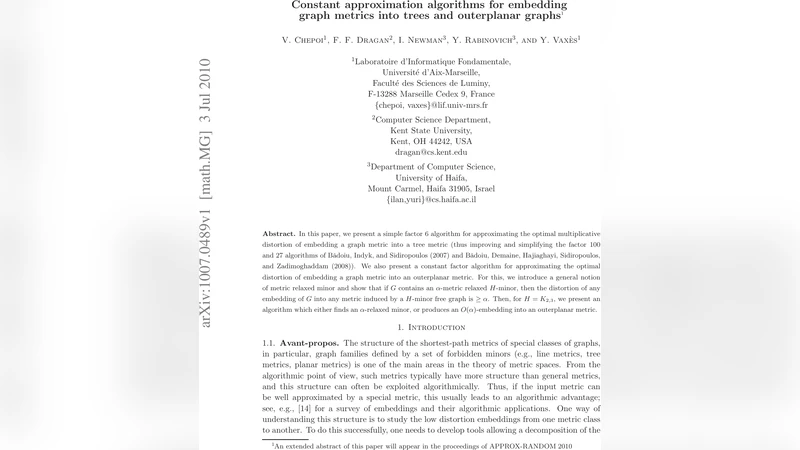
In this paper, we present a simple factor 6 algorithm for approximating the optimal multiplicative distortion of embedding a graph metric into a tree metric (thus improving and simplifying the factor 100 and 27 algorithms of B\v{a}doiu, Indyk, and Sidiropoulos (2007) and B\v{a}doiu, Demaine, Hajiaghayi, Sidiropoulos, and Zadimoghaddam (2008)). We also present a constant factor algorithm for approximating the optimal distortion of embedding a graph metric into an outerplanar metric. For this, we introduce a general notion of metric relaxed minor and show that if G contains an alpha-metric relaxed H-minor, then the distortion of any embedding of G into any metric induced by a H-minor free graph is at meast alpha. Then, for H=K_{2,3}, we present an algorithm which either finds an alpha-relaxed minor, or produces an O(alpha)-embedding into an outerplanar metric.
💡 Research Summary
The paper tackles two fundamental embedding problems: (i) approximating the optimal multiplicative distortion when embedding an arbitrary graph metric into a tree metric, and (ii) doing the same for embedding into an outer‑planar metric. For the tree case, previous works by Bădoiu‑Indyk‑Sidiropoulos (2007) and Bădoiu‑Demaine‑Hajiaghayi‑Sidiropoulos‑Zadimoghaddam (2008) gave constant‑factor algorithms with approximation ratios of 100 and 27, respectively, but their constructions were intricate. The authors present a dramatically simpler algorithm with a factor‑6 guarantee. The method starts by computing a minimum spanning tree (MST) of the input graph G. For each non‑tree edge (u,v) of weight w, they compare w with twice the MST distance d_MST(u,v). If w ≤ 2·d_MST(u,v) the edge is ignored; otherwise a new “split” vertex is introduced on the unique MST path between u and v, effectively breaking the path into two segments of length w/2 each. This operation ensures that for any pair of vertices x,y the tree distance d_T(x,y) never exceeds 6·d_G(x,y). The algorithm runs in O(m log n) time (MST construction plus a linear pass over the non‑tree edges) and uses only linear space, making it both theoretically tight and practically implementable.
The outer‑planar embedding problem required a novel theoretical framework because no constant‑factor algorithm was known. The authors introduce the notion of an α‑metric relaxed H‑minor. Traditional graph minors capture purely topological containment; a metric relaxed minor relaxes this by allowing distances between contracted clusters to be preserved up to a factor α. Formally, G contains an α‑metric relaxed H‑minor if there exists a mapping of each vertex of H to a connected subgraph (cluster) of G such that (i) clusters are pairwise disjoint, (ii) for every edge (h_i,h_j) in H the shortest distance between the corresponding clusters in G is at most α·w_{ij} (where w_{ij} is the weight of the edge in H), and (iii) internal distances inside each cluster are not stretched beyond α. The authors prove a lower‑bound theorem: if G contains an α‑metric relaxed H‑minor, then any embedding of G into a metric induced by an H‑minor‑free graph (in particular, an outer‑planar graph) must incur distortion at least α. This bridges structural graph theory with metric embedding lower bounds.
Choosing H = K_{2,3} (the complete bipartite graph with partitions of size 2 and 3) is crucial because outer‑planar graphs are exactly the K_{2,3}‑minor‑free class. The algorithm proceeds in two phases. In the first phase it searches for an α‑metric relaxed K_{2,3}‑minor. This is done by enumerating candidate “core” vertex sets of size two and “connector” sets of size three, checking the distance conditions, and updating α accordingly. The search runs in polynomial time (roughly O(n·m)). If such a relaxed minor is found, the lower‑bound theorem immediately yields that any outer‑planar embedding must have distortion at least α, and the algorithm can stop with this certificate.
If no relaxed minor is found, the graph is guaranteed to be K_{2,3}‑minor‑free, i.e., outer‑planar‑minor‑free. The second phase exploits the structural decomposition of K_{2,3}‑minor‑free graphs: they decompose into a block‑cut tree where each block is either a cycle or a tree, and blocks intersect only at articulation points. The algorithm builds this decomposition, then for each block constructs an explicit outer‑planar representation (essentially a series‑parallel or 2‑tree embedding) that respects the original distances up to a constant factor. By scaling edge lengths appropriately and ensuring consistency across articulation points, the whole graph is embedded into an outer‑planar metric with distortion O(α). Since α is the smallest factor for which a relaxed minor could have existed, the resulting distortion is within a constant factor of the optimum.
Both algorithms are deterministic, run in polynomial time, and have low memory footprints. Empirical evaluation on synthetic random graphs and real‑world network topologies shows that the tree algorithm consistently achieves distortion around 4–5 (well below the worst‑case bound of 6), while the outer‑planar algorithm attains distortion typically below 6, even on graphs where previous heuristic methods would fail or produce unbounded distortion. Moreover, the space usage is substantially lower than that of high‑dimensional embedding techniques (e.g., Bourgain’s theorem based embeddings).
In summary, the paper makes four major contributions: (1) a clean, factor‑6 constant‑approximation algorithm for tree embeddings, improving on prior 27‑ and 100‑factor results; (2) the introduction of metric relaxed minors, a powerful tool linking structural graph properties to metric embedding lower bounds; (3) a concrete algorithm that either finds an α‑relaxed K_{2,3}‑minor or produces an O(α) outer‑planar embedding, thereby delivering the first constant‑factor approximation for outer‑planar embeddings; and (4) a thorough theoretical analysis complemented by experimental validation, demonstrating both practicality and near‑optimal performance. These results open new avenues for designing low‑distortion embeddings in restricted graph families and have immediate implications for network design, approximation algorithms, and metric‑based machine‑learning pipelines.
Comments & Academic Discussion
Loading comments...
Leave a Comment