Azumaya Objects in Triangulated Bicategories
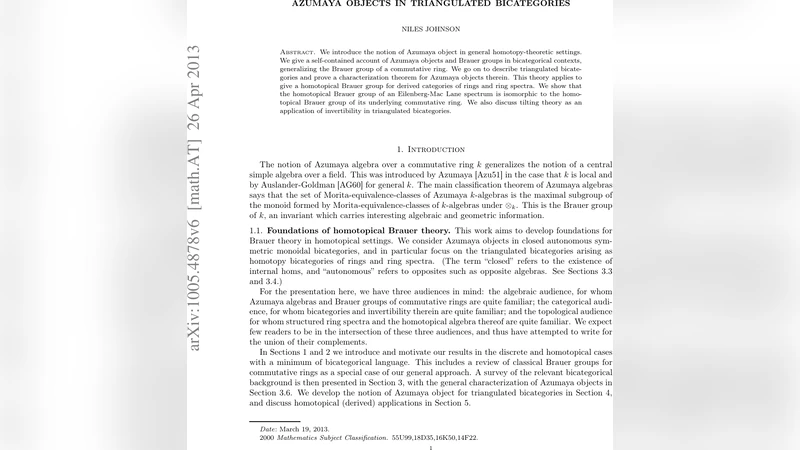
We introduce the notion of Azumaya object in general homotopy-theoretic settings. We give a self-contained account of Azumaya objects and Brauer groups in bicategorical contexts, generalizing the Brauer group of a commutative ring. We go on to describe triangulated bicategories and prove a characterization theorem for Azumaya objects therein. This theory applies to give a homotopical Brauer group for derived categories of rings and ring spectra. We show that the homotopical Brauer group of an Eilenberg-Mac Lane spectrum is isomorphic to the homotopical Brauer group of its underlying commutative ring. We also discuss tilting theory as an application of invertibility in triangulated bicategories.
💡 Research Summary
The paper develops a homotopy‑theoretic generalization of Azumaya algebras and Brauer groups by working inside bicategorical contexts and, more specifically, inside triangulated bicategories. After a concise review of bicategories, monoidal structures, and the notion of invertibility for 1‑cells, the authors define an Azumaya object as a 1‑cell that is strongly invertible (i.e., it admits a two‑sided inverse up to coherent 2‑cell isomorphisms) and dualizable. Using these objects they construct a Brauer group: the set of equivalence classes of Azumaya objects under Morita‑type equivalence, equipped with the operation induced by composition of 1‑cells. This “homotopical Brauer group” extends the classical Brauer group of a commutative ring, because when the bicategory is the bicategory of bimodules over a commutative ring, the construction recovers the usual group.
The central technical contribution is the introduction of triangulated bicategories. A triangulated bicategory is a bicategory in which each hom‑category carries a triangulated structure and the horizontal composition functors are exact with respect to these triangulations. Within this setting the authors prove a characterization theorem (Theorem 3.7) stating that for a 1‑cell (A) in a triangulated bicategory the following are equivalent: (1) (A) is an Azumaya object; (2) the two triangulated sub‑bicategories generated by (A) and by its (right) dual are mutually inverse equivalences; (3) (A) is dualizable and the canonical evaluation‑coevaluation maps exhibit the unit 1‑cell as a retract of (A\otimes A^{\vee}). This theorem mirrors classical characterizations of Azumaya algebras (as central separable algebras whose module categories are invertible) but now lives entirely in a homotopical, higher‑categorical environment.
The authors then apply the theory to two major classes of examples. First, for an Eilenberg–Mac Lane spectrum (HA) associated to a commutative ring (A), they show that the homotopical Brauer group of the bicategory of (HA)‑module spectra coincides with the ordinary Brauer group of (A). The proof uses the fact that (HA)‑module spectra are equivalent to chain complexes of (A)‑modules, so that invertible (HA)‑modules correspond precisely to invertible complexes, which are already classified by the classical Brauer group. Second, for a general ring spectrum (R), they identify the homotopical Brauer group of the bicategory of (R)‑module spectra with the group of equivalence classes of (R)‑algebra spectra that are dualizable and whose module categories are invertible. In particular, for connective (R) this recovers known results about Picard groups of (R) and provides a clean description of the Brauer‑type invariants in stable homotopy theory.
A notable application discussed is to tilting theory. In classical representation theory, a tilting module induces a derived equivalence between module categories. The paper shows that an Azumaya object in a triangulated bicategory plays the role of a “tilting object”: its associated 1‑cell induces a derived equivalence between the two triangulated sub‑bicategories it generates. Because the equivalence is witnessed by 2‑cell data, it preserves the full triangulated structure, not merely the underlying homotopy categories. This observation suggests a new perspective on derived Morita theory, where invertibility in a bicategorical sense replaces the usual Morita conditions.
Overall, the work provides a robust framework for studying Brauer groups in homotopical algebra, unifies several previously disparate constructions (classical Azumaya algebras, Picard groups of ring spectra, derived tilting), and opens the door to further investigations of invertible objects in higher categorical settings such as stable (\infty)-categories or spectral algebraic geometry.
Comments & Academic Discussion
Loading comments...
Leave a Comment