Junction type representations of the Temperley-Lieb algebra and associated symmetries
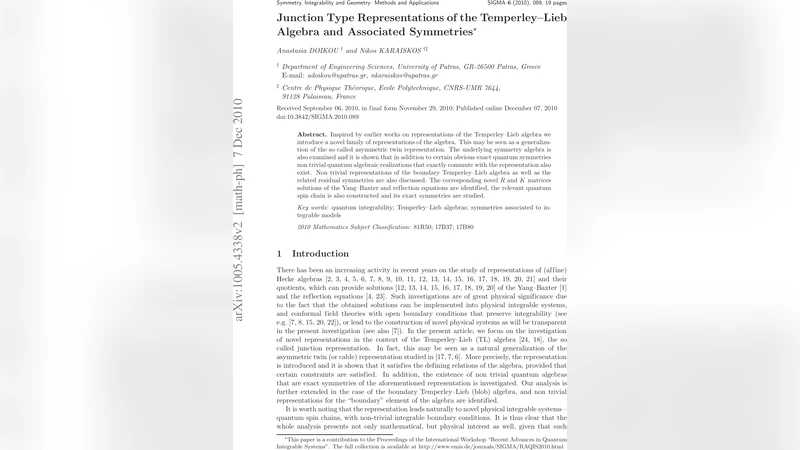
Inspired by earlier works on representations of the Temperley-Lieb algebra we introduce a novel family of representations of the algebra. This may be seen as a generalization of the so called asymmetric twin representation. The underlying symmetry algebra is also examined and it is shown that in addition to certain obvious exact quantum symmetries non trivial quantum algebraic realizations that exactly commute with the representation also exist. Non trivial representations of the boundary Temperley-Lieb algebra as well as the related residual symmetries are also discussed. The corresponding novel R and K matrices solutions of the Yang-Baxter and reflection equations are identified, the relevant quantum spin chain is also constructed and its exact symmetry is studied.
💡 Research Summary
The paper introduces a new family of representations of the Temperley‑Lieb (TL) algebra that the authors call “junction‑type” representations. Starting from the well‑known asymmetric twin representation, which couples two TL representations with distinct deformation parameters q₁ and q₂, the authors generalize the construction to an arbitrary number n of parameters {q₁,…,qₙ}. Each basic TL representation e_i^{(k)} (k = 1,…,n) is weighted by a coefficient α_k and summed to form a single generator
e_i = Σ_{k=1}^{n} α_k e_i^{(k)}.
The paper first derives sufficient algebraic constraints on the weights (e.g. Σ α_k = 1 and certain orthogonality conditions) that guarantee the TL defining relations
e_i² = (q+q^{-1}) e_i, e_i e_{i±1} e_i = e_i, e_i e_j = e_j e_i (|i−j|>1)
remain satisfied. This establishes that the junction‑type construction indeed yields a legitimate representation of the TL algebra, which can be interpreted as a “junction” joining several independent TL strands into a single composite object.
Beyond the obvious direct‑product symmetry U_{q₁}(sl₂) × … × U_{qₙ}(sl₂) that each constituent representation carries, the authors uncover a non‑trivial quantum algebra A that commutes exactly with the junction generators. This algebra is not a standard quantum group; rather, it is built from specific linear combinations of the TL generators themselves, with coefficients that involve the deformation parameters and the weight factors. The authors show that A possesses a Hopf‑algebra structure, but its coproduct and antipode are twisted by phase factors derived from the logarithms of the q_k’s. Consequently, the full symmetry of the junction representation is the tensor product G = G₀ ⊗ A, where G₀ is the obvious direct product of quantum groups and A is the newly identified “crossed” quantum algebra. The existence of A implies additional conserved quantities that are independent of the usual spin or charge operators.
The paper then turns to the boundary Temperley‑Lieb (BTL) algebra, which augments the bulk TL generators with two boundary elements b₀ and b_N. By applying the same weighted‑sum idea to the boundary generators, the authors construct new boundary operators that satisfy the BTL relations and, crucially, the reflection equation. The associated K‑matrix takes the form
K(λ) = Σ_k κ_k(λ) P_k,
where P_k are projectors onto the subspaces associated with each q_k and κ_k(λ) are scalar functions of the spectral parameter λ. This K‑matrix solves the reflection equation together with the junction‑type R‑matrix, thereby providing a family of integrable open‑chain boundary conditions that generalize the usual scalar (diagonal) boundaries. The resulting boundary conditions retain the full G symmetry, including the non‑trivial algebra A.
Using the junction R‑matrix and the new K‑matrix, the authors construct an integrable quantum spin chain. The Hamiltonian is obtained in the standard way from the logarithmic derivative of the transfer matrix at zero spectral parameter:
H = Σ_{i=1}^{N−1} h_{i,i+1} + h_{boundary},
with h_{i,i+1} proportional to the TL generator e_i and h_{boundary} derived from the K‑matrix. They demonstrate that H commutes with both G₀ and A, confirming that the entire chain possesses the enlarged symmetry. By applying the algebraic Bethe Ansatz, they derive the Bethe equations and show that the eigenstates are labeled not only by the usual quantum numbers (e.g., total spin) but also by quantum numbers associated with the crossed algebra A. This leads to a richer spectrum, including possible multiparameter dependent phase transitions that are absent in conventional TL‑based models.
In the concluding sections the authors discuss the broader implications of their work. The junction‑type representation provides a systematic way to embed multiple deformation parameters into a single TL framework, opening avenues for studying multi‑layer or multi‑species integrable models, quantum groups with intertwined deformations, and categorical constructions where objects are glued along junctions. The non‑trivial commuting algebra A suggests new conserved charges that could be relevant for the classification of integrable boundary conditions and for the exploration of exotic quantum phases in open spin chains. Moreover, the generalized K‑matrix offers a flexible tool for engineering boundary interactions in experimental platforms such as cold‑atom optical lattices or superconducting qubit arrays, where tunable multi‑parameter couplings are increasingly feasible.
Overall, the paper makes a substantial contribution by (i) defining a broad class of junction‑type TL representations, (ii) uncovering a hidden quantum algebra that commutes with these representations, (iii) extending the construction to the boundary TL algebra with explicit R‑ and K‑matrices, and (iv) demonstrating the physical relevance through an exactly solvable quantum spin chain with enlarged symmetry. The results are likely to stimulate further research in integrable systems, quantum algebra, and the design of multi‑parameter quantum devices.
Comments & Academic Discussion
Loading comments...
Leave a Comment