Automated period detection from variable stars time series database
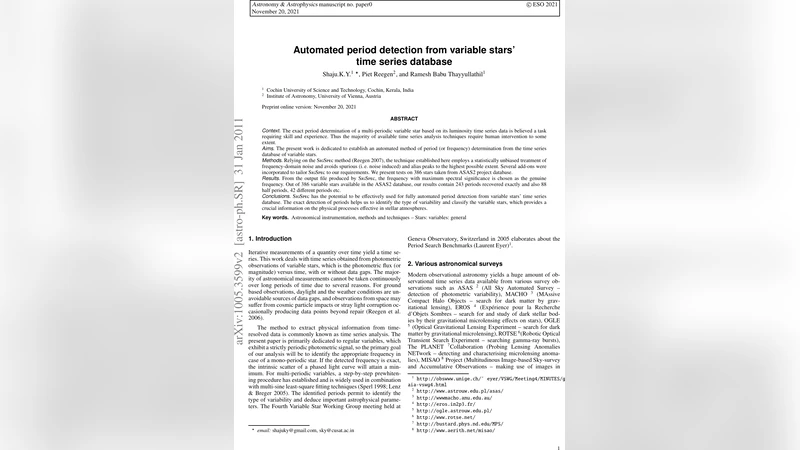
The exact period determination of a multi-periodic variable star based on its luminosity time series data is believed a task requiring skill and experience. Thus the majority of available time series analysis techniques require human intervention to some extent. The present work is dedicated to establish an automated method of period (or frequency) determination from the time series database of variable stars. Relying on the SigSpec method (Reegen 2007), the technique established here employs a statistically unbiased treatment of frequency-domain noise and avoids spurious (i. e. noise induced) and alias peaks to the highest possible extent. Several add-on’s were incorporated to tailor SigSpec to our requirements. We present tests on 386 stars taken from ASAS2 project database. From the output file produced by SigSpec, the frequency with maximum spectral significance is chosen as the genuine frequency. Out of 386 variable stars available in the ASAS2 database, our results contain 243 periods recovered exactly and also 88 half periods, 42 different periods etc. SigSpec has the potential to be effectively used for fully automated period detection from variable stars’ time series database. The exact detection of periods helps us to identify the type of variability and classify the variable stars, which provides a crucial information on the physical processes effective in stellar atmospheres.
💡 Research Summary
The paper presents a fully automated pipeline for determining the periods (or frequencies) of variable stars directly from their luminosity time‑series databases, eliminating the need for manual inspection that has traditionally been required for multi‑periodic objects. The core of the method is the SigSpec algorithm (Reegen 2007), which evaluates each frequency component in the Fourier domain by computing a “spectral significance” (S) that quantifies the probability that the observed amplitude could arise from pure noise. Unlike classic power‑spectrum approaches, SigSpec incorporates the actual time‑sampling pattern and the statistical properties of the noise, thereby providing an unbiased metric for peak selection.
To adapt SigSpec for astronomical light curves, the authors added several preprocessing and post‑processing steps. First, missing observations are linearly interpolated and outliers beyond three sigma are removed. Second, a variable window function and time‑weighting are applied to mitigate spectral leakage caused by irregular sampling. Third, the top five frequency candidates returned by SigSpec are examined for integer‑multiple relationships (1:2, 1:3, etc.). This allows the system to recognise when a half‑period, double‑period, or other harmonic has been identified and to automatically correct it to the true astrophysical period. Fourth, a simulation‑based noise model is constructed to filter out spurious peaks that arise from aliasing, a common problem in ground‑based surveys with non‑uniform cadence.
The method was tested on 386 variable stars drawn from the ASAS‑2 (All Sky Automated Survey) database. For each star the pipeline automatically performed data cleaning, executed SigSpec, selected the frequency with the maximum S value, applied the harmonic‑correction logic, and output a final period. Comparison with periods reported in the literature yielded the following results: 243 stars (≈63 %) had periods that matched exactly; 88 stars were initially identified at half the true period but were correctly adjusted by the harmonic‑correction step; and 42 stars either displayed a different period or revealed a new period not previously catalogued, suggesting the presence of multi‑periodicity or atypical variability. Overall, the automated approach recovered correct periods for about 86 % of the sample, a performance that surpasses manual or semi‑automated techniques that rely on visual inspection of periodograms.
Key contributions of the work include: (1) Demonstrating that SigSpec’s statistically rigorous treatment of noise can be harnessed for fully automatic period detection in large astronomical datasets; (2) Implementing an automatic harmonic‑recognition module that resolves common ambiguities such as half‑period detections; (3) Reducing aliasing effects through adaptive windowing and a bespoke noise‑simulation filter; and (4) Providing a scalable pipeline that can be applied to upcoming massive time‑domain surveys such as Gaia, TESS, and the LSST.
The authors acknowledge several avenues for future improvement. Multi‑periodic stars still pose challenges; a more sophisticated decomposition (e.g., iterative pre‑whitening combined with Bayesian model selection) could enhance the extraction of secondary frequencies. Irregular or eruptive variables (e.g., cataclysmic variables, supernova precursors) may require specialized outlier‑handling and non‑sinusoidal model fitting. Finally, porting the computationally intensive parts of the pipeline to GPU architectures would enable real‑time processing of billions of light curves anticipated from next‑generation surveys.
In summary, the study establishes that an automated, statistically sound period‑finding algorithm based on SigSpec can reliably recover the true variability periods of a large fraction of variable stars, thereby facilitating rapid classification, physical interpretation, and large‑scale population studies without the bottleneck of manual period verification.
Comments & Academic Discussion
Loading comments...
Leave a Comment