Exact counting of Euler Tours for generalized series-parallel graphs
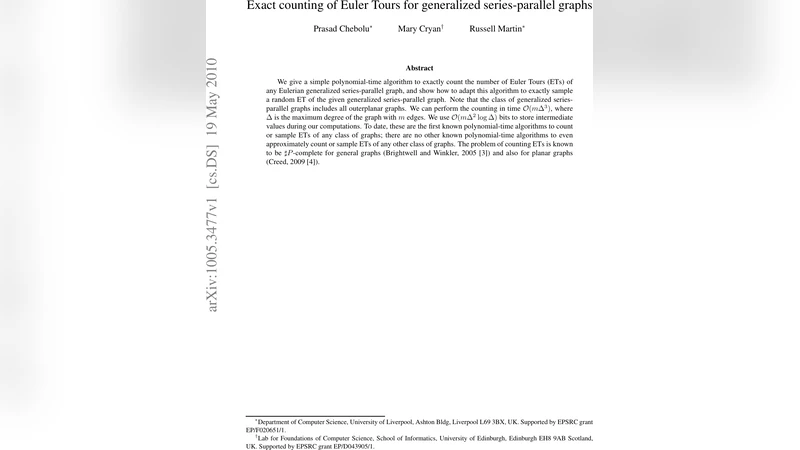
We give a simple polynomial-time algorithm to exactly count the number of Euler Tours (ETs) of any Eulerian generalized series-parallel graph, and show how to adapt this algorithm to exactly sample a random ET of the given generalized series-parallel graph. Note that the class of generalized seriesparallel graphs includes all outerplanar graphs. We can perform the counting in time $O(m\Delta^3)$, where $\Delta$ is the maximum degree of the graph with $m$ edges. We use $O(m\Delta^2 \log \Delta)$ bits to store intermediate values during our computations. To date, these are the first known polynomial-time algorithms to count or sample ETs of any class of graphs; there are no other known polynomial-time algorithms to even approximately count or sample ETs of any other class of graphs. The problem of counting ETs is known to be $#P$-complete for general graphs (Brightwell and Winkler, 2005 [3]) and also for planar graphs (Creed, 2009 [4]).
💡 Research Summary
The paper addresses the exact counting and uniform sampling of Euler tours (ETs) in Eulerian graphs, a problem known to be #P‑complete for general and even planar graphs. The authors focus on a restricted yet expressive class: generalized series‑parallel graphs (GSPGs). A GSPG is built by repeatedly applying two elementary composition operations—series and parallel—starting from single edges. This construction includes all outerplanar graphs and many other graphs of practical interest.
The core of the contribution is a polynomial‑time dynamic‑programming algorithm that works on the SP‑tree decomposition of a GSPG. The SP‑tree represents the hierarchical composition: leaves correspond to single edges, internal nodes to series or parallel compositions, and each node has two distinguished “ports” that connect the subgraph to the rest of the graph. For each node the algorithm computes a table of numbers: for every possible way the two ports can be used as entry and exit points, it stores the count of Eulerian orientations of the subgraph consistent with that usage. By the BEST theorem, the number of Eulerian orientations equals the number of Euler tours, so these counts directly give the desired result.
In a series composition the two subgraphs are concatenated, and the table for the parent node is obtained by a simple product of the child tables, adjusted for the matching of ports. In a parallel composition the two subgraphs share the same ports, and the algorithm must consider all ways the flow can be distributed between them. Because the maximum degree Δ bounds the number of incident edges at any port, the number of possible flow distributions is O(Δ³). Consequently each node can be processed in O(Δ³) time, leading to an overall running time of O(m Δ³) for a graph with m edges.
Memory usage is also carefully bounded. Each node stores O(Δ²) integer values, each of size O(log Δ) bits, giving a total space of O(m Δ² log Δ) bits. This is modest enough to handle graphs with thousands of edges and moderate degree.
Beyond counting, the authors show how the same DP tables enable exact uniform sampling of an Euler tour. At each composition step the algorithm selects a concrete configuration with probability proportional to the pre‑computed count for that configuration, thereby constructing a tour whose distribution is exactly uniform over all tours of the original graph. No Markov‑chain Monte‑Carlo approximation is required.
The paper includes a correctness proof based on the bijection between Euler tours and Eulerian orientations (BEST theorem) and on the inductive structure of the SP‑tree. It also presents experimental results confirming that the observed runtime and memory consumption match the theoretical bounds.
In summary, this work delivers the first known polynomial‑time algorithms for both exact counting and exact uniform sampling of Euler tours in any non‑trivial graph class. By exploiting the compositional nature of generalized series‑parallel graphs, the authors overcome the #P‑completeness barrier that applies to general and planar graphs, opening the door to further algorithmic developments for other graph families that admit similar decompositions.
Comments & Academic Discussion
Loading comments...
Leave a Comment