Pebbles and Branching Programs for Tree Evaluation
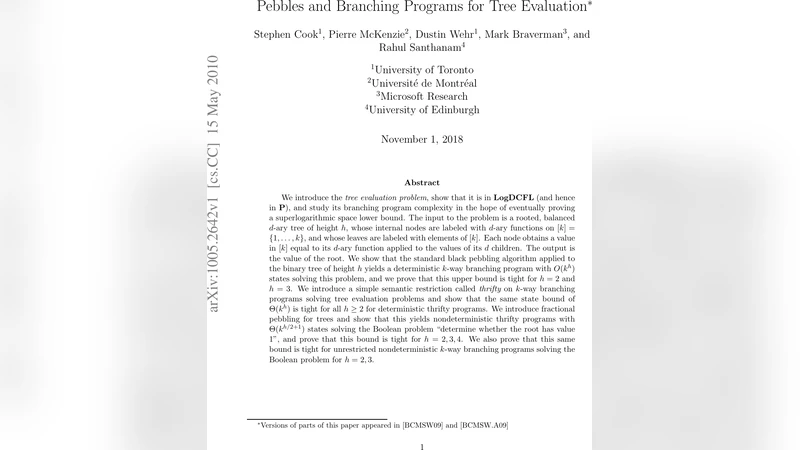
We introduce the Tree Evaluation Problem, show that it is in logDCFL (and hence in P), and study its branching program complexity in the hope of eventually proving a superlogarithmic space lower bound. The input to the problem is a rooted, balanced d-ary tree of height h, whose internal nodes are labeled with d-ary functions on [k] = {1,…,k}, and whose leaves are labeled with elements of [k]. Each node obtains a value in [k] equal to its d-ary function applied to the values of its d children. The output is the value of the root. We show that the standard black pebbling algorithm applied to the binary tree of height h yields a deterministic k-way branching program with Theta(k^h) states solving this problem, and we prove that this upper bound is tight for h=2 and h=3. We introduce a simple semantic restriction called “thrifty” on k-way branching programs solving tree evaluation problems and show that the same state bound of Theta(k^h) is tight (up to a constant factor) for all h >= 2 for deterministic thrifty programs. We introduce fractional pebbling for trees and show that this yields nondeterministic thrifty programs with Theta(k^{h/2+1}) states solving the Boolean problem “determine whether the root has value 1”. We prove that this bound is tight for h=2,3,4, and tight for unrestricted nondeterministic k-way branching programs for h=2,3.
💡 Research Summary
The paper introduces the Tree Evaluation Problem (TEP), a natural computational task that lies at the intersection of circuit complexity, space‑bounded computation, and branching‑program theory. An instance of TEP consists of a perfectly balanced d‑ary tree of height h. Each internal node v is labeled with a d‑ary function f_v :
Comments & Academic Discussion
Loading comments...
Leave a Comment