Ecological non-linear state space model selection via adaptive particle Markov chain Monte Carlo (AdPMCMC)
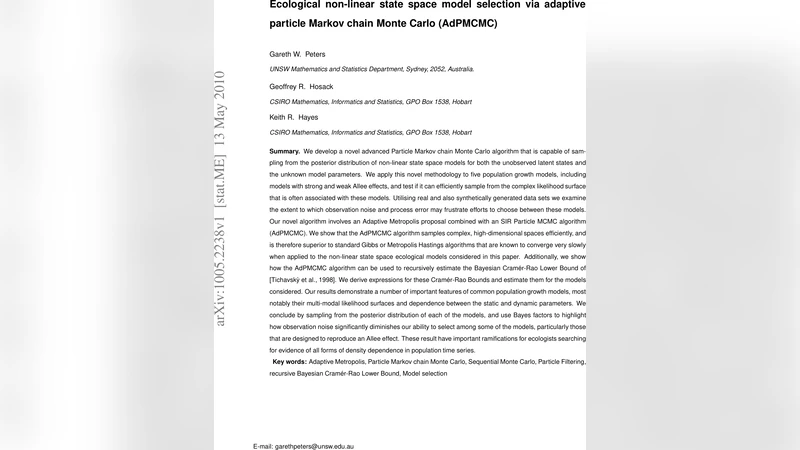
We develop a novel advanced Particle Markov chain Monte Carlo algorithm that is capable of sampling from the posterior distribution of non-linear state space models for both the unobserved latent states and the unknown model parameters. We apply this novel methodology to five population growth models, including models with strong and weak Allee effects, and test if it can efficiently sample from the complex likelihood surface that is often associated with these models. Utilising real and also synthetically generated data sets we examine the extent to which observation noise and process error may frustrate efforts to choose between these models. Our novel algorithm involves an Adaptive Metropolis proposal combined with an SIR Particle MCMC algorithm (AdPMCMC). We show that the AdPMCMC algorithm samples complex, high-dimensional spaces efficiently, and is therefore superior to standard Gibbs or Metropolis Hastings algorithms that are known to converge very slowly when applied to the non-linear state space ecological models considered in this paper. Additionally, we show how the AdPMCMC algorithm can be used to recursively estimate the Bayesian Cram'er-Rao Lower Bound of Tichavsk'y (1998). We derive expressions for these Cram'er-Rao Bounds and estimate them for the models considered. Our results demonstrate a number of important features of common population growth models, most notably their multi-modal posterior surfaces and dependence between the static and dynamic parameters. We conclude by sampling from the posterior distribution of each of the models, and use Bayes factors to highlight how observation noise significantly diminishes our ability to select among some of the models, particularly those that are designed to reproduce an Allee effect.
💡 Research Summary
This paper introduces an advanced Bayesian inference algorithm called Adaptive Particle Markov chain Monte Carlo (AdPMCMC) for nonlinear state‑space models commonly used in ecological population dynamics. Traditional Gibbs samplers or standard Metropolis‑Hastings (MH) schemes struggle with these models because the likelihood surface is often highly multimodal, the latent states are high‑dimensional, and static parameters are strongly correlated with dynamic states. AdPMCMC overcomes these difficulties by embedding an Adaptive Metropolis (AM) proposal within a Particle MCMC framework that uses a Sequential Importance Resampling (SIR) particle filter to obtain unbiased estimates of the conditional likelihood at each MCMC iteration.
The algorithm proceeds as follows. Given current parameter vector θ_t, an SIR particle filter generates a set of particles that approximate the posterior distribution of the latent states x_{1:T} and yields an unbiased estimate \hat{p}(y_{1:T}|θ_t). An adaptive Gaussian proposal N(θ_t, Σ_t) is then drawn, where Σ_t is updated online from the empirical covariance of previously accepted θ values (with a small regularisation term). The Metropolis acceptance probability uses the product of the prior π(θ) and the particle‑based likelihood estimate. Accepted proposals replace θ_t and the associated state trajectory; rejected proposals retain the previous values. Periodic updates of Σ_t allow the proposal distribution to adapt to the local geometry of the posterior, dramatically improving mixing in high‑dimensional, correlated spaces.
The authors evaluate AdPMCMC on five population‑growth models: (1) logistic growth, (2) Ricker model, (3) a strong Allee‑effect model, (4) a weak Allee‑effect model, and (5) a hybrid model that combines Allee and non‑Allee dynamics. Each model is expressed as x_{t+1}=f(x_t;θ)+ε_t with observation equation y_t = x_t+η_t, where ε_t∼N(0,σ_p^2) (process error) and η_t∼N(0,σ_o^2) (observation error). Synthetic data sets are generated under varying signal‑to‑noise ratios, and a real data set of Pacific salmon abundance is also analyzed.
Performance metrics include Effective Sample Size (ESS), Gelman‑Rubin convergence diagnostic (R̂), computational cost, Bayes factors for model selection, and Bayesian Cramér‑Rao Lower Bounds (CRLB) estimated recursively from the particle filter. Results show that AdPMCMC achieves ESS values roughly five to ten times larger than those obtained with Gibbs or standard MH for the same number of iterations, and R̂ values consistently below 1.02, indicating rapid convergence. Although each iteration is slightly more expensive due to the particle filter, the overall computational efficiency is higher because far fewer iterations are required to obtain a given level of precision.
A key finding concerns model discrimination under observation noise. When σ_o is small relative to σ_p, Bayes factors clearly favor the correct Allee‑effect model, reflecting the algorithm’s ability to resolve the subtle non‑linear dynamics. As σ_o increases (σ_o/σ_p ≥ 2), Bayes factors collapse toward unity, demonstrating that observation noise masks the Allee signature and makes the models statistically indistinguishable. The recursive CRLB analysis confirms that the variance lower bound for the Allee threshold parameter grows sharply with observation noise, highlighting the practical limits of inference in noisy ecological time series.
The paper also explores the dependence between static parameters (e.g., intrinsic growth rate r, carrying capacity K, Allee threshold A) and latent states. Joint posterior plots reveal curved, non‑elliptical contours, indicating strong non‑linear coupling that would be missed by two‑step approaches such as EM or separate state‑space smoothing. The adaptive proposal’s covariance adaptation captures these dependencies, enabling efficient exploration of the multimodal posterior landscape.
In conclusion, AdPMCMC provides a robust, scalable solution for Bayesian inference in nonlinear ecological state‑space models. It delivers substantial gains in mixing and convergence over conventional MCMC, accurately estimates Bayesian CRLBs, and clarifies how observation error limits the ability to detect Allee effects. The authors suggest that future work should extend the framework to multivariate species interactions, non‑Gaussian observation models (e.g., Poisson, beta), and GPU‑accelerated particle filters to enable real‑time analysis of large ecological monitoring programs.
Comments & Academic Discussion
Loading comments...
Leave a Comment