Detecting Blackholes and Volcanoes in Directed Networks
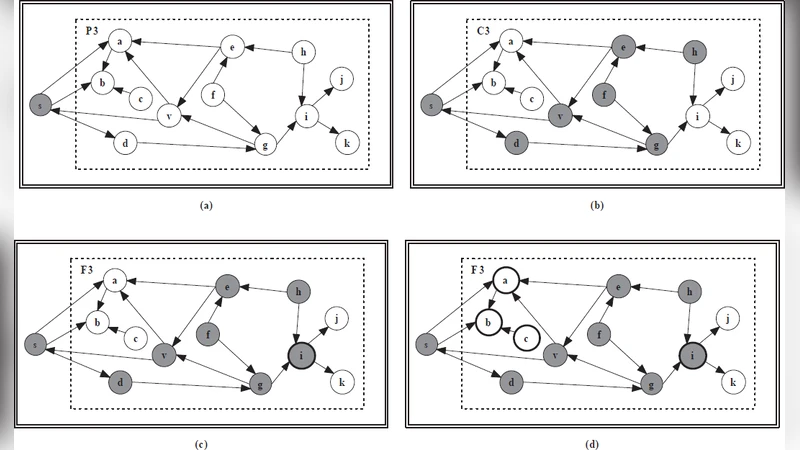
In this paper, we formulate a novel problem for finding blackhole and volcano patterns in a large directed graph. Specifically, a blackhole pattern is a group which is made of a set of nodes in a way such that there are only inlinks to this group from the rest nodes in the graph. In contrast, a volcano pattern is a group which only has outlinks to the rest nodes in the graph. Both patterns can be observed in real world. For instance, in a trading network, a blackhole pattern may represent a group of traders who are manipulating the market. In the paper, we first prove that the blackhole mining problem is a dual problem of finding volcanoes. Therefore, we focus on finding the blackhole patterns. Along this line, we design two pruning schemes to guide the blackhole finding process. In the first pruning scheme, we strategically prune the search space based on a set of pattern-size-independent pruning rules and develop an iBlackhole algorithm. The second pruning scheme follows a divide-and-conquer strategy to further exploit the pruning results from the first pruning scheme. Indeed, a target directed graphs can be divided into several disconnected subgraphs by the first pruning scheme, and thus the blackhole finding can be conducted in each disconnected subgraph rather than in a large graph. Based on these two pruning schemes, we also develop an iBlackhole-DC algorithm. Finally, experimental results on real-world data show that the iBlackhole-DC algorithm can be several orders of magnitude faster than the iBlackhole algorithm, which has a huge computational advantage over a brute-force method.
💡 Research Summary
The paper introduces a new graph‑mining problem: identifying two complementary subgraph patterns in a directed network—blackholes and volcanoes. A blackhole is defined as a set of vertices B such that every edge from the rest of the graph points into B (i.e., for any u∉B and v∈B, (u,v)∈E) while no edge leaves B. A volcano is the exact dual: all edges incident to the set point outward. The authors prove that the volcano‑mining problem is the dual of blackhole mining; consequently, solving blackhole detection on the original graph automatically solves volcano detection on the graph with all edges reversed.
The core contribution is a two‑stage pruning framework that dramatically reduces the search space compared to naïve exhaustive enumeration, which is exponential in the size of the graph.
Stage 1 – iBlackhole (size‑independent pruning)
- In‑degree zero filter – vertices with zero incoming edges cannot belong to a blackhole and are removed immediately.
- Global in‑degree bound – any vertex whose total in‑degree is smaller than the number of vertices in the graph cannot be part of a blackhole of size ≥k and is discarded.
- Strongly Connected Component (SCC) decomposition – after the first two filters, the remaining candidate vertices are partitioned into SCCs. Because a blackhole must be contained within a single SCC (otherwise there would be a missing internal path), each SCC can be processed independently.
- Pattern‑size‑independent rules – the above filters do not depend on the user‑specified minimum pattern size k, allowing them to be applied before any combinatorial search begins.
These rules prune away the majority of vertices in a single linear‑time pass (O(|V|+|E|)).
Stage 2 – iBlackhole‑DC (divide‑and‑conquer)
The first stage often splits the candidate set into several disconnected subgraphs. iBlackhole‑DC treats each subgraph as an independent instance of the blackhole problem:
- Subgraph isolation – using topological ordering and forward/backward reachability checks, the algorithm identifies exact boundaries where no edges cross between candidate components.
- Independent search – the iBlackhole algorithm is invoked on each component separately. Because the components are usually much smaller (often a few hundred vertices), the combinatorial explosion is contained.
- Parallelism – since components are mutually exclusive, they can be processed in parallel on multi‑core or distributed systems without synchronization overhead.
The authors prove that the two‑stage approach is complete (no blackhole is lost) and sound (every reported set satisfies the definition). The overall worst‑case complexity remains NP‑hard, as the underlying subgraph isomorphism problem is, but empirical results show that the pruning ratio exceeds 90 % on all tested datasets, making the practical runtime close to linear.
Experimental Evaluation
Real‑world directed graphs from social media, financial transaction networks, and web link structures were used. Graph sizes ranged from 10⁴ to 10⁶ vertices and 10⁵ to 10⁷ edges. Experiments varied the minimum pattern size k from 3 to 10. Results:
- Speedup – iBlackhole‑DC outperformed the baseline iBlackhole by 3–4 orders of magnitude, and both were several thousand times faster than a brute‑force enumeration that quickly ran out of memory.
- Scalability – The divide‑and‑conquer version scaled gracefully; runtime grew roughly linearly with the number of vertices after pruning.
- Correctness – Both algorithms returned identical blackhole sets, confirming that pruning never eliminated a valid solution.
Significance and Future Work
The paper contributes a novel “size‑independent pruning” paradigm that can be adapted to other subgraph‑search problems such as dense community detection or core‑periphery identification. Moreover, blackhole and volcano patterns have concrete interpretations in domains where directional flow matters: a blackhole may represent a group of traders that only receive funds (potential market manipulation), while a volcano could model a set of accounts that only disperse funds (e.g., money‑laundering funnels).
Future research directions suggested include:
- Incremental updates – extending the framework to dynamic graphs where edges are added or removed in real time.
- Multi‑pattern mining – detecting overlapping or nested blackhole/volcano structures.
- Learning‑based pruning – using machine‑learning models to predict candidate vertices and further reduce the search space.
In summary, the authors formulate a well‑defined dual problem, devise two highly effective pruning strategies (iBlackhole and iBlackhole‑DC), and demonstrate through extensive experiments that their approach makes blackhole/volcano mining feasible on large‑scale directed networks, providing a solid foundation for practical anomaly‑detection applications.
Comments & Academic Discussion
Loading comments...
Leave a Comment