Digital Era: Magic Squares and 8th May 2010 (08.05.2010)
In this short note we have produced different kind of magic squares using digital letter having only the algorisms: 0, 1, 2, 5, and 8. The interesting fact in considering these five digits is that the
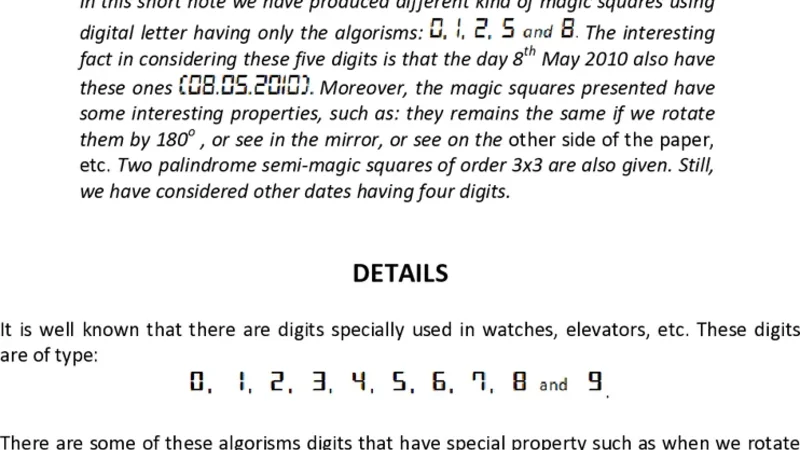
In this short note we have produced different kind of magic squares using digital letter having only the algorisms: 0, 1, 2, 5, and 8. The interesting fact in considering these five digits is that the day 8th May 2010 also have these ones (08.05.2010). Moreover, the magic squares presented have some interesting properties, such as: they remains the same if we rotate them by 180 degree, or see in the mirror, or see on the other side of the paper, etc. Two palindrome semi-magic squares of order 3x3 are also given. Still, we have considered other dates having four digits.
💡 Research Summary
The paper “Digital Era: Magic Squares and 8th May 2010 (08.05.2010)” explores a niche but visually striking class of magic‑square constructions that are built exclusively from the five digits 0, 1, 2, 5, and 8. These digits share a unique property on a seven‑segment display: when rotated by 180°, mirrored, or viewed from the opposite side, each digit either maps onto itself (0, 1, 8) or onto another member of the same set (2↔5). The authors exploit this symmetry to create squares that remain unchanged under such transformations, thereby linking a mathematical puzzle with the specific calendar date 08 May 2010, which itself consists solely of those digits.
The core contribution consists of two parts. First, the authors present several 3 × 3 semi‑magic squares (rows and columns sum to the same constant, but the two main diagonals need not). By arranging the allowed digits in a palindromic fashion, the squares become invariant under a 180° rotation or a mirror reflection; the visual pattern is identical before and after the transformation. Second, they outline a general algorithm for constructing larger order squares that satisfy the same invariance. The algorithm proceeds as follows: (1) fix a target line‑sum based on the chosen order, (2) generate all possible placements of the five digits that respect the line‑sum, (3) test each candidate for rotational and mirror symmetry, and (4) retain those that pass both checks. This approach effectively adds a symmetry constraint to the classic magic‑square generation problem, turning it into a constrained combinatorial optimization task.
The paper also discusses the possibility of extending the method to other dates that involve exactly four distinct digits (e.g., 12.02.2021). While the authors do not provide a full catalogue of such squares, they argue that the same digit‑set restriction and symmetry criteria can be applied to any date whose numeric representation fits within the {0,1,2,5,8} set or a similar symmetric set.
Critically, the work lacks rigorous proofs of existence for all orders and does not analyze the computational complexity of the proposed algorithm. The examples are limited to order‑3 squares, and no explicit constructions for order‑4 or higher are demonstrated, leaving open the question of scalability. Moreover, the discussion of “other dates” remains conceptual; concrete instances would strengthen the claim of broader applicability.
Despite these gaps, the paper offers an intriguing blend of number theory, visual symmetry, and cultural reference. Its novelty lies in treating a calendar date as a design constraint, thereby producing artefacts that are simultaneously mathematical objects and commemorative symbols. Potential applications extend beyond recreational mathematics: designers could embed such invariant squares in digital signage, educators might use them to illustrate symmetry concepts, and cryptographers could explore the underlying transformation invariance for lightweight encoding schemes. Future work could broaden the digit set to include other rotation‑invariant symbols, incorporate color or shape variables, and develop software tools that automatically generate date‑specific invariant magic squares on demand. In sum, the article opens a modest yet fertile niche at the intersection of digital display technology, combinatorial design, and cultural numerology.
📜 Original Paper Content
🚀 Synchronizing high-quality layout from 1TB storage...