Extracting abundance indices from longline surveys : method to account for hook competition and unbaited hooks
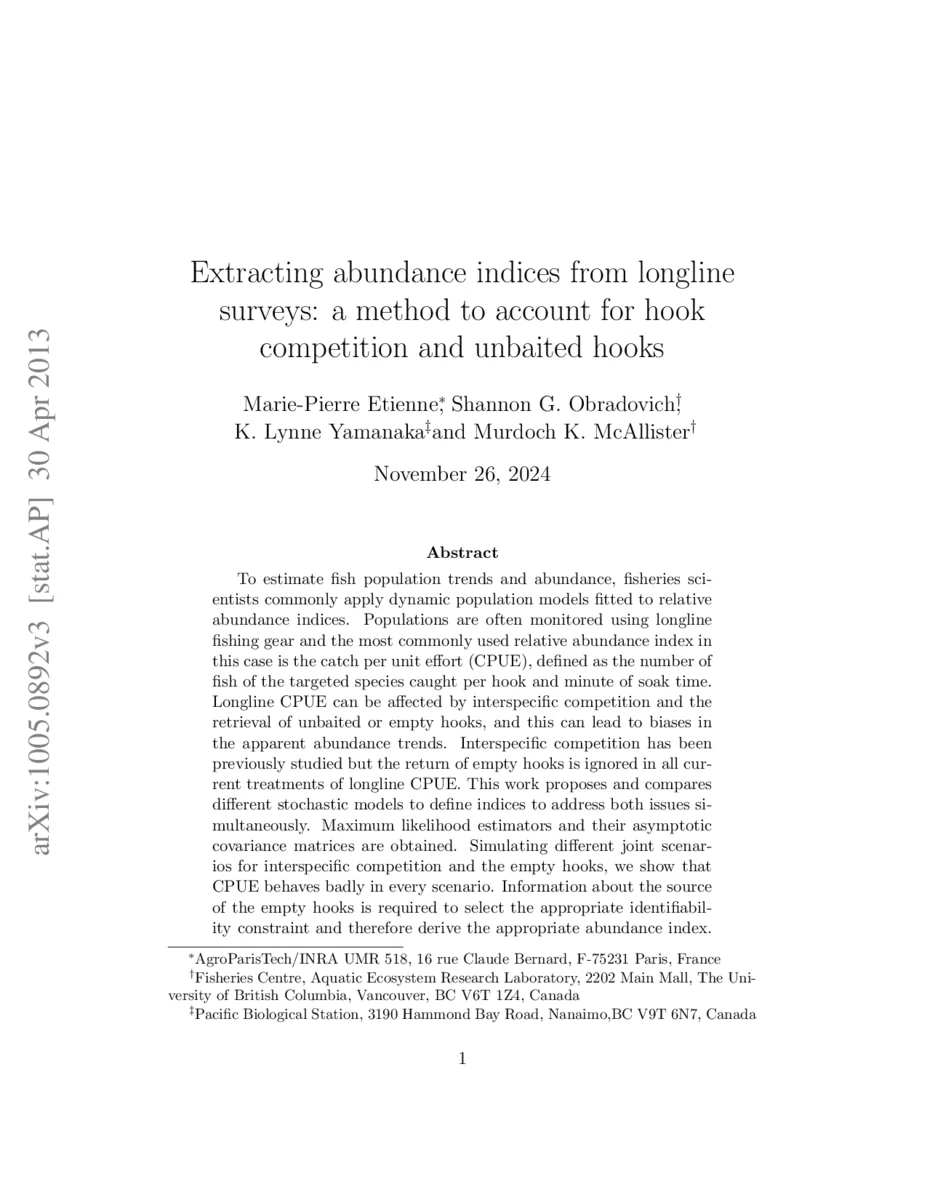
The most commonly used relative abundance index in stock assessments of longline fisheries is catch per unit effort (CPUE), here defined as the number of fish of the targeted species caught per hook and minute of soak time. Longline CPUE can be affected by interspecific competition and the retrieval of unbaited or empty hooks, and interannual variation in these can lead to biases in the apparent abundance trends in the CPUE. Interspecific competition on longlines has been previously studied but the return of empty hooks is ignored in all current treatments of longline CPUE. In this work we propose some different methods to build indices to address the interspecific competition that relates to empty hooks. We show that in the absence of information about empty hooks, the relative abundance estimates have constant biases with respect to fish density and this is typically not problematic for stock assessment. The simple CPUE index behaves poorly in every scenario. Understanding the reasons for empty hooks allows selection of the appropriate index. A scientific longline survey is conducted every two years in the Strait of Georgia, British Columbia by Fisheries and Oceans Canada. The above methods are applied to build the time-series of indices from 2003 to 2009 for quillback rockfish (Sebastes maliger). Due to variation in the incidence of non-target species, the index trend obtained is moderately sensitive to the choice of the estimator.
💡 Research Summary
The paper addresses a fundamental bias in longline fisheries stock assessments: the commonly used catch‑per‑unit‑effort (CPUE) index ignores competition for baited hooks among species and the occurrence of empty hooks (hooks that return without bait or fish). Building on earlier work by Somerton & Kikkawa (1995) and Rothschild (1967), the authors develop a generalized framework that treats the capture process as a set of exponential waiting times for target (λ_T) and non‑target (λ_NT) species. The basic Multinomial Exponential Model (MEM) describes each hook as having three possible outcomes—still baited, caught target fish, or caught non‑target fish—leading to a multinomial likelihood for the observed counts (baited hooks N_B, target catches N_T, non‑target catches N_NT).
To incorporate empty hooks (N_E), the authors extend MEM by introducing escape probabilities p_T for target species and p_NT for non‑target species. This extension creates an identifiability problem because only the products λ_T(1‑p_T) and λ_NT(1‑p_NT) can be estimated from the data. To resolve this, two constrained versions are proposed:
- MEM1 assumes empty hooks arise solely from non‑target species (p_T = 0, α = 0).
- MEM2 assumes equal escape probabilities for both groups (p_T = p_NT, α = 1).
Under these constraints, maximum‑likelihood estimators (MLEs) can be derived analytically when all sets share the same soak time; otherwise, numerical optimization (e.g., R’s optim) is required. The authors also adapt the Simple Exponential Model (SEM) to handle empty hooks, creating SEM1 (empty hooks pooled with non‑target catches) and SEM2 (empty hooks treated as a third “species” with its own λ_E).
A comprehensive simulation study evaluates bias and coefficient of variation for λ_T and λ_NT across 16 combinations of realistic parameter values (λ_T = 10⁻⁵ to 5·10⁻⁴; λ_NT = 5·10⁻⁴ to 10⁻²) and 5,000 replicates per scenario. Results show that traditional CPUE can be severely biased, especially when competition is strong and empty‑hook rates are high. MEM1 and MEM2 consistently produce lower bias and more stable estimates; when λ_T is small and competition weak, all methods converge to similar values, confirming theoretical expectations.
The methodology is applied to a real dataset: a biennial scientific longline survey conducted from 2003‑2009 in the Strait of Georgia, British Columbia, targeting quillback rockfish (Sebastes maliger). The authors compute five indices (CPUE, SEM1, SEM2, MEM1, MEM2) for each year. Because the proportion of non‑target species varies across years, the resulting trends differ modestly among indices. MEM1, which attributes empty hooks to non‑target species, yields the most conservative (lowest) abundance estimates in years with high non‑target catch, whereas MEM2 provides intermediate values. CPUE consistently underestimates abundance relative to the MEM‑based indices, particularly when empty‑hook percentages exceed 10 %.
The paper concludes that explicitly modeling interspecific competition and empty hooks yields more reliable abundance indices for longline surveys. When hook numbers are large and soak times are uniform, closed‑form MLEs enable straightforward implementation; otherwise, numerical optimization is feasible but may be less stable. The authors suggest future work to obtain empirical estimates of escape probabilities (p_T, p_NT) through field experiments or to incorporate informative priors within a Bayesian framework, thereby overcoming the remaining identifiability challenges. This refined approach has practical implications for stock assessment and management, offering a statistically sound alternative to the traditional CPUE metric.
Comments & Academic Discussion
Loading comments...
Leave a Comment