Four problems regarding representable functors
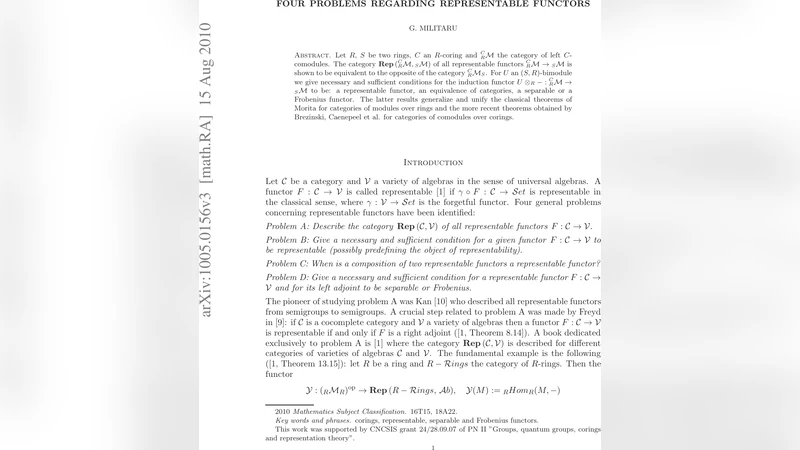
Let $R$, $S$ be two rings, $C$ an $R$-coring and ${}{R}^C{\mathcal M}$ the category of left $C$-comodules. The category ${\bf Rep}, ( {}{R}^C{\mathcal M}, {}{S}{\mathcal M} )$ of all representable functors ${}{R}^C{\mathcal M} \to {}{S}{\mathcal M}$ is shown to be equivalent to the opposite of the category ${}{R}^C{\mathcal M}S$. For $U$ an $(S,R)$-bimodule we give necessary and sufficient conditions for the induction functor $U\otimes_R - : {}{R}^C\mathcal{M} \to {}_{S}\mathcal{M}$ to be: a representable functor, an equivalence of categories, a separable or a Frobenius functor. The latter results generalize and unify the classical theorems of Morita for categories of modules over rings and the more recent theorems obtained by Brezinski, Caenepeel et al. for categories of comodules over corings.
💡 Research Summary
**
The paper investigates functors from the category of left comodules over an (R)-coring (C) to the category of left modules over a ring (S). The authors first establish that the category of all representable functors ({\bf Rep}({}{R}^{C}\mathcal M, {}{S}\mathcal M)) is equivalent to the opposite of the bicomodule category ({}{R}^{C}\mathcal M{S}). In concrete terms, each object (M) of ({}{R}^{C}\mathcal M{S}) (i.e., a left (C)-comodule that is simultaneously a right (S)-module with compatible structures) gives rise to a representable functor (\operatorname{Hom}{{}{R}^{C}\mathcal M}(M,-)), and morphisms between such bicomodules correspond contravariantly to natural transformations between the associated functors.
Having set this categorical framework, the authors turn to a specific class of functors obtained by tensoring with a fixed ((S,R))-bimodule (U): \