Recursions of Symmetry Orbits and Reduction without Reduction
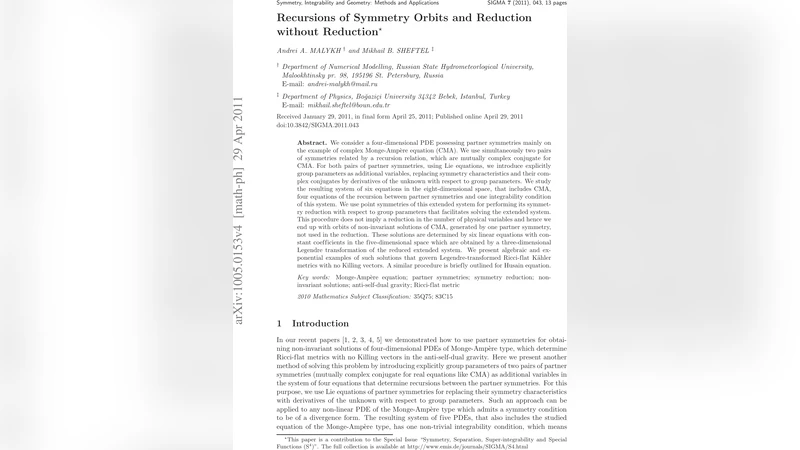
We consider a four-dimensional PDE possessing partner symmetries mainly on the example of complex Monge-Amp`ere equation (CMA). We use simultaneously two pairs of symmetries related by a recursion relation, which are mutually complex conjugate for CMA. For both pairs of partner symmetries, using Lie equations, we introduce explicitly group parameters as additional variables, replacing symmetry characteristics and their complex conjugates by derivatives of the unknown with respect to group parameters. We study the resulting system of six equations in the eight-dimensional space, that includes CMA, four equations of the recursion between partner symmetries and one integrability condition of this system. We use point symmetries of this extended system for performing its symmetry reduction with respect to group parameters that facilitates solving the extended system. This procedure does not imply a reduction in the number of physical variables and hence we end up with orbits of non-invariant solutions of CMA, generated by one partner symmetry, not used in the reduction. These solutions are determined by six linear equations with constant coefficients in the five-dimensional space which are obtained by a three-dimensional Legendre transformation of the reduced extended system. We present algebraic and exponential examples of such solutions that govern Legendre-transformed Ricci-flat K"ahler metrics with no Killing vectors. A similar procedure is briefly outlined for Husain equation.
💡 Research Summary
The paper develops a novel method for generating non‑invariant solutions of the four‑dimensional complex Monge‑Ampère equation (CMA) by exploiting “partner symmetries.” Instead of using a single symmetry to reduce the number of independent variables, the authors consider two conjugate pairs of partner symmetries simultaneously. Each pair is linked by a recursion relation, which allows the symmetry characteristics to be replaced by derivatives of the unknown function with respect to newly introduced group parameters. By treating these parameters as additional independent variables, the original CMA is embedded in an eight‑dimensional space (four physical coordinates plus two complex group parameters).
In this extended space the authors write a system of six equations: the original CMA, four recursion equations (real and imaginary parts for each partner symmetry), and one integrability condition ensuring consistency of the over‑determined system. The extended system possesses point symmetries that act only on the group parameters. By performing a symmetry reduction with respect to these parameter‑only symmetries, the number of physical variables is left unchanged, while the parameter dependence is simplified. After reduction the system collapses to six linear equations with constant coefficients in a five‑dimensional space (the four original variables plus one remaining parameter).
To solve this linear system the authors apply a three‑dimensional Legendre transformation, which converts the equations into a set of constant‑coefficient linear PDEs that are straightforward to integrate. The resulting solutions fall into two families: algebraic (polynomial) expressions and exponential (complex‑exponential) expressions. When transformed back to the original variables, these families provide non‑invariant solutions of the CMA that are not generated by the symmetry used in the reduction.
Crucially, the obtained solutions serve as potentials for Ricci‑flat Kähler metrics. The metrics derived from these potentials have no Killing vectors, meaning they possess no continuous isometries. This property makes them valuable examples in complex differential geometry and in the construction of gravitational instantons without symmetry.
The paper also sketches how the same methodology can be applied to the Husain equation, another four‑dimensional nonlinear PDE with self‑dual properties. By defining appropriate partner symmetries for the Husain equation, introducing group parameters, and performing a similar reduction, one can generate non‑invariant solutions in that context as well.
Overall, the work unifies two seemingly opposite strategies: using symmetries to reduce a system and using symmetries to generate new, non‑invariant solutions. By promoting symmetry parameters to independent variables and then reducing only those parameters, the authors open a new pathway for exploring the solution space of complex nonlinear PDEs, especially those arising in Kähler geometry and self‑dual gravity.
Comments & Academic Discussion
Loading comments...
Leave a Comment