External characterization of I-favorable spaces
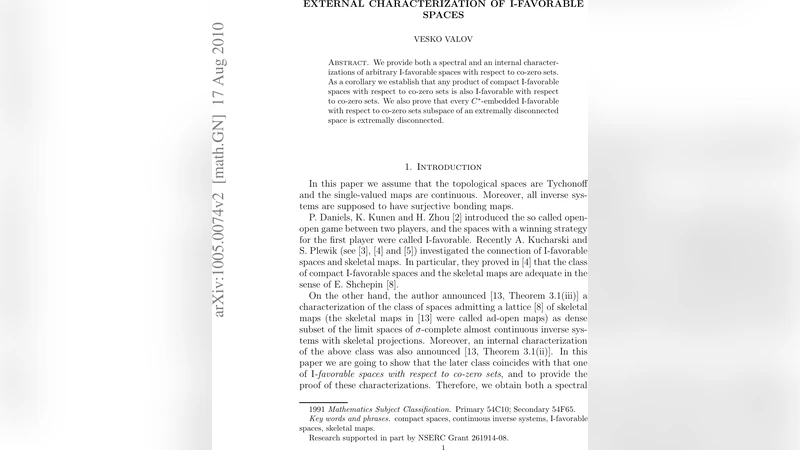
We provide both a spectral and an internal characterizations of arbitrary I-favorable spaces with respect to co-zero sets. As a corollary we establish that any product of compact I-favorable spaces with respect to co-zero sets is also I-favorable with respect to co-zero sets. We also prove that every C*-embedded I-favorable with respect to co-zero sets subspace of an extremally disconnected space is extremally disconnected.
💡 Research Summary
The paper investigates I‑favorable spaces when the players in the underlying topological game are restricted to choosing co‑zero sets (i.e., non‑zero sets of continuous real‑valued functions). Two complementary characterizations are presented: an external (spectral) one and an internal (club‑filter) one.
Spectral characterization. The authors show that a space (X) is I‑favorable with respect to co‑zero sets if and only if it can be represented as the inverse limit of a σ‑complete inverse system ({X_\alpha, p_\alpha^\beta, A}) where each (X_\alpha) is a compact metrizable space, each bonding map (p_\alpha^\beta) is continuous, onto, and preserves co‑zero sets (the pre‑image of a co‑zero set is again co‑zero). The proof proceeds by lifting a winning strategy for player I from the limit space to each stage of the system: at each level player I selects a co‑zero set in (X_\alpha) that corresponds, via the bonding maps, to the move in the limit game. Conversely, a winning strategy on each stage can be projected down to a winning strategy on the limit, establishing the equivalence. This result extends classical spectral representations of compact spaces to the game‑theoretic setting of I‑favorability.
Internal (club‑filter) characterization. The second main theorem introduces a club filter on the family (\mathcal{C}(X)) of co‑zero subsets of (X). A club is a collection of co‑zero sets that is linearly ordered by inclusion, closed under countable increasing unions, and unbounded in (\mathcal{C}(X)). The authors prove that (X) is I‑favorable with respect to co‑zero sets precisely when such a club filter exists. The direction “I‑favorable ⇒ club” is obtained by taking the family of all co‑zero sets that can appear in a winning strategy; this family naturally satisfies the club axioms. The converse uses the club to define a systematic way for player I to respond to any move of player II: given a co‑zero set chosen by II, I picks a larger element of the club, guaranteeing progress toward the limit of the decreasing sequence of chosen sets, which forces a win.
Applications.
-
Products. Using the spectral description, the authors prove that the arbitrary product of compact I‑favorable spaces (with respect to co‑zero sets) is again I‑favorable. Each factor admits a σ‑complete inverse system as above; the product system is obtained by taking pointwise products of the factor spaces and bonding maps. The resulting inverse limit is exactly the product space, and the preservation of co‑zero sets under product projections ensures the I‑favorability of the whole product.
-
Extremally disconnected subspaces. If (Y) is extremally disconnected (the closure of every open set is open) and (X\subseteq Y) is a C(^)-embedded subspace that is I‑favorable with respect to co‑zero sets, then (X) itself must be extremally disconnected. The C(^)-embedding guarantees that every continuous real‑valued function on (X) extends to (Y), which in turn implies that co‑zero sets of (X) correspond to co‑zero sets of (Y). Since the club filter on (X) can be transferred to a club filter on (Y) and (Y) already has the extremal disconnection property, the same property is inherited by (X).
Significance and future directions. By linking I‑favorability to inverse limit constructions and to club filters on co‑zero families, the paper provides a robust framework that unifies game‑theoretic, categorical, and filter‑theoretic perspectives. The product theorem resolves a natural closure question for I‑favorable spaces, while the extremally disconnected result connects the game‑theoretic notion to classical separation axioms. Potential extensions include: (i) relaxing compactness assumptions to explore locally compact or σ‑compact settings; (ii) replacing co‑zero sets by other definable families such as (G_\delta) sets; (iii) investigating the impact of I‑favorability on function spaces, C(^*)-algebras, and descriptive set‑theoretic hierarchies. Overall, the work deepens our understanding of how strategic topological games interact with structural properties of spaces.
Comments & Academic Discussion
Loading comments...
Leave a Comment