Cop and robber games when the robber can hide and ride
In the classical cop and robber game, two players, the cop C and the robber R, move alternatively along edges of a finite graph G. The cop captures the robber if both players are on the same vertex at
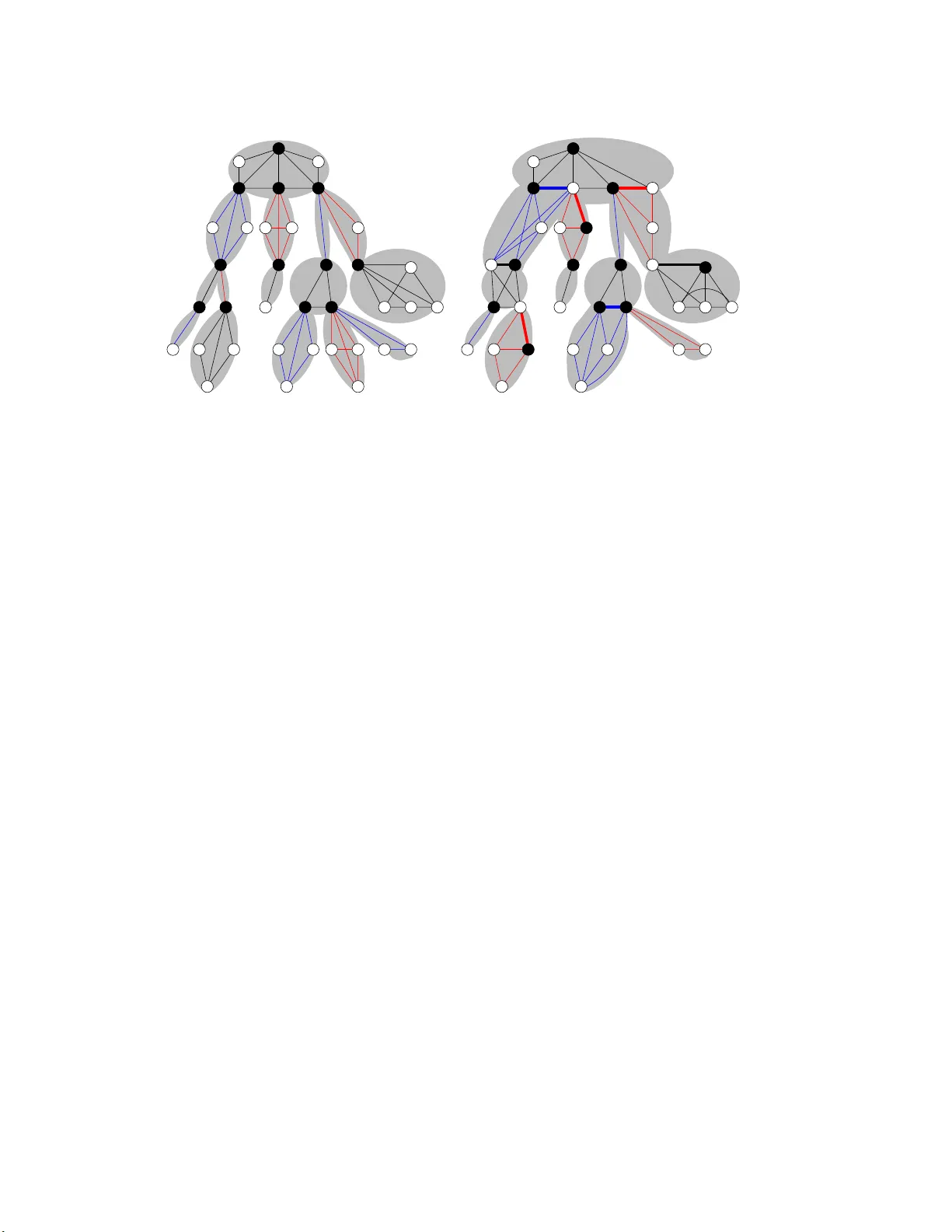
In the classical cop and robber game, two players, the cop C and the robber R, move alternatively along edges of a finite graph G. The cop captures the robber if both players are on the same vertex at the same moment of time. A graph G is called cop win if the cop always captures the robber after a finite number of steps. Nowakowski, Winkler (1983) and Quilliot (1983) characterized the cop-win graphs as graphs admitting a dismantling scheme. In this paper, we characterize in a similar way the class CW(s,s’) of cop-win graphs in the game in which the cop and the robber move at different speeds s’ and s, s’<= s. We also establish some connections between cop-win graphs for this game with s’<s and Gromov’s hyperbolicity. In the particular case s’=1 and s=2, we prove that the class of cop-win graphs is exactly the well-known class of dually chordal graphs. We show that all classes CW(s,1), s>=3, coincide and we provide a structural characterization of these graphs. We also investigate several dismantling schemes necessary or sufficient for the cop-win graphs in the game in which the robber is visible only every k moves for a fixed integer k>1. We characterize the graphs which are cop-win for any value of k. Finally, we consider the game where the cop wins if he is at distance at most 1 from the robber and we characterize via a specific dismantling scheme the bipartite graphs where a single cop wins in this game.
💡 Research Summary
The paper studies several extensions of the classic cop‑and‑robber pursuit game on finite graphs, focusing on structural characterizations of the graphs on which a single cop can guarantee capture. The authors first generalize the game to allow the cop and the robber to move with different speeds, denoted s′ (cop) and s (robber) with s′ ≤ s. They introduce an “s‑dismantling” scheme: a vertex v can be removed if there exists another vertex u such that the closed s′‑neighbourhood of v is contained in the closed s‑neighbourhood of u (N_{s′}
📜 Original Paper Content
🚀 Synchronizing high-quality layout from 1TB storage...