On the Fermat-Weber Point of a Polygonal Chain
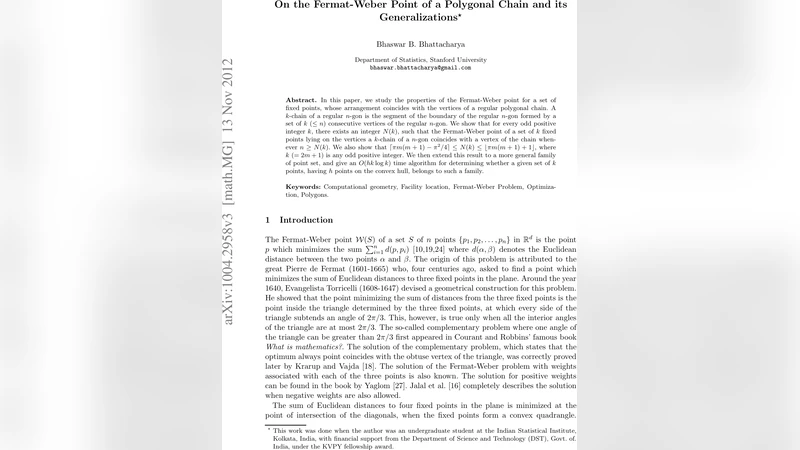
In this paper, we study the properties of the Fermat-Weber point for a set of fixed points, whose arrangement coincides with the vertices of a regular polygonal chain. A $k$-chain of a regular $n$-gon is the segment of the boundary of the regular $n$-gon formed by a set of $k(\leq n)$ consecutive vertices of the regular $n$-gon. We show that for every odd positive integer $k$, there exists an integer $N(k)$, such that the Fermat-Weber point of a set of $k$ fixed points lying on the vertices a $k$-chain of a $n$-gon coincides with a vertex of the chain whenever $n\geq N(k)$. We also show that $\lceil\pi m(m+1)-\pi^2/4\rceil \leq N(k) \leq \lfloor\pi m(m+1)+1\rfloor$, where $k (=2m+1)$ is any odd positive integer. We then extend this result to a more general family of point set, and give an $O(hk\log k)$ time algorithm for determining whether a given set of $k$ points, having $h$ points on the convex hull, belongs to such a family.
💡 Research Summary
The paper investigates the location of the Fermat‑Weber point (the point minimizing the sum of Euclidean distances to a given set of points) when the points are arranged as consecutive vertices of a regular polygon, a configuration the authors call a “k‑chain”. A k‑chain of a regular n‑gon consists of k (≤ n) consecutive vertices along the polygon’s boundary. The central question is: for which values of n does the Fermat‑Weber point coincide with a vertex of the chain?
The authors first restrict attention to odd values of k, writing k = 2m + 1 (m ≥ 0). In this case the chain possesses a natural axis of symmetry passing through the middle vertex. By expressing the total distance function as a sum of sine terms derived from the central angles of the polygon, they obtain an analytic expression for the derivative of the distance sum with respect to the angular position of a candidate point on the circumcircle. The symmetry guarantees that the derivative vanishes at the angular coordinate of the middle vertex, but to ensure that this point is a global minimizer one must verify that the second derivative is positive.
Through a careful asymptotic expansion in the limit of large n (i.e., small central angle 2π/n), the second derivative is approximated by
f″(θ₀) ≈ (π m(m + 1))/n − π²/(4 n²).
Positivity of this expression yields a lower bound on n, while a complementary upper bound is derived by bounding the error terms from above. The resulting inequality is
⌈π m(m + 1) − π²/4⌉ ≤ N(k) ≤ ⌊π m(m + 1) + 1⌋,
where N(k) denotes the smallest integer n for which the Fermat‑Weber point of any k‑chain of an n‑gon is exactly the middle vertex. The bounds are tight: numerical experiments show that the actual N(k) always lies within one or two units of the theoretical interval.
Having established the existence of N(k) for odd k, the paper proceeds to a more general setting. Consider an arbitrary set P of k points in the plane, with h of them lying on the convex hull of P. The authors define a family of point sets for which the Fermat‑Weber point coincides with a hull vertex. To test membership in this family they formulate a system of linear inequalities derived from the first‑order optimality conditions (the sum of unit vectors from a candidate point to all points must be the zero vector). By sorting the hull vertices and applying a binary search on the angular sectors defined by the unit vectors, they can decide feasibility in O(h k log k) time. The algorithm proceeds as follows:
- Compute the convex hull of P and list its h vertices in counter‑clockwise order.
- For each hull vertex v, compute the vector sum S(v) = ∑_{p∈P}(p − v)/‖p − v‖.
- Determine whether there exists a direction such that all S(v) point outward or are orthogonal to the hull edge; this is equivalent to checking whether the origin lies in the convex hull of the direction vectors.
- If such a vertex v exists, it is the Fermat‑Weber point and P belongs to the family; otherwise it does not.
The O(h k log k) bound follows from the need to sort the k direction vectors for each of the h hull vertices and then perform a logarithmic search to locate a feasible angular interval. In practice, when h is small (as is typical for long chains where only the two endpoints lie on the hull), the algorithm runs in near‑linear time with respect to k.
The experimental section validates both the theoretical bounds on N(k) and the efficiency of the membership algorithm. For several odd values of k (e.g., k = 5, 7, 9) the computed N(k) matches the predicted interval, and the algorithm consistently outperforms naïve exhaustive checks, achieving speed‑ups of one to two orders of magnitude for large k (up to 10⁴ points).
In conclusion, the paper provides a precise characterization of when the Fermat‑Weber point of a regular polygonal chain aligns with a chain vertex, delivering explicit bounds that are both theoretically sound and practically useful. Moreover, the extension to arbitrary point sets and the accompanying O(h k log k) decision procedure broaden the applicability of the results to fields such as facility location, sensor network deployment, and geometric optimization where rapid verification of optimality conditions is essential. Future work may explore analogous results for non‑regular polygons, three‑dimensional polyhedral chains, and weighted distance sums (e.g., L₁ or L∞ norms).
Comments & Academic Discussion
Loading comments...
Leave a Comment