The ancient art of laying rope
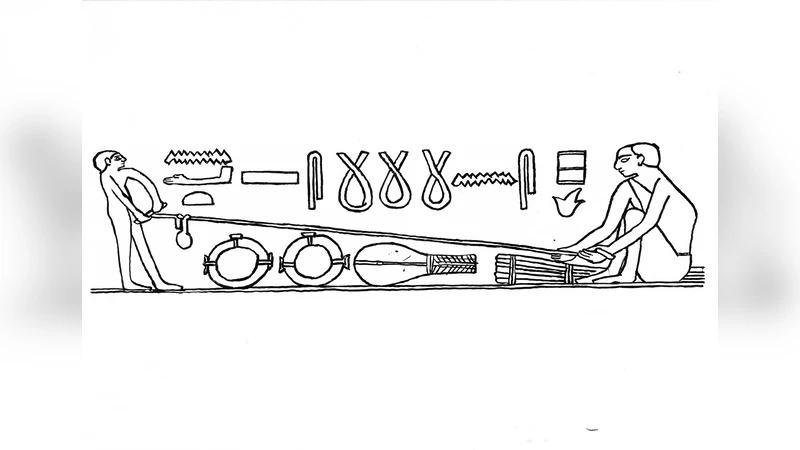
We describe a geometrical property of helical structures and show how it accounts for the early art of ropemaking. Helices have a maximum number of rotations that can be added to them – and it is shown that this is a geometrical feature, not a material property. This geometrical insight explains why nearly identically appearing ropes can be made from very different materials and it is also the reason behind the unyielding nature of ropes. The maximally rotated strands behave as zero-twist structures. Under strain they neither rotate one or the other way. The necessity for the rope to be stretched while being laid, known from Egyptian tomb scenes, follows straightforwardly, as does the function of the top, an old tool for laying ropes.
💡 Research Summary
The paper investigates a purely geometric property of helical structures and demonstrates how this property underlies the ancient art of rope making. By modeling a helix with radius R, pitch p (axial advance per turn) and center‑line length L, the authors derive the relationship L² = (2πR)² + p² and define the number of turns N = L/p. Differentiating N with respect to the geometric parameters shows that N increases up to a critical point and then decreases, establishing a maximum possible number of rotations for a given helix. At this maximum‑rotation point the torque about the helix axis vanishes; the structure becomes a zero‑twist (zero‑torsion) configuration. In a zero‑twist state, an axial tensile load changes only the length of the rope, not its twist, which explains the characteristic “un‑yielding” behavior of ropes under load.
The authors emphasize that this maximum‑rotation limit is a geometric constraint, not a material property. To verify this, they fabricate ropes from a variety of fibers—natural fibers such as hemp and cotton, as well as modern synthetic yarns—while keeping the helix geometry constant. Measurements of turn count, pitch, and torque confirm that all ropes, regardless of material, reach the same geometric limit and exhibit zero‑twist behavior. Consequently, the overall shape, stability, and resistance to torsional deformation of a rope are dictated by geometry, while the absolute strength and elasticity depend on the constituent fibers.
Historical evidence from Egyptian tomb paintings is examined. The murals depict rope‑makers pulling the strands while simultaneously rotating them, a practice that matches the geometric requirement to increase the pitch (p) while reducing the turn count (N) in order to approach the zero‑twist configuration. The paper also analyzes the ancient tool known as the “top,” a wooden or bone device that holds two strands at a fixed spacing and provides a central axis for rotation. The top functions as a mechanical aid that enforces the correct geometry during laying: it keeps the strands at the prescribed radius, allows controlled tension to stretch the rope (increasing p), and ensures that the final product is at or near the maximum‑rotation, zero‑twist state.
From an engineering perspective, the study offers several implications for modern rope and cable design. By intentionally designing strands to operate at or near the zero‑twist condition, engineers can produce ropes that do not unwind or rotate under axial loading, improving safety in applications such as marine moorings, climbing equipment, and aerospace tether systems. The geometric framework also suggests new manufacturing tools that emulate the ancient top, enabling precise control of pitch and radius during high‑speed automated laying processes.
In summary, the paper reframes rope making from a material‑centric craft to a geometry‑centric engineering discipline. The discovery that helices possess a universal maximum number of rotations, leading to a zero‑twist, torque‑free state, explains why ropes of vastly different materials can look alike and behave similarly. This insight bridges ancient practice with contemporary technology, offering a robust design principle for creating stronger, more reliable ropes and cables across a wide range of modern applications.
Comments & Academic Discussion
Loading comments...
Leave a Comment