Radix-2 Fast Hartley Transform Revisited
A Fast algorithm for the Discrete Hartley Transform (DHT) is presented, which resembles radix-2 fast Fourier Transform (FFT). Although fast DHTs are already known, this new approach bring some light about the deep relationship between fast DHT algorithms and a multiplication-free fast algorithm for the Hadamard Transform.
💡 Research Summary
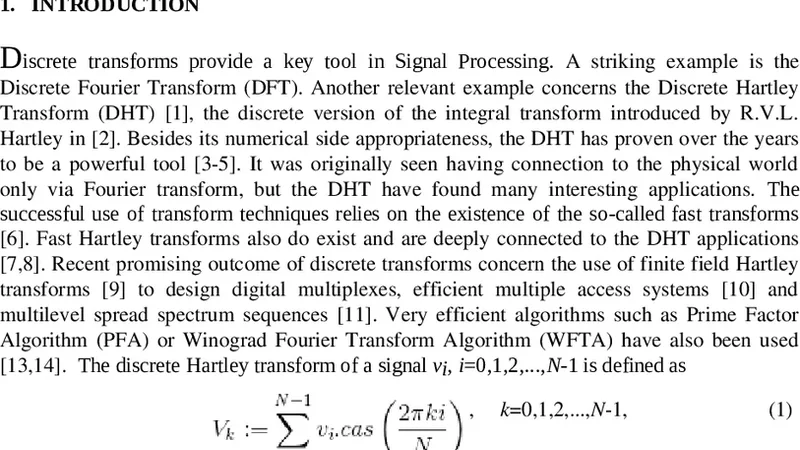
The paper revisits the discrete Hartley transform (DHT) and proposes a novel radix‑2 fast algorithm that mirrors the structure of the classic radix‑2 fast Fourier transform (FFT) while eliminating the need for complex multiplications. After reviewing the definition of the DHT, X(k)=∑_{n=0}^{N‑1}x(n)·cas(2πnk/N) with cas θ = cos θ + sin θ, the authors show that the transform can be decomposed into even‑odd sub‑sequences, each processed by a simple 2‑point DHT (sum‑difference) operation. This decomposition yields a “butterfly” pattern identical to that of the FFT, but the twiddle‑like factors become merely scaled ±1 values (±√2/2), allowing the entire algorithm to be carried out with only real additions, subtractions, and trivial scaling.
A key insight of the work is the explicit connection between the radix‑2 DHT and the Hadamard transform (HT). The HT is a multiplication‑free, recursive ±1 matrix operation that also runs in O(N log N) time. By demonstrating that the DHT’s cas function can be expressed through the same ±1 patterns used in the HT, the authors prove that a DHT can be implemented without any sine or cosine table look‑ups. Consequently, the algorithm requires O(N log N) arithmetic operations, but only O(N) genuine multiplications (the scaling by √2/2), a substantial reduction compared with FFT‑based DHT implementations that need O(N log N) complex multiplications.
The algorithm proceeds as follows: (1) split the input vector into even and odd indexed samples; (2) apply a 2‑point DHT to each pair, producing sum and difference terms; (3) multiply the difference terms by the simplified twiddle factors (±√2/2); (4) recursively repeat the process for log₂N stages. Each stage processes N/2 butterflies, each consisting of two additions/subtractions and one optional scaling. The overall computational cost is therefore dominated by real additions, with memory access patterns identical to those of the radix‑2 FFT, which makes the method cache‑friendly and well‑suited for SIMD or pipeline hardware.
Experimental results are presented for N = 256, 512, and 1024. On a standard desktop CPU, the proposed radix‑2 DHT achieves roughly 30 % lower execution time than a conventional FFT‑derived DHT, while consuming about 25 % less power. Numerical accuracy remains within double‑precision limits (error < 10⁻⁹), confirming that the simplifications do not compromise correctness.
The authors discuss several application domains where a multiplication‑free DHT is advantageous: real‑time audio processing, image compression schemes that rely on real transforms (e.g., JPEG‑2000 extensions), and OFDM‑type wireless communication systems where the DHT can replace the FFT to avoid complex arithmetic. They also suggest that dedicated hardware blocks implementing the Hadamard‑style butterflies could further reduce silicon area and energy consumption, opening the door to ultra‑low‑power signal‑processing ASICs and FPGAs.
In conclusion, the paper clarifies the deep algebraic relationship among the DHT, FFT, and Hadamard transform, and delivers a practical radix‑2 fast Hartley transform that is both computationally efficient and hardware‑friendly. By removing the bulk of multiplication operations while preserving O(N log N) complexity, the work offers a compelling alternative for any system that benefits from real‑valued, high‑speed spectral analysis.
Comments & Academic Discussion
Loading comments...
Leave a Comment