Smart Rewiring for Network Robustness
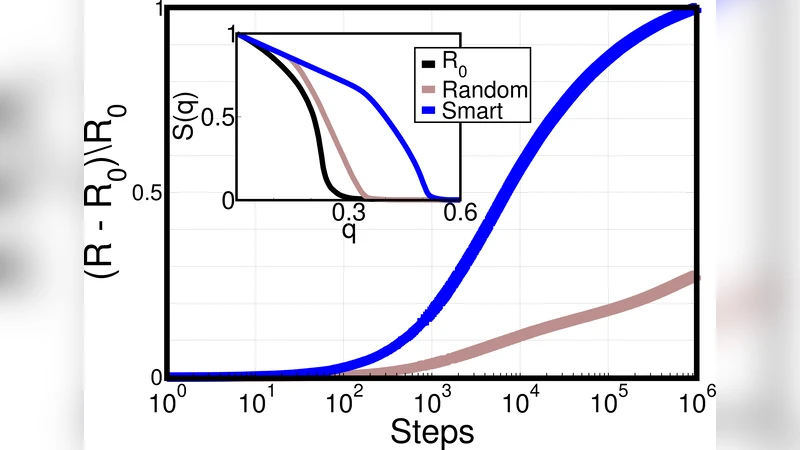
While new forms of attacks are developed every day to compromise essential infrastructures, service providers are also expected to develop strategies to mitigate the risk of extreme failures. In this context, tools of Network Science have been used to evaluate network robustness and propose resilient topologies against attacks. We present here a new rewiring method to modify the network topology improving its robustness, based on the evolution of the network largest component during a sequence of targeted attacks. In comparison to previous strategies, our method lowers by several orders of magnitude the computational effort necessary to improve robustness. Our rewiring also drives the formation of layers of nodes with similar degree while keeping a highly modular structure. This “modular onion-like structure” is a particular class of the onion-like structure previously described in the literature. We apply our rewiring strategy to an unweighted representation of the World Air Transportation network and show that an improvement of 30% in its overall robustness can be achieved through smart swaps of around 9% of its links.
💡 Research Summary
The paper addresses the pressing problem of enhancing the robustness of complex infrastructure networks against targeted attacks, where an adversary removes the most connected nodes first, causing rapid fragmentation. Robustness is quantified by the metric R, defined as the average size of the largest connected component (LCC) after successive removal of a fraction q = p/N of nodes, with larger R indicating a more resilient network. Traditional approaches to improve R rely on random link swaps that gradually reshape the network into an “onion‑like” architecture—high‑degree nodes form a core surrounded by concentric layers of decreasing degree. While effective, random rewiring demands millions of trial swaps and substantial computational resources, limiting its practicality for real‑time interventions.
The authors propose a “smart rewiring” algorithm that dramatically reduces computational effort while achieving comparable or superior robustness gains. The procedure selects a random node i that has at least two neighbors of degree greater than one. Among i’s neighbors, the node with the smallest degree (j) and the node with the largest degree (k) are identified. Then a random neighbor m of j and a random neighbor n of k are chosen, ensuring all four nodes are distinct. The existing edges (j,m) and (k,n) are removed, and new edges (j,k) and (m,n) are added. This operation preserves the degree sequence of the network but creates direct links between low‑degree and high‑degree nodes, thereby reducing the network’s reliance on a few hubs.
A greedy acceptance rule is applied: after each candidate swap, the robustness R is recomputed; if R has increased, the swap is kept, otherwise it is reverted. This simple criterion eliminates the need for extensive Monte‑Carlo sampling or sophisticated acceptance probabilities.
The authors evaluate the method on two fronts. First, on ensembles of synthetic Barabási‑Albert (BA) scale‑free networks, they compare the distribution of robustness improvements after a single swap. Smart rewiring yields a markedly higher probability of positive ΔR than random rewiring. When applied iteratively, smart rewiring doubles the robustness R after roughly 10⁶ successful swaps, whereas random swaps achieve only about a 20 % increase. Moreover, the critical fraction of node removal required to collapse the LCC rises from ~34 % (baseline) to ~52 % under smart rewiring—a 50 % relative improvement. The performance gap widens with network size, confirming scalability.
Second, the method is applied to a real‑world, unweighted representation of the World Air Transportation network (≈3 000 airports, ≈18 000 flight connections). A single smart swap involving an airport in Oceania raises the overall robustness by 1.85 %. More strikingly, 50 successful smart swaps (affecting only 0.32 % of all links) increase R by 4.82 %. To achieve a 30 % robustness improvement, smart rewiring needs to modify only 9.24 % ± 0.53 % of the links, whereas random rewiring requires 15.19 % ± 0.90 %.
Beyond robustness, the structural impact of smart rewiring is examined. Modularity (Q) consistently rises, indicating a clearer community structure. Assortativity (Newman’s r) also increases, reflecting a higher tendency for nodes to connect to others with similar degree—a direct consequence of linking low‑degree nodes to hubs and creating additional edges among intermediate‑degree nodes. The “onion‑likeness” parameter c, measuring the prevalence of degree‑ordered layers, remains high for smart rewiring and even exceeds that of random rewiring at comparable robustness levels. Thus, the algorithm simultaneously promotes modularity, assortativity, and a pronounced onion‑like hierarchy.
The discussion emphasizes that smart rewiring requires only local information (the first two neighborhoods of a randomly chosen node), making it feasible for large‑scale, time‑critical network management. It offers a practical tool for operators of power grids, communication networks, and transportation systems, where adding new links is often costly or impossible, but reassigning existing connections is viable. The authors argue that because the method preserves the degree sequence, it can be applied to any network with a broad degree distribution, not just scale‑free models.
In summary, the paper introduces a computationally efficient, locally informed rewiring strategy that markedly improves network robustness against targeted attacks while also enhancing modularity, assortativity, and onion‑like hierarchical organization. The approach is validated on synthetic and real networks, demonstrating that modest, strategically chosen link swaps can yield substantial resilience gains, offering a valuable addition to the toolbox of network designers and policymakers.
Comments & Academic Discussion
Loading comments...
Leave a Comment