Application of magnetically induced hyperthermia on the model protozoan Crithidia fasciculata as a potential therapy against parasitic infections
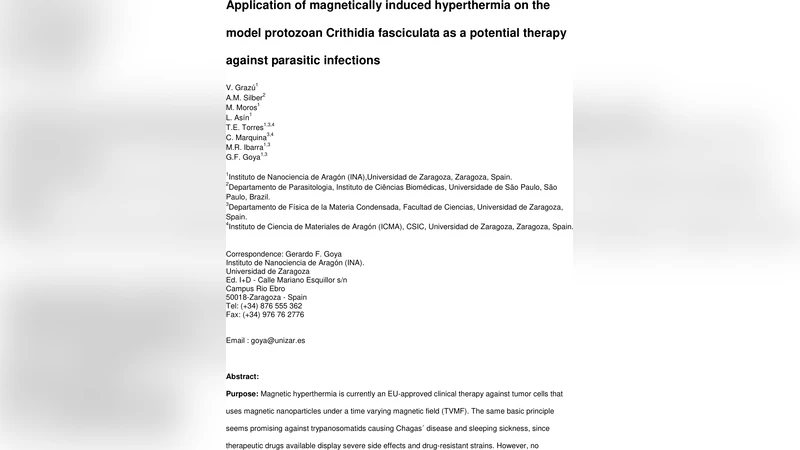
Magnetic hyperthermia is currently an EU-approved clinical therapy against tumor cells that uses magnetic nanoparticles under a time varying magnetic field (TVMF). The same basic principle seems promising against trypanosomatids causing Chagas disease and sleeping sickness, since therapeutic drugs available display severe side effects and drug-resistant strains. However, no applications of this strategy against protozoan-induced diseases have been reported so far. In the present study, Crithidia fasciculata, a widely used model for therapeutic strategies against pathogenic trypanosomatids, was targeted with Fe_{3}O_{4} magnetic nanoparticles (MNPs) in order to remotely provoke cell death using TVMFs. The MNPs with average sizes of d approx. 30 nm were synthesized using a precipitation of FeSO_{4}4 in basic medium. The MNPs were added to Crithidia fasciculata choanomastigotes in exponential phase and incubated overnight. The amount of uploaded MNPs per cell was determined by magnetic measurements. Cell viability using the MTT colorimetric assay and flow cytometry showed that the MNPs were incorporated by the cells with no noticeable cell-toxicity effects. When a TVMF (f = 249 kHz, H = 13 kA/m) was applied to MNP-bearing cells, massive cell death was induced via a non-apoptotic mechanism. No effects were observed by applying a TVMF on control (without loaded MNPs) cells. No macroscopic rise in temperature was observed in the extracellular medium during the experiments. Scanning Electron Microscopy showed morphological changes after TVMF experiments. These data indicate (as a proof of principle) that intracellular hyperthermia is a suitable technology to induce the specific death of protozoan parasites bearing MNPs. These findings expand the possibilities for new therapeutic strategies that combat parasitic infections.
💡 Research Summary
The manuscript presents a proof‑of‑concept study that adapts magnetic hyperthermia—a technique already approved in the European Union for the treatment of solid tumors—to the eradication of a protozoan parasite. The authors selected Crithidia fasciculata, a non‑pathogenic trypanosomatid widely used as a surrogate for disease‑causing species such as Trypanosoma cruzi and T. brucei, to evaluate whether intracellularly delivered iron‑oxide magnetic nanoparticles (MNPs) could be remotely heated by an alternating magnetic field (AMF) and thereby induce parasite death.
Nanoparticle synthesis and characterization
Fe₃O₄ nanoparticles were produced by a simple precipitation of FeSO₄·4 in a basic medium. Transmission electron microscopy revealed a relatively narrow size distribution with an average diameter of ~30 nm. X‑ray diffraction confirmed the spinel structure, and vibrating‑sample magnetometry demonstrated super‑paramagnetic behavior, ensuring that the particles would generate heat efficiently under an AMF without retaining remanent magnetization. No additional surface coating was applied, a deliberate choice to promote cellular uptake.
Loading of parasites
Exponentially growing choanomastigotes were incubated overnight with 1 mg mL⁻¹ of the MNP suspension. After washing, magnetic measurements indicated an average iron content of about 1 pg per cell, corresponding to roughly 10⁶ particles per parasite. This loading level is sufficient to produce a measurable temperature rise within the confined intracellular volume when the particles are subjected to an AMF.
Cytotoxicity of the particles
Cell viability was assessed by the MTT assay and flow cytometry. In the absence of an AMF, MNP‑laden parasites displayed >95 % viability after 24 h, indicating that the nanoparticles themselves are essentially non‑toxic to C. fasciculata under the experimental conditions.
Application of the alternating magnetic field
A time‑varying magnetic field (TVMF) with a frequency of 249 kHz and an amplitude of 13 kA m⁻¹ was applied for 30 minutes. In the MNP‑containing group, more than 80 % of the parasites lost metabolic activity, as shown by the MTT assay, and flow cytometry revealed a dramatic increase in propidium iodide uptake without annexin V staining. In contrast, control parasites lacking MNPs showed no loss of viability under identical field exposure. Importantly, the bulk temperature of the culture medium increased by less than 0.5 °C, confirming that the lethal effect originated from intracellular heating rather than macroscopic hyperthermia.
Mechanism of cell death
Annexin V/PI double staining and scanning electron microscopy (SEM) indicated a non‑apoptotic, necrosis‑like death. SEM images displayed extensive membrane rupture, cytoplasmic leakage, and disintegration of internal organelles. The authors interpret these findings as the consequence of rapid, localized temperature spikes that denature proteins, destabilize lipid bilayers, and cause mechanical disruption of the parasite’s ultrastructure.
Significance and future directions
The study demonstrates three critical points: (1) magnetic nanoparticles can be efficiently internalized by a trypanosomatid without compromising its short‑term viability; (2) an external AMF can selectively kill only those parasites that have incorporated the particles, while sparing surrounding media and, by implication, host tissues; (3) the lethal effect is achieved without a measurable rise in bulk temperature, which is a major safety advantage for potential in‑vivo applications.
These results open a new avenue for anti‑parasitic therapy, especially for diseases where current chemotherapeutics suffer from severe side effects and emerging drug resistance. However, the work remains at the in‑vitro stage. Translational steps will require (i) validation in animal infection models to assess biodistribution, clearance, and immune responses to the nanoparticles; (ii) optimization of AMF parameters (frequency, field strength, exposure time) to maximize parasite killing while minimizing any off‑target heating; (iii) surface functionalization of the MNPs with parasite‑specific ligands to enhance selective uptake in vivo; and (iv) comprehensive toxicological profiling to satisfy regulatory requirements.
In conclusion, the authors provide compelling evidence that intracellular magnetic hyperthermia can be harnessed to induce rapid, non‑apoptotic death of a model protozoan parasite. This proof‑of‑principle study lays the groundwork for developing magnetic‑field‑mediated, drug‑free treatments against trypanosomatid infections such as Chagas disease and African sleeping sickness, potentially expanding the therapeutic toolbox beyond conventional chemotherapy.
Comments & Academic Discussion
Loading comments...
Leave a Comment