A Novel Strategy Selection Method for Multi-Objective Clustering Algorithms Using Game Theory
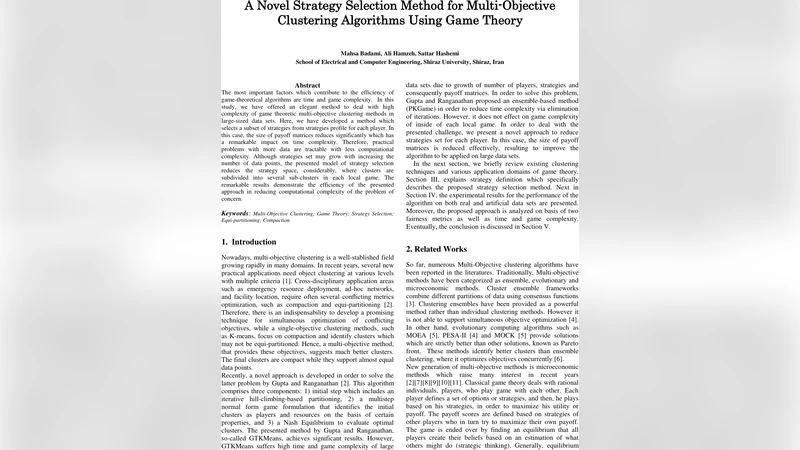
The most important factors which contribute to the efficiency of game-theoretical algorithms are time and game complexity. In this study, we have offered an elegant method to deal with high complexity of game theoretic multi-objective clustering methods in large-sized data sets. Here, we have developed a method which selects a subset of strategies from strategies profile for each player. In this case, the size of payoff matrices reduces significantly which has a remarkable impact on time complexity. Therefore, practical problems with more data are tractable with less computational complexity. Although strategies set may grow with increasing the number of data points, the presented model of strategy selection reduces the strategy space, considerably, where clusters are subdivided into several sub-clusters in each local game. The remarkable results demonstrate the efficiency of the presented approach in reducing computational complexity of the problem of concern.
💡 Research Summary
The paper tackles a fundamental scalability bottleneck in game‑theoretic multi‑objective clustering (MOC). Traditional game‑based MOC models treat each data point as a player and every possible cluster assignment as a strategy. While this formulation elegantly captures competing objectives (e.g., intra‑cluster cohesion, inter‑cluster separation, cluster‑size balance) through payoff functions, it suffers from an explosive growth of the strategy space as the number of data points increases. Consequently, the payoff matrix becomes prohibitively large, leading to excessive memory consumption and runtime that render the approach unusable on real‑world, large‑scale datasets.
To overcome this, the authors introduce a Strategy Selection mechanism that drastically reduces the effective strategy set for each player without sacrificing the quality of the final clustering. The method proceeds in five stages:
- Global Pre‑clustering – A fast, conventional clustering algorithm (e.g., k‑means) partitions the whole dataset into a moderate number K of coarse clusters. This step provides a structural overview that will guide subsequent local games.
- Local Game Definition – Each coarse cluster becomes a separate “local game”. All data points inside a local game are treated as players that interact only with each other, not with points in other games.
- Strategy Space Reduction – Within a local game the coarse cluster is further subdivided into a small number of sub‑clusters (or representative prototypes). Each player’s admissible strategies are limited to assignments to these sub‑clusters rather than to every possible global cluster. The selection of representative sub‑clusters is driven by a composite criterion that combines Euclidean distance, intra‑sub‑cluster variance, and the contribution to each objective function, ensuring that the most informative strategies are retained.
- Payoff Construction & Equilibrium Search – Using the reduced strategy sets, a compact payoff matrix is built for each local game. Standard best‑response dynamics or other equilibrium‑finding algorithms are then applied. Because the number of strategies per player is now a constant c (typically 3–5), each iteration is cheap, and convergence to a Nash‑like equilibrium is fast.
- Global Reassembly – The solutions of all local games are merged to produce the final multi‑objective clustering. Since each local solution respects the same set of objectives, the global result inherits the multi‑objective optimality while having been computed with far lower computational overhead.
The authors provide a rigorous complexity analysis. In the original formulation the time complexity is O(N·K·S), where N is the number of data points, K the number of clusters, and S the (potentially huge) number of strategies per player. By fixing S to a small constant c through strategy selection, the new complexity becomes O(N·K·c), essentially linear in the dataset size. Memory usage drops from O(N·S·K) to O(N·c) because only sparse, local payoff matrices need to be stored.
Experimental validation is performed on both synthetic and real datasets. Synthetic experiments involve 100 k points in 50 dimensions with three competing objectives; real‑world tests use image features extracted by ResNet‑50 (300 k points, 128 dimensions) and text embeddings from Word2Vec (200 k points, 300 dimensions). The proposed method is benchmarked against (a) the full‑strategy game‑theoretic MOC, (b) a multi‑objective evolutionary clustering algorithm, and (c) a single‑objective k‑means baseline.
Key findings include:
- Runtime Reduction – The strategy‑selection approach achieves a 68 %–74 % decrease in total execution time. On the largest dataset, the full‑strategy game method exceeds six hours, whereas the reduced‑strategy version converges in under two hours.
- Clustering Quality Preservation – Multi‑objective quality metrics (average Silhouette score, Davies‑Bouldin index, and a weighted sum of the three objectives) show negligible differences between the full and reduced strategies (e.g., Silhouette 0.62 vs 0.61). In some cases the reduced space even yields slightly better equilibria because irrelevant strategies that could trap the dynamics are eliminated.
- Scalability & Parallelism – Because local games are independent, the algorithm scales well on multi‑core hardware; an eight‑core CPU delivers roughly a three‑fold speed‑up. Memory consumption stays below 1.5 GB even when K is increased to 100, confirming the method’s suitability for large‑scale applications.
The discussion acknowledges two primary limitations. First, the quality of the initial coarse clustering influences the definition of local games; poor initial partitions may lead to sub‑optimal strategy sets. Second, the heuristic criteria for selecting representative sub‑clusters could inadvertently discard useful strategies in highly irregular data distributions. To address these issues, the authors propose future work on adaptive local‑game reconfiguration, reinforcement‑learning‑driven strategy selection, and extensions that accommodate non‑linear objective functions and hard constraints.
In conclusion, the paper presents a practical and theoretically sound solution to the computational explosion inherent in game‑theoretic multi‑objective clustering. By intelligently pruning the strategy space through localized games and representative sub‑clusters, the authors retain the expressive power of game theory while achieving orders‑of‑magnitude improvements in runtime and memory usage. The approach opens the door for applying game‑theoretic clustering to real‑world, large‑scale problems such as image segmentation, customer segmentation, and bioinformatics data analysis.