Dynamics on Networks of Manifolds
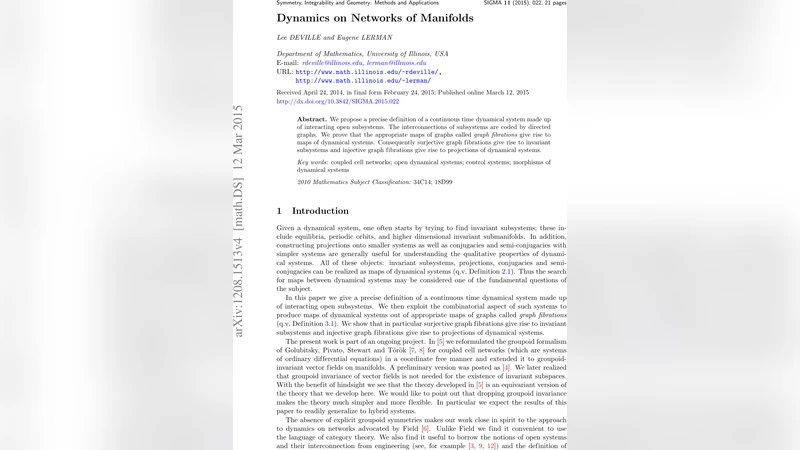
We propose a precise definition of a continuous time dynamical system made up of interacting open subsystems. The interconnections of subsystems are coded by directed graphs. We prove that the appropriate maps of graphs called graph fibrations give rise to maps of dynamical systems. Consequently surjective graph fibrations give rise to invariant subsystems and injective graph fibrations give rise to projections of dynamical systems.
💡 Research Summary
The paper introduces a rigorous framework for describing continuous‑time dynamical systems that are built from interacting open subsystems. Each subsystem possesses its own state manifold and intrinsic vector field, but it also has designated input and output ports through which it exchanges signals with other subsystems. The pattern of interconnections is encoded by a directed graph: vertices represent subsystems, and edges represent directed couplings (outputs feeding inputs).
The central mathematical construct is a graph fibration, a special type of graph homomorphism φ : G → H that preserves not only adjacency but also the local input‑output structure at every vertex. Formally, for each vertex v in G, the map φ induces a bijection between the set of edges entering (or leaving) v and the set of edges entering (or leaving) φ(v) in H. This condition guarantees that the “port structure” of each subsystem is replicated exactly under φ.
Given a fibration φ, the authors show how to lift it to a smooth map Φ between the corresponding product manifolds of the two networks. If each vertex v of G carries a manifold M_v and a vector field X_v, then the vertex φ(v) of H carries a manifold N_{φ(v)} and a vector field Y_{φ(v)} defined so that the dynamics on the ports match under φ. The fibration ensures that the interconnection maps (which glue together the individual vector fields according to the graph) commute with Φ. Consequently, Φ is a morphism of dynamical systems: trajectories of the source network are mapped to trajectories of the target network, preserving time parametrisation.
Two important special cases are highlighted:
-
Surjective (onto) graph fibrations – every vertex and edge of H is the image of some vertex or edge of G. In this situation Φ embeds the state space of the source network as an invariant submanifold of the target network. Dynamically, the target system contains a subsystem that evolves exactly as the source system, while the remaining degrees of freedom evolve independently. This provides a systematic way to identify invariant subsystems within a larger network.
-
Injective (one‑to‑one) graph fibrations – G is embedded as a subgraph of H. Here Φ acts as a projection: the state of the larger network H can be reduced to the state of the smaller network G by forgetting the extra components. Dynamically, the behavior of G is a “shadow” of the behavior of H; any trajectory of H projects to a trajectory of G. This yields a principled model‑reduction scheme that respects the interconnection structure.
The authors prove these statements using differential‑geometric tools. They construct the product manifold M = ∏_{v∈G} M_v and the global vector field X that results from wiring the local fields according to the edge set. The fibration φ induces a smooth bundle map between the product bundles over G and H, and the compatibility conditions guarantee that the push‑forward of X under Φ equals the vector field Y on H. The proof also shows that if the local subsystems carry additional geometric structures (e.g., symplectic forms, Lyapunov functions), these can be preserved under suitable fibrations, opening the door to extensions in Hamiltonian or control‑theoretic contexts.
To illustrate the theory, the paper presents several examples. A linear electrical circuit is modeled as a graph of resistors, capacitors, and inductors; a surjective fibration collapses a subcircuit to a fixed voltage node, producing an invariant subsystem that corresponds to a constant‑potential block. Conversely, a biological signaling network is reduced via an injective fibration that retains only the core cascade, discarding peripheral pathways while preserving the input‑output dynamics of the core.
In summary, the work establishes graph fibrations as the natural categorical morphisms between networked dynamical systems. By linking graph‑theoretic structure with smooth dynamics, it provides a unified language for describing subsystem composition, invariant subnetwork extraction, and structure‑preserving model reduction. The results have immediate implications for control design, multi‑scale modeling, and the analysis of complex engineered or natural systems where the interplay of topology and dynamics is essential.
Comments & Academic Discussion
Loading comments...
Leave a Comment