Boundary growth in one-dimensional cellular automata
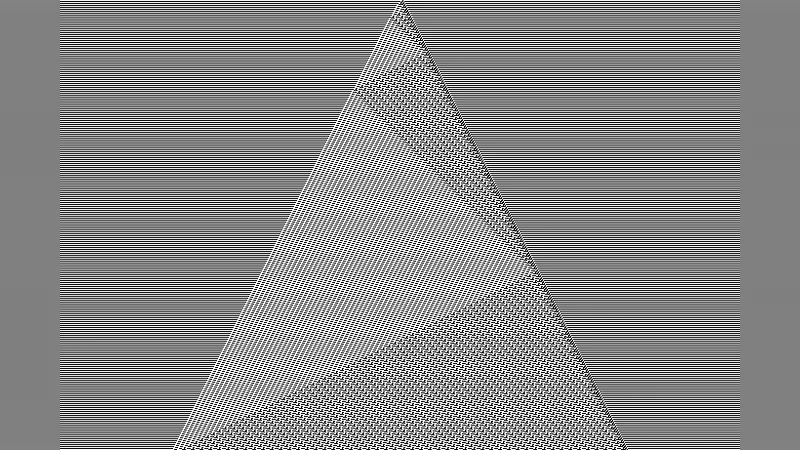
We systematically study the boundaries of one-dimensional, 2-color cellular automata depending on 4 cells, begun from simple initial conditions. We determine the exact growth rates of the boundaries that appear to be reducible. Morphic words characterize the reducible boundaries. For boundaries that appear to be irreducible, we apply curve-fitting techniques to compute an empirical growth exponent and (in the case of linear growth) a growth rate. We find that the random walk statistics of irreducible boundaries exhibit surprising regularities and suggest that a threshold separates two classes. Finally, we construct a cellular automaton whose growth exponent does not exist, showing that a strict classification by exponent is not possible.
💡 Research Summary
The paper conducts a systematic investigation of boundary growth in one‑dimensional, two‑color cellular automata (CA) with a radius of two (i.e., each update depends on four neighboring cells). Starting from the simplest possible initial condition—a single non‑background cell—the authors simulate all 256 possible rules up to a large number of time steps and record the evolution of the left‑most and right‑most active cells, which define the “boundary” of the pattern.
The study separates the observed boundaries into three categories. The first category, called “reducible” boundaries, exhibits regular, repeatable structure. By applying automated string‑compression and pattern‑matching techniques, the authors extract morphic substitution rules that generate the boundary exactly. For each reducible case they construct a morphic word (or an equivalent L‑system), derive the associated substitution matrix, and compute its dominant eigenvalue. This yields a closed‑form expression for the boundary length L(t) as a function of time, often linear (growth rate = 1) or polynomial, and in a few cases exponential. Classic examples include Rule 184, whose boundary grows linearly with a unit rate, and Rule 110, whose boundary doubles each step, giving an exact exponent of 1.
The second category comprises “irreducible” boundaries that do not admit a finite morphic description. These boundaries appear random, yet statistical analysis reveals a consistent scaling law. The authors plot log L(t) versus log t and fit a straight line using least‑squares regression, obtaining an empirical growth exponent α such that L(t) ≈ C t^α. The measured exponents cluster around two regimes: α ≈ 0.5, reminiscent of a simple random walk (diffusive growth), and α ≈ 1, indicating near‑linear propagation. A threshold near α ≈ 0.7 separates the two regimes, suggesting a phase‑like transition between diffusive and ballistic boundary dynamics. Further, they compute the variance σ²(t) of the boundary position and find that σ²(t)/μ(t) (where μ(t) is the mean position) is smaller than in a pure Brownian motion, implying that the CA’s deterministic rule imposes subtle constraints on the stochastic‑like evolution.
The third and most striking contribution is the construction of a CA whose boundary growth exponent does not exist. By interleaving two distinct morphic substitution systems in a rule‑dependent manner, the authors create a pattern where the boundary sometimes expands dramatically and sometimes contracts or stalls. Consequently, the log‑log plot of L(t) versus t is not linear over any extended interval, and no single α can describe the growth. This example demonstrates that a classification based solely on a growth exponent is insufficient; some cellular automata exhibit genuinely non‑asymptotic boundary behavior.
Overall, the paper provides three key insights. First, all boundaries that are regular enough to be reduced can be captured exactly by morphic words, allowing precise calculation of growth rates. Second, irreducible boundaries, while seemingly chaotic, obey statistical scaling laws that fall into two distinct classes, hinting at an underlying universality. Third, the existence of a CA with no well‑defined exponent shows that the landscape of boundary dynamics is richer than a simple exponent taxonomy. The authors conclude by suggesting extensions to multi‑color automata, higher dimensions, and externally driven systems, arguing that a full understanding of CA boundary growth will require a synthesis of formal language theory, stochastic processes, and nonlinear dynamics.
Comments & Academic Discussion
Loading comments...
Leave a Comment