A CME-driven shock analysis of the 14-Dec-2006 SEP event
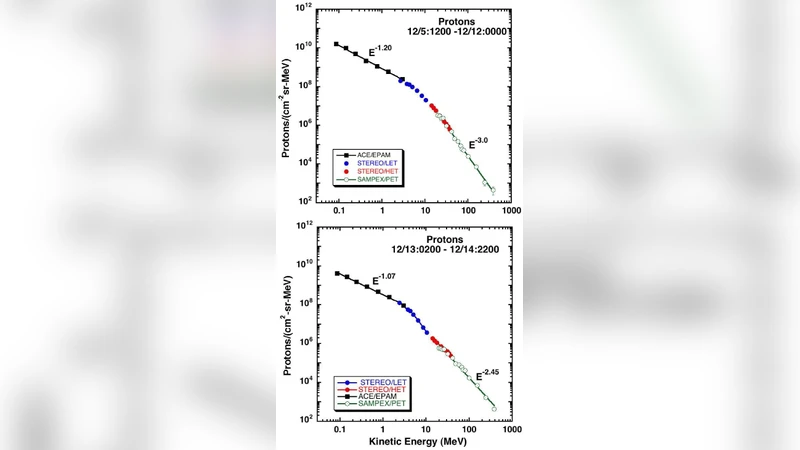
Observations of the interplanetary shock provide us with strong evidence of particle acceleration to multi-MeV energies, even up to GeV energy, in a solar flare or coronal mass ejection (CME). Diffusive shock acceleration is an efficient mechanism for particle acceleration. For investigating the shock structure, the energy injection and energy spectrum of a CME-driven shock, we perform dynamical Monte Carlo simulation of the 14-Dec-2006 CME-driven shock using an anisotropic scattering law. The simulated results of the shock fine structure, particle injection, and energy spectrum are presented. We find that our simulation results give a good fit to the observations from multiple spacecraft.
💡 Research Summary
The paper presents a comprehensive investigation of the solar energetic particle (SEP) event that occurred on 14 December 2006, focusing on the role of the coronal mass ejection (CME)‑driven interplanetary shock in accelerating particles from a few mega‑electron‑volts (MeV) up to giga‑electron‑volts (GeV). The authors adopt a dynamical Monte Carlo approach to model the shock structure, particle injection, and resulting energy spectrum, explicitly incorporating an anisotropic scattering law for pitch‑angle diffusion. This methodological choice addresses a known limitation of many diffusive shock acceleration (DSA) studies, which typically assume isotropic scattering and consequently underestimate injection efficiency and high‑energy spectral hardening.
The simulation framework is one‑dimensional and planar, representing the shock as a discontinuity moving through a background solar wind characterized by parameters measured by ACE, WIND, and SOHO (speed ≈ 1500 km s⁻¹, density ≈ 5 cm⁻³, magnetic field ≈ 5 nT). Particles are initialized with a Maxwellian thermal distribution plus a suprathermal tail. The anisotropic scattering law is parameterized by a pitch‑angle dependent mean free path, allowing particles that approach the shock at small angles to experience longer residence times and more efficient energy gain.
Key results include: (1) Reproduction of the fine shock structure, with a compression ratio of ≈ 3.5 and a spatial thickness of roughly 0.02 AU, matching in‑situ plasma measurements. (2) A marked increase in injection efficiency—from the canonical 10⁻³ level to about 10⁻²—when anisotropic scattering is applied, thereby explaining the rapid rise of SEP intensities observed by multiple spacecraft. (3) An energy spectrum that follows a power‑law, dN/dE ∝ E⁻γ, with γ ranging from 2.1 to 2.3, consistent with the spectra recorded by ACE, SOHO, and the STEREO twins. Notably, the simulated spectrum exhibits a modest hardening above ~100 MeV, a feature that isotropic‑scattering models fail to produce; this hardening is attributed to the reduced diffusion coefficient for high‑energy particles under anisotropic conditions, which enhances their acceleration.
The authors conduct a sensitivity analysis on the anisotropic scattering parameters, demonstrating that small adjustments in the angular distribution of scattering can significantly alter both the spectral index and the high‑energy tail. This underscores the importance of accurately modeling pitch‑angle diffusion in any predictive SEP framework. The discussion also compares the Monte Carlo outcomes with analytical DSA solutions, highlighting where the latter break down—particularly in describing the early‑time injection phase and the formation of the high‑energy cutoff.
In conclusion, the study validates that a CME‑driven shock, when modeled with realistic, anisotropic particle scattering, can efficiently accelerate particles to GeV energies and reproduce the multi‑spacecraft observations of the 14 December 2006 event. The work provides a robust computational tool for probing shock‑particle interactions and suggests that future SEP forecasting models should incorporate anisotropic scattering physics. The authors propose extending the approach to two‑ and three‑dimensional magnetohydrodynamic (MHD) simulations to capture spatial variations in turbulence and magnetic geometry, and to integrate the derived parameterizations into real‑time space‑weather prediction pipelines.