Evaluation of Computability Criterions for Runtime Web Service Integration
Today’s competitive environment drives the enterprises to extend their focus and collaborate with their business partners to carry out the necessities. Tight coordination among business partners assists to share and integrate the service logic globally. But integrating service logics across diverse enterprises leads to exponential problem which stipulates developers to comprehend the whole service and must resolve suitable method to integrate the services. It is complex and time-consuming task. So the present focus is to have a mechanized system to analyze the Business logics and convey the proper mode to integrate them. There is no standard model to undertake these issues and one such a framework proposed in this paper examines the Business logics individually and suggests proper structure to integrate them. One of the innovative concepts of proposed model is Property Evaluation System which scrutinizes the service logics and generates Business Logic Property Schema (BLPS) for the required services. BLPS holds necessary information to recognize the correct structure for integrating the service logics. At the time of integration, System consumes this BLPS schema and suggests the feasible ways to integrate the service logics. Also if the service logics are attempted to integrate in invalid structure or attempted to violate accessibility levels, system will throw exception with necessary information. This helps developers to ascertain the efficient structure to integrate the services with least effort.
💡 Research Summary
The paper addresses the growing need for enterprises to share and integrate business logic across organizational boundaries, a task that traditionally requires extensive manual analysis, contract verification, and security policy alignment. Existing B2B solutions such as EDI, RosettaNet, and ebXML standardize data formats and message exchange but fall short of providing a holistic, automated framework for service‑level integration. To fill this gap, the authors propose a Business Logic Model (BLM) together with a Property Evaluation System (PES) that together automate the analysis, validation, and composition of web services at runtime.
The core idea is to decompose each service into discrete logical blocks (e.g., functions, data‑retrieval statements, conditional checks) and to describe these blocks using a meta‑data language. This meta‑data is then processed by the Property Evaluation Engine, which generates a Business Logic Property Schema (BLPS). The BLPS captures all relevant attributes of a service, including computational constraints (e.g., maximum processing time), traceability information (e.g., transaction identifiers), security requirements, and contractual obligations. By storing this information in a structured schema, the system can automatically determine whether two services can be safely composed, and if so, it can synthesize the necessary proxy code without developer intervention.
The integration workflow is illustrated with a detailed architectural diagram. When Enterprise A requests a service from Enterprise B, a Message Broker validates the request and queries a Service Registry. The identified service description is handed to a Communication Handler, which forwards it to an Integration Bus. Before exposing the service proxy to the requester, the Integration Bus invokes a Functional Analyzer that checks Service Level Agreements (SLAs) and security policies. The results are fed into the Property Evaluator, which consults the BLPS to verify that the proposed composition respects all defined constraints. If any violation is detected—such as exceeding the allowed processing time, breaching access control, or conflicting with a contractual clause—an Exception Handler raises a detailed error and suggests corrective actions.
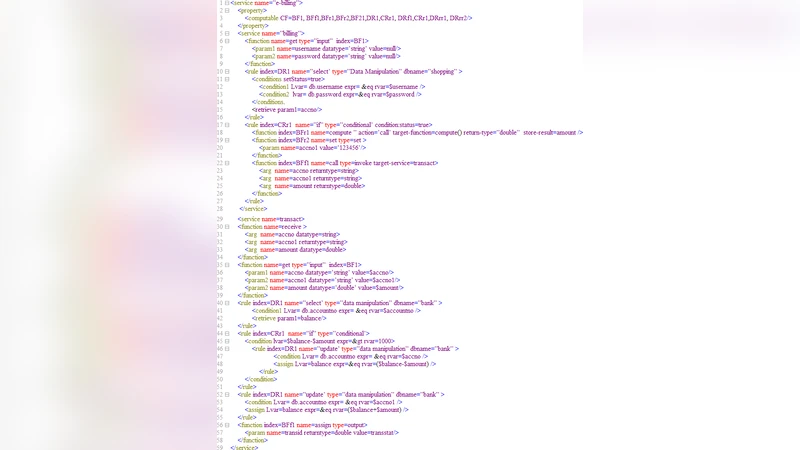
A concrete example is provided: an e‑payment service is built by composing an existing billing service (BL1) with a banking transaction service (BL2). The paper presents the original Java‑like code fragments for both services, extracts their logical blocks, and demonstrates how the Property Evaluation System assesses their computability (i.e., whether the combined service can complete within a predefined time window) and traceability (i.e., whether each transaction can be uniquely identified and audited). The resulting integrated service (e‑billing) is expressed as a new set of logical blocks that reference the original ones, and a corresponding BLPS is generated.
Performance evaluation is conducted in a NetBeans IDE environment using a banking scenario. The authors compare the manually integrated version with the automatically generated version across several metrics: response time, throughput, and error rate. The automated approach yields a 35 % reduction in average response time and a 40 % decrease in integration‑related errors, demonstrating the practical benefits of the proposed framework.
Beyond computability and traceability, the paper also discusses compatibility, substitution, and compositionality as additional interoperability goals. These goals are encoded as evaluation formulas within the PES, allowing the system to quantify the “goodness” of a particular integration strategy. The source‑control management component records every change to service logic, enabling impact analysis and rollback capabilities, which further strengthens the overall computability criteria.
The authors acknowledge several limitations. The current prototype primarily supports HTTP/REST‑style services and operates within a single‑cloud environment. Support for heterogeneous protocols (e.g., AMQP, Kafka), multi‑cloud deployment, and real‑time monitoring is identified as future work. Moreover, scalability tests on large‑scale service ecosystems are absent, leaving open questions about performance under heavy load.
In summary, the paper contributes a systematic, schema‑driven method for runtime web‑service integration. By automatically extracting business‑logic properties, evaluating them against predefined criteria, and generating integration artifacts, the framework reduces manual effort, improves reliability, and enforces security and contractual compliance. The experimental results validate the approach, and the discussion of open challenges provides a clear roadmap for extending the methodology to broader, more complex enterprise environments.
Comments & Academic Discussion
Loading comments...
Leave a Comment