Turbidity current flow over an obstacle and phases of sediment wave generation
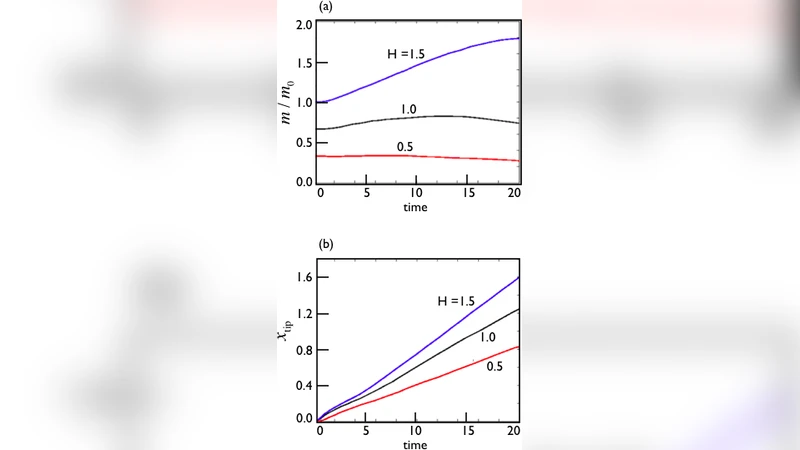
We study the flow of particle-laden turbidity currents down a slope and over an obstacle. A high-resolution 2D computer simulation model is used, based on the Navier-Stokes equations. It includes poly-disperse particle grain sizes in the current and substrate. Particular attention is paid to the erosion and deposition of the substrate particles, including application of an active layer model. Multiple flows are modeled from a lock release that can show the development of sediment waves (SW). These are stream-wise waves that are triggered by the increasing slope on the downstream side of the obstacle. The initial obstacle is completely erased by the resuspension after a few flows leading to self consistent and self generated SW that are weakly dependant on the initial obstacle. The growth of these waves is directly related to the turbidity current being self sustaining, that is, the net erosion is more than the net deposition. Four system parameters are found to influence the SW growth: (1) slope, (2) current lock height, (3) grain lock concentration, and (4) particle diameters. Three phases are discovered for the system: (1) “no SW”, (2) “SW buildup”, and (3) “SW growth”. The second phase consists of a soliton-like SW structure with a preserved shape. The phase diagram of the system is defined by isolating regions divided by critical slope angles as functions of current lock height, grain lock concentration, and particle diameters.
💡 Research Summary
This paper investigates how particle‑laden turbidity currents flowing down a slope and over a topographic obstacle generate and evolve sediment waves (SW). Using a high‑resolution two‑dimensional numerical model that solves the Navier‑Stokes equations with a Boussinesq approximation, the authors incorporate poly‑disperse grain sizes both in the flowing current and in the substrate. A realistic erosion‑deposition framework is implemented through an Exner‑type equation coupled with an active‑layer (AL) model that represents the thin, well‑mixed zone of the seabed from which particles can be resuspended.
The simulations are initiated by a lock‑release configuration: a finite volume of fluid with prescribed height (H) and grain concentration (C₀) is released at the upstream end of a sloping domain that contains a single obstacle (a localized bump). Multiple successive flows are run, allowing the obstacle to be progressively eroded and eventually removed. The model tracks the evolution of the substrate elevation, the thickness of the active layer, and the distribution of grain classes, while accounting for settling velocities derived from Dietrich’s empirical formula and a resuspension law based on Garcia and Parker’s laboratory experiments. The resuspension term contains a high‑order dependence on the ratio of shear velocity to settling velocity, providing a sharp threshold that mimics the onset of entrainment observed in nature.
Four controlling parameters are systematically varied: (1) slope angle (θ), (2) lock height (H), (3) initial grain concentration (C₀), and (4) grain diameter (d). By scanning this multidimensional parameter space the authors identify three distinct dynamical regimes, which they term “phases”:
- No‑SW phase – The current is everywhere depositional; net erosion is negative and no coherent sediment wave forms.
- SW‑buildup phase – The flow is self‑sustaining only on the downstream side of the obstacle. A solitary‑wave‑like structure emerges, maintaining a nearly constant shape while migrating upstream. This soliton‑like SW represents a delicate balance between erosion and deposition and is analogous to the “buildup” mode known from laser physics.
- SW‑growth phase – The current is self‑sustaining over the entire slope. Net erosion exceeds deposition everywhere, leading to the amplification of the sediment wave. The wavelength (λ) and height (h) of the wave obey the empirical relation λ ≈ 2πh, consistent with field observations of submarine fans and levees.
The transition between these phases is governed by critical slope angles that depend on H, C₀, and d, producing a phase diagram that delineates regions of no wave, wave buildup, and wave growth. The authors demonstrate that once the obstacle is eroded away, the system can still generate self‑consistent SWs, indicating that the obstacle merely acts as a catalyst for the initial perturbation.
A key contribution of the work is the explicit comparison between the full 2‑D depth‑dependent model and traditional depth‑averaged models. Depth‑averaged simulations, which lack explicit eddy structures, produce smooth, featureless profiles and cannot capture the synchronized eddy‑driven sediment waves observed in the 2‑D runs. The authors show that the eddy‑scale variability in the flow field is essential for the formation of the periodic sediment structures and for the coupling between flow dynamics and substrate evolution.
The paper also discusses the role of the active layer thickness (Lₐ). When Lₐ is small, only the finest grains are readily resuspended, leading to armoring of the bed by coarse particles and eventual flow decay. When Lₐ is large, a broader range of grain sizes participates in the exchange, sustaining higher entrainment rates and promoting wave growth. The shear factor (f_shr) introduced to avoid unrealistic resuspension links directly to the bottom drag coefficient (C_D) used in other turbulence closures, providing a bridge between the present formulation and more conventional k‑ε or depth‑averaged models.
Overall, the study provides a comprehensive mechanistic picture of how turbidity currents interact with seabed topography to generate sediment waves, emphasizing the importance of non‑linear feedbacks, threshold‑controlled resuspension, and the active layer. The findings have implications for interpreting ancient submarine fan deposits, predicting the evolution of modern deep‑sea channels, and improving hazard assessments for submarine landslides and turbidity‑current‑driven sediment transport.
Comments & Academic Discussion
Loading comments...
Leave a Comment