A robust approach to estimating rates from time-correlation functions
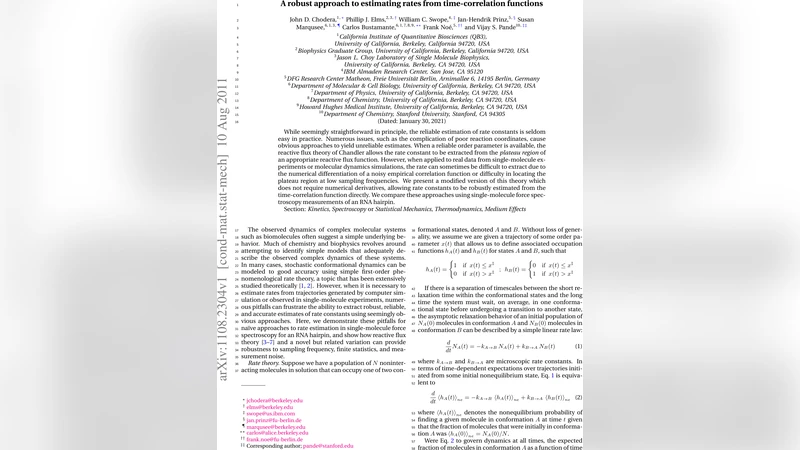
While seemingly straightforward in principle, the reliable estimation of rate constants is seldom easy in practice. Numerous issues, such as the complication of poor reaction coordinates, cause obvious approaches to yield unreliable estimates. When a reliable order parameter is available, the reactive flux theory of Chandler allows the rate constant to be extracted from the plateau region of an appropriate reactive flux function. However, when applied to real data from single-molecule experiments or molecular dynamics simulations, the rate can sometimes be difficult to extract due to the numerical differentiation of a noisy empirical correlation function or difficulty in locating the plateau region at low sampling frequencies. We present a modified version of this theory which does not require numerical derivatives, allowing rate constants to be robustly estimated from the time-correlation function directly. We compare these approaches using single-molecule force spectroscopy measurements of an RNA hairpin.
💡 Research Summary
The paper addresses the long‑standing problem of extracting reliable phenomenological rate constants from time‑series data, especially when the reaction coordinate is imperfect and the sampling frequency is limited. Conventional estimators—simple crossing counts (Eq. 4) and mean lifetimes (Eq. 5)—are shown to be highly sensitive to the choice of dividing surface and to the temporal resolution of the data. A poor reaction coordinate leads to an over‑estimate of the rate (approaching the transition‑state‑theory value k_TST), whereas low sampling rates cause missed crossings and an under‑estimate. The authors illustrate these pitfalls using force‑extension traces of a p5ab RNA hairpin recorded in an optical trap at 50 kHz and down‑sampled to 1 kHz. Near the optimal dividing surface (x‡≈12.57 pN) the naive crossing‑rate estimator yields dramatically different values (≈45 s⁻¹ at 1 kHz versus ≈552 s⁻¹ at 50 kHz), and small shifts in x‡ produce large fluctuations in the estimated rate, demonstrating the lack of robustness.
To overcome these issues, the paper revisits Chandler’s reactive‑flux formalism, where the rate is obtained from the time‑dependent reactive‑flux function k_RF(t) = –d/dt ⟨δh_A(0) δh_A(t)⟩ / ⟨δh_A²⟩. While theoretically sound, the practical implementation requires numerical differentiation of a noisy correlation function, which amplifies noise and makes the identification of the plateau region (where k_RF(t) ≈ k) difficult, especially at low sampling frequencies. In the high‑frequency (50 kHz) data, k_RF(t) stabilizes around 36 s⁻¹ after a transient of ≈3 ms, providing a clear plateau. In the 1 kHz data the plateau is narrow and obscured by noise, illustrating the limitations of the traditional reactive‑flux approach.
The authors therefore propose an alternative “implied‑rate” estimator, k_im(t), which bypasses numerical differentiation entirely. Starting from the master‑equation description d p(t)/dt = K p(t) with K the 2×2 rate matrix, they compute the transition probability matrix over an observation interval t and extract an effective rate constant that would produce the observed state‑to‑state probabilities. This implied rate converges to the true phenomenological rate for observation times τ_mol < t ≲ τ_rxn (where τ_mol is the intrastate relaxation time and τ_rxn = 1/k is the reaction time). Crucially, k_im(t) exhibits a broad plateau even when the sampling interval Δt is comparable to τ_rxn, making it far more robust to low temporal resolution.
Applying k_im(t) to the same RNA hairpin data, the authors find that both k_im(t) and k_RF(t) are essentially independent of the exact location of the dividing surface and of the sampling frequency, provided t is chosen in the appropriate window (≈3–4 ms for this system). In contrast, the naive estimators vary wildly with x‡ and Δt. The implied‑rate method thus delivers a stable, reproducible estimate of the kinetic constant without the need for smoothing or fitting procedures that could introduce bias.
In summary, the paper makes three key contributions: (1) a clear demonstration of the failure modes of traditional crossing‑count and lifetime‑based rate estimators in the presence of imperfect reaction coordinates and limited sampling; (2) a critical assessment of the reactive‑flux approach, highlighting its dependence on numerical differentiation and plateau detection; and (3) the introduction of a derivative‑free implied‑rate estimator that leverages state‑transition probabilities, offering a wide, easily identifiable plateau and robustness to both reaction‑coordinate quality and sampling frequency. The methodology is validated on experimental single‑molecule force‑spectroscopy data and is poised to become a standard tool for kinetic analysis in both experimental and simulation studies of biomolecular systems.
Comments & Academic Discussion
Loading comments...
Leave a Comment