Two-step melting in two dimensions: First-order liquid-hexatic transition
Melting in two spatial dimensions, as realized in thin films or at interfaces, represents one of the most fascinating phase transitions in nature, but it remains poorly understood. Even for the fundamental hard-disk model, the melting mechanism has not been agreed on after fifty years of studies. A recent Monte Carlo algorithm allows us to thermalize systems large enough to access the thermodynamic regime. We show that melting in hard disks proceeds in two steps with a liquid phase, a hexatic phase, and a solid. The hexatic-solid transition is continuous while, surprisingly, the liquid-hexatic transition is of first-order. This melting scenario solves one of the fundamental statistical-physics models, which is at the root of a large body of theoretical, computational and experimental research.
💡 Research Summary
The paper resolves a decades‑long controversy over the nature of melting in two‑dimensional (2D) systems by performing unprecedentedly large Monte Carlo simulations of hard disks. Using the event‑chain algorithm, the authors equilibrate systems ranging from 10⁴ up to 10⁶ particles, far beyond the sizes previously accessible. This computational breakthrough allows them to probe the true thermodynamic limit and to distinguish between the competing scenarios proposed for 2D melting: the Kosterlitz‑Thouless‑Halperin‑Nelson‑Young (KTHNY) two‑step continuous transition (liquid → hexatic → solid) and a single first‑order liquid–solid transition.
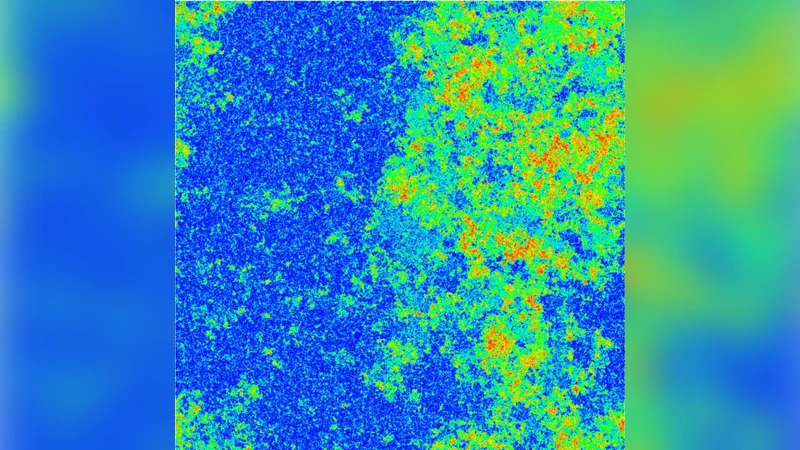
The main findings are as follows. In the density interval η≈0.700–0.716 the system exhibits clear phase coexistence between a low‑density liquid and a higher‑density hexatic phase. Visualizations of the local bond‑orientational order parameter Ψₖ reveal alternating “stripe” regions as well as isolated “bubble” inclusions of the minority phase. In a finite periodic box this coexistence produces a characteristic loop in the pressure–volume isotherm. By performing Maxwell constructions for each system size the authors extract the coexistence densities (η₁=0.700, η₂=0.716) and measure the interfacial free energy per particle Δf. The scaling Δf∝1/√N, consistent with an interface whose length grows as √N, confirms that the liquid–hexatic transition is first order.
Beyond η≈0.716 the system becomes a single homogeneous phase. Correlation analyses show that at η=0.718 the positional pair correlation function g(Δr) decays exponentially, indicating the absence of true translational order, while the bond‑orientational correlation remains quasi‑long‑ranged (very slow decay). This is the hallmark of the hexatic phase. Increasing the density further to η≈0.720, the positional correlations cross over to an algebraic decay with an exponent close to –1/3, exactly the value predicted by KTHNY for the stability limit of the solid. In this regime the pressure–volume curve shows no loop, the compressibility remains low, and finite‑size effects are minimal, all of which signal a continuous transition from hexatic to solid.
Thus the melting scenario for hard disks is a hybrid: the liquid–hexatic transition is first order, while the hexatic–solid transition follows the continuous KTHNY scenario. The hexatic phase, although narrow (η≈0.716–0.720), is an order of magnitude wider than the density fluctuations that would otherwise mask it, making it experimentally observable. The authors also demonstrate that the event‑chain algorithm is roughly two orders of magnitude faster than traditional local Monte Carlo, enabling equilibration times of ~10⁶ particle moves per particle and production runs of ~6×10⁷ moves for the largest systems.
The significance of this work is manifold. It finally settles the fundamental statistical‑mechanical model of 2D melting, providing a benchmark for theoretical, computational, and experimental studies of thin films, colloidal monolayers, and other soft‑matter systems. It shows that entropy‑driven interactions can generate both first‑order and continuous transitions within the same system, depending on the nature of the order parameter involved. Moreover, the methodological advance—large‑scale event‑chain Monte Carlo—opens the door to systematic investigations of more complex potentials, confinement effects, and the crossover from two to three dimensions. In summary, the paper delivers a definitive answer to the long‑standing question of how hard disks melt in two dimensions and establishes a powerful computational framework for future explorations of low‑dimensional phase transitions.
Comments & Academic Discussion
Loading comments...
Leave a Comment